



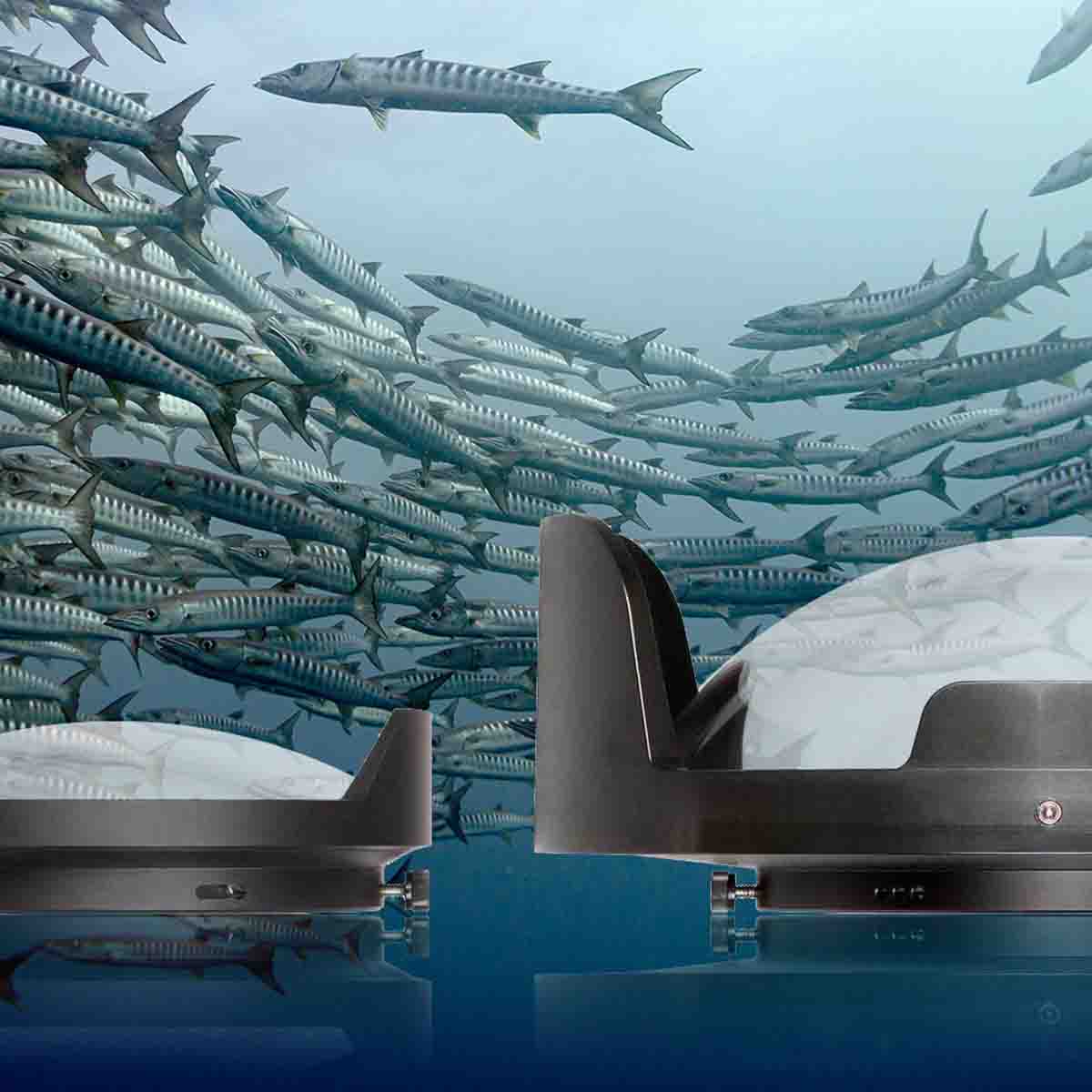

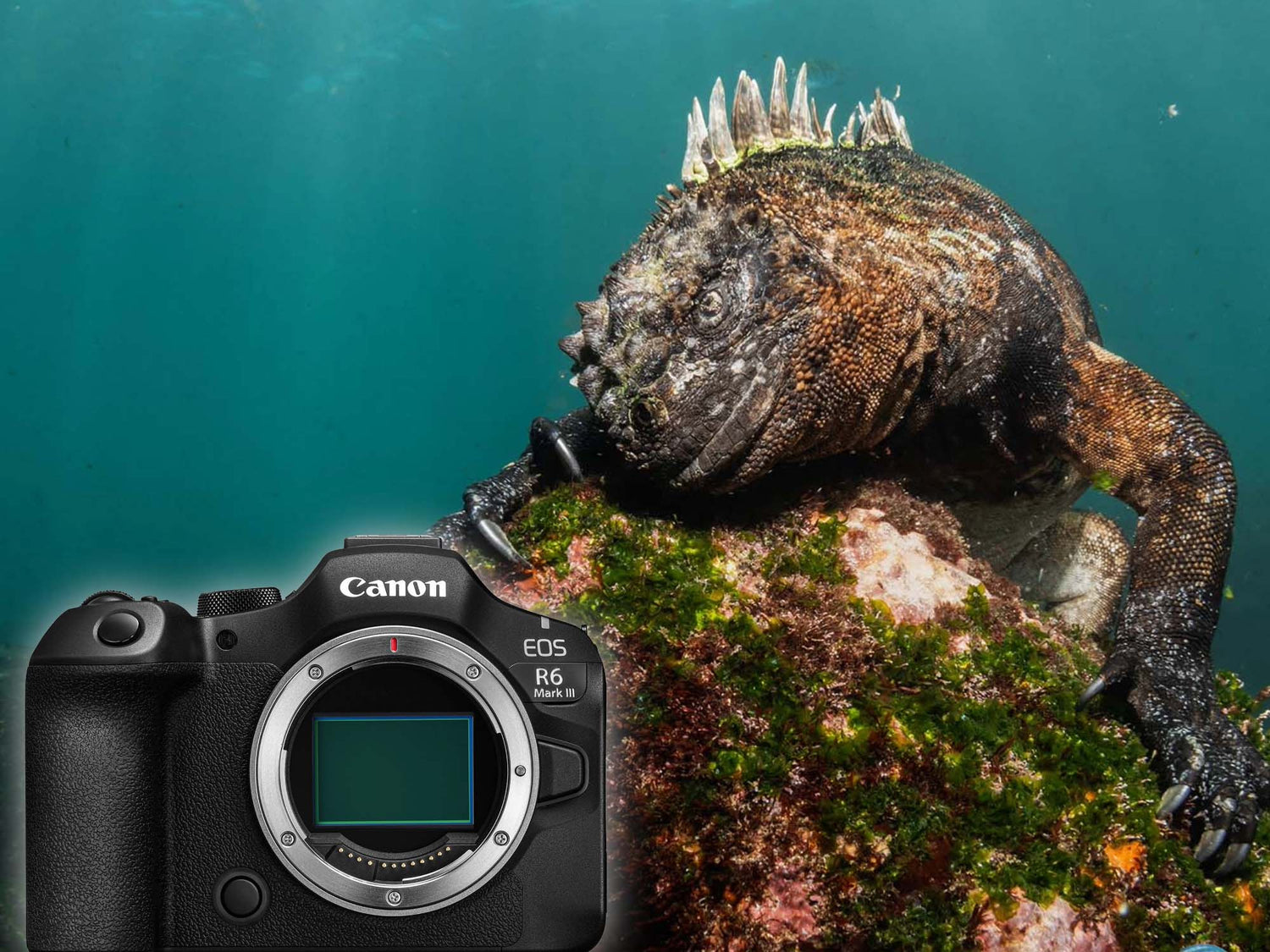
Review by Jean Rydberg
Photos by Nirupam Nigam
We have been longtime lovers of the Canon mirrorless line, and they have made some of our absolute favorite cameras to take underwater. There are technical nuances to every system, and the pixel peepers can debate the merits and drawbacks of any camera ad nauseum. We shoot every camera out there, and while they're all capable of capturing spectacular images, there are some that are just more enjoyable to use underwater than others. And the Canon EOS R6 III is one of those cameras. Even our own resident Sony-zealot (and Video Producer) Logan Wood said "WOW" when he came back from shooting it in the Florida Keys.
I'll say it up front - in the ever increasing "camera arms race" between Canon and Sony, Canon has won the prosumer full frame mirrorless round with the Canon R6 Mark III.
-Nirupam Nigam, Review of the Canon R6 III at bluewaterphotostore.com

Canon R6 III + Canon RF 7-14mm f/2.8 fisheye lens at 14mm • 1/160 • f/13 • ISO 320 © Nirupam Nigam
Camera Specifications
- Full frame 32.5 megapixel CMOS sensor
- Up to 40 frames per second capture
- Dual pixel CMOS AF II with DIGIC X processor
- Up to 8.5 stops IBIS (in-body image stabilization)
- CFexpress and UHS-II SD card slots
- Up to 7K RAW video
- Accepts RF / RF-S lenses or EF lenses with adapter
- 3” TFT 1.6 million dots color LCD
- 0.5” OLED 3.69 million dots color EVF

Canon R6 III + Canon RF 7-14mm fisheye lens at 14mm • 1/160 • f/14 • ISO 320 © Nirupam Nigam
Image Quality
The new 32.5 megapixel sensor combined with up to 8.5 stops IBIS (in-body image stabilization) in the Canon R6 III gives you crisp detail even in low-light conditions or at high ISO settings. We think subject recognition tracking autofocus is particularly good underwater with the Canon mirrorless line-up. It has given us the power to nail shots of small, fast-moving macro subjects that we didn’t even try to get before.

Canon R6 III + Canon RF 7-14mm fisheye lens at 13mm • 1/160 • f/14 • ISO 320 © Nirupam Nigam
Lens Choice
While the Sony lens selection runs deep, it is missing some of our key favorites for underwater - namely a strong native-mount fisheye lens. We think that Canon’s current lens line-up is the best one going for underwater shooters right now, particularly with the release of the new RF 7-14mm F2.8-3.5L Fisheye Lens.
This joins the ranking of our favorite full frame Canon lenses for use underwater:
- RF 7-14mm F2.8-3.5L Fisheye (~$1900US)
- RF 14-35mm F4L IS USM (~$1500US)
- RF 15-30mm F4.5-6.3 IS STM (~$600US)
- RF 16-28mm F2.8 IS STM (~$1000US)
-
RF 100mm F2.8L Macro IS USM (~$1350US)
The RF 15-35mm F2.8L IS USM (~$2400 US) is also a very capable lens but for underwater we find that the size and extra FOV of the 14-35mm F4 is a good trade for the one-stop differential.
You can still mount your older EF lenses including the classic EF 8-15mm fisheye, in or out of the housing, using a Canon Mount Adapter EF-EOS R. But you may find a compelling reason to upgrade your glass if you look hard enough.

Canon R6 III + Canon RF 7-14mm f/2.8 fisheye lens at 14mm • 1/100 • f/13 • ISO 320 © Nirupam Nigam
Flash Support
Canon’s E-TTL II Auto Flash metering is a must for fast moving subjects. When combined with a compatible TTL strobe system, the camera supports instantaneous adjustment of flash power in relation to subject distance. Whether you’re shooting a moving subject like a turtle or shark, or coming in for your close-up of a seahorse, E-TTL flash exposure is a valuable tool in your tool kit.
There are three popular ways to shoot E-TTL II flash with Ikelite underwater strobes:
- Add the DL5 Canon DS Link TTL Converter with an electrical sync cord and single or dual Ikelite DS strobes.
- Replace the electrical flash bulkhead with the TT5 Canon TTL Fiber Optic Transmitter and combine with fiber optic cords and single or dual Ikelite RC strobes or the Ikelite Ecko Fiber.
- Use the TT5 Canon TTL Fiber Optic Transmitter with fiber optic cords and single or dual Ikelite DS strobes fitted with the RC2 TTL Receiver.
Maintain your creative control while shooting TTL flash through the combination of manual exposure mode on your camera and flash exposure compensation.
TTL strobe exposure makes a lot of sense when combined with burst shooting and a powerful strobe like the DS232 or RC232. Knock off up to 10 frames per second with ease to get the perfect split shot or shark smile.

Canon R6 III + Canon RF 14-35mm lens at 35mm • 1/80 • f/14 • ISO 400 © Nirupam Nigam
Battery Life
In general we find battery life on Canon’s mirrorless line to be good and the R6 III is no exception. The CIPA rating is 620 shots when using the rear LCD or 390 with the electronic viewfinder (EVF).
We always recommend optimizing your power save settings to get the most out of your camera underwater. If you set the camera to go to sleep often but wake up with shutter press, the camera is always ready to go quickly when you need to take a shot. Canon mirrorless cameras last for days in sleep mode and immediately jump back to life with the press of a button.
If you’re shooting a lot of video and find the need to top off in-between dives, then the USB-C charging & data transfer bulkhead is a must-have. Just remove the waterproof cap and plug the camera into a power bank, without removing it from the housing. You can even plug it into your laptop to offload photos and start working on them during lunch. The USB-C bulkhead is standard on our Deluxe Underwater Housing for the Canon R6 III, which also comes standard with our tried-and-true vacuum leak detection system.

Canon R6 III + Canon RF 14-35mm at 35mm • 1/125 • f/14 • ISO 640 © Nirupam Nigam
As a Hybrid Video Camera
For shooters who are truly after both stills and video, the R6 III is a great all-around workhorse. The R6 III can take 4K video at up to 120 frames per second. Like its sister camera, the video-centric Canon R6 V, the R6 III also supports 7K 60p video capture.
Most of us have 4K monitors and TVs so you may be wondering why shoot 7K. A big reason is cropping in post-production. For example, you can crop tighter on 7K video of a macro subject and still end up with footage that blends seamlessly with your 4K wide angle shots.
The R6 III also makes it easy to manually white balance for more accurate colors as long as you have enough light. Typically with most cameras, manual white balance will do well for you up to about 40-60 feet (12-18 meters) depending on conditions. Beyond than that there just isn’t enough light, you’ll need to have strobes or video lights to bring out color in your photos at the deeper depths.

Canon R6 III + Canon RF 14-35mm lens at 14mm • 1/200 • f/13 • ISO 400 © Nirupam Nigam
Handling
We hardly have enough good things to say about the ergonomics of Canon’s control layout inside of the 200DL underwater housing. All three control dials are at your fingertips to effortlessly adjust shutter speed, aperture, ISO (or any custom setting) on the fly.
Two trigger style levers for the shutter release and AF-ON control are user-adjustable for perfect positioning and comfortable forefinger/thumb action when composing your frame. A large rubberized 5-lobed knob on the side of the housing engages with an assortment of affordable zoom gears for a wide selection of popular lenses.
All of the controls are direct-drive with controls that are field serviceable in a pinch.
An optically enhanced viewfinder allows use of the camera’s EVF underwater and can be easily exchanged for a more powerful 45º or straight magnifying viewfinder for a bigger, brighter image.
The Ikelite housing is form fit to the camera and balanced for neutral buoyancy. The heavy-duty, custom formulated ABS-PC front is lighter than aluminum yet highly durable and fundamentally corrosion-proof. The uniquely clear back provides a direct view of the rear o-ring seal, camera body, and rear LCD screen.

Canon R6 III + Canon RF 14-35mm at 14mm • 1/200 • f/13 • ISO 400 © Nirupam Nigam
Conclusion
Canon’s mirrorless line-up is starting to look like a greatest hits collection and the R6 III is certainly no slouch. If you’re looking for a top-of-the-line system that serves you well for both stills and video underwater, you don’t have to look any further. Great ergonomics, stunning imaging capabilities, and superior lens choices tick all of our boxes. We would be happy to take the R6 III on our next dive trip anywhere in the world.

Canon R6 III + Canon RF 100mm macro lens • 1/160 • f/18 • ISO 250 © Nirupam Nigam
Availability
The Ikelite housing is available now worldwide in both the standard version and a Deluxe model with integrated USB-C charging & data transfer and vacuum leak detection system.

Canon R6 III + Canon RF 14-35mm lens at 14mm • 1/80 • f/14 • ISO 500 © Nirupam Nigam

Canon R6 III + Canon RF 7-14mm fisheye lens at 14mm • 1/100 • f/13 • ISO 320 © Nirupam Nigam

Canon R6 III + Canon RF 7-14mm fisheye lens at 14mm • 1/125 • f/13 • ISO 320 © Nirupam Nigam

Canon R6 III + Canon RF 14-35mm at 33mm • 1/200 • f/22 • ISO 100 © Nirupam Nigam

Canon R6 III + Canon RF 14-35mm at 33mm • 1/200 • f/22 • ISO 100 © Nirupam Nigam

Canon R6 III + Canon RF 14-35mm at 14mm • 1/160 • f/10 • ISO 500 © Nirupam Nigam

Canon R6 III + Canon RF 100mm lens • 1/640 • f/2.8 • ISO 200 © Nirupam Nigam
Equipment Used

- Canon R6 III Camera
- 200DL Underwater Housing for Canon EOS R6 III Deluxe Version # 71772-DLX
- Canon RF 7-14mm Fisheye Lens
- Canon RF 14-35mm Lens
- Canon RF 100mm Macro Lens
- DL Compact 8 inch Dome Port # 75344
- DL Flat Port # 75301
- Dual RC232 TTL Underwater Strobe with Video Light [Fiber Optic] # 40123
- TT5 Canon TTL Fiber Optic Transmitter # 44701
Additional Viewing
Canon R6 III Setting It Up // 200DL Underwater Housing [VIDEO]
Canon R6 III Underwater Footage from Florida Keys [VIDEO]
Faster, Brighter, Fiber Optic // Introducing RC232 Strobe + Video Light Hybrid [VIDEO]
Canon RF 7-14mm Fisheye FIRST RESULTS Underwater Photos & 4K Video [VIDEO]
Canon RF 14-35mm f/4 L IS USM Lens Review & Results
Best Macro Lens for Canon Mirrorless Shooters: RF 100mm F2.8 L Macro IS USM

Nirupam Nigam is a dedicated underwater photographer and fisheries scientist. While growing up in Los Angeles he fell in love with the ocean and pursued underwater photography in the local Channel Islands. He received degrees in Aquatic and Fisheries Science and General Biology, as well as a minor in Arctic Studies, at the University of Washington. Nirupam is the editor-in-chief of the Underwater Photography Guide and Bluewater Photo. He also works as a fisheries observer on boats in the Bering Sea and North Pacific. When he is not at sea, he is traveling with his fiancee and taking photos. Check out more of his photography at www.photosfromthesea.com!
 Jean Rydberg, daughter of Ike Brigham, became President & CEO of Ikelite in 2006. Prior to that, she wisely pursued a degree in Astronomy & Astrophysics to prepare herself for the challenges of running a technology-driven manufacturing business with global distribution. Jean fully embraces the need to travel outside of her hometown of Indianapolis to experience good diving. She believes that any camera is capable of amazing results in the right hands, and anyone can become a great photographer given the right advice. When she's not working she's spending time with her husband, cats, and two daughters (though not necessarily in that order).
![Canon RF 16-28mm Lens Review for Underwater Photo & Video [VIDEO]](http://www.ikelite.com/cdn/shop/articles/canon-16-28-review-jacques-de-vos-blog-cover_56aae82f-7a8a-4ea5-8db9-0976aa01ba61.jpg?v=1788531488&width=2000)
