




By Jeff Milisen
All images shot with the Canon R5 II
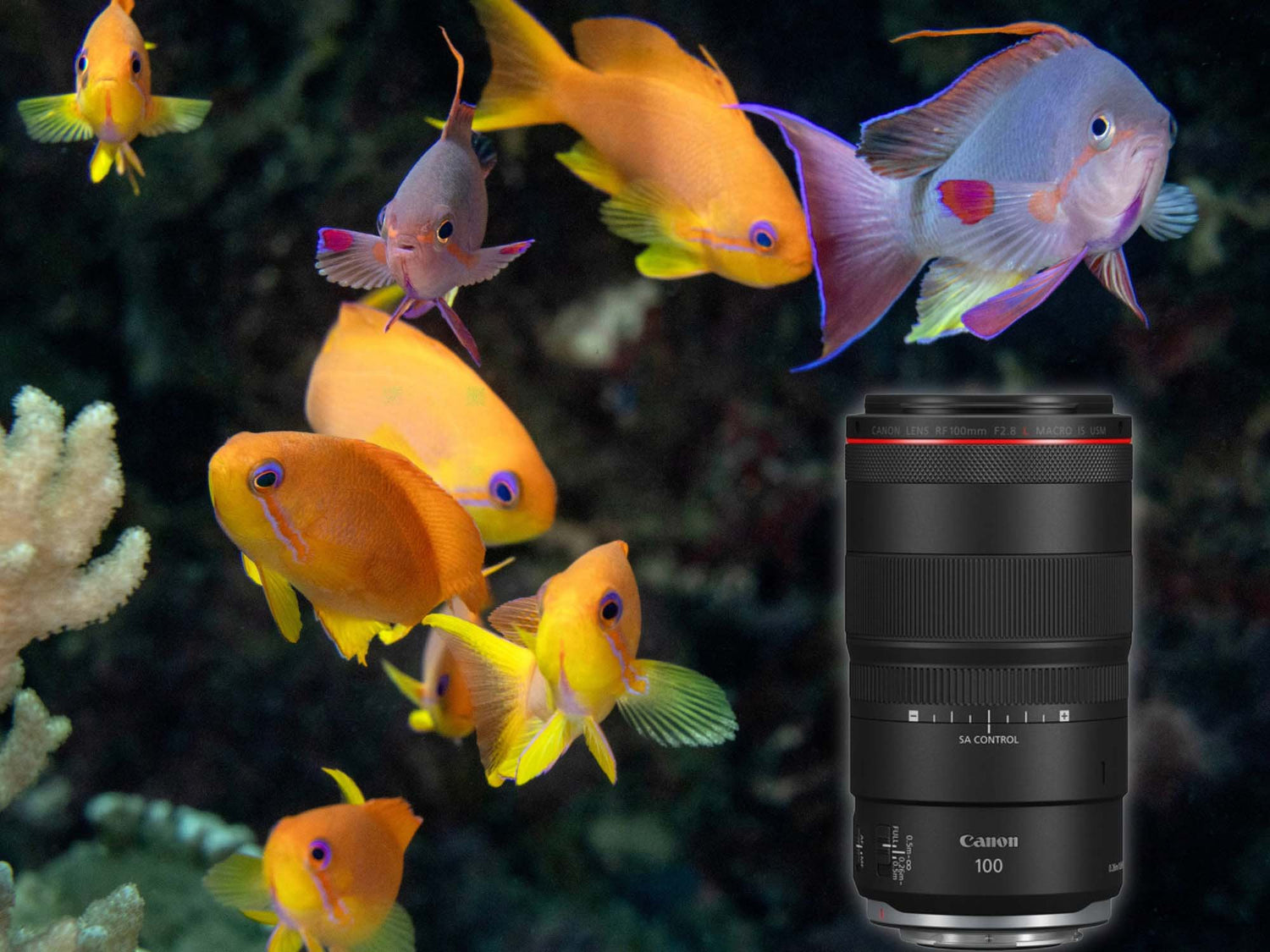
The “L” in the name and red line on the lens body signify that Canon, an oligarch in the photography world and creator of arguably the best lens lineup in history, has put its everything into the best build quality, and non-compromising optical elements. With every L-series product, Canon puts its reputation on the line. They are dependable when every photo means winning or losing a client. They should produce astonishing images with every click. To speak ill of L-series lenses is photographic blasphemy and will stir gasps in the right circles.

Gymnomuraena zebra • 1/200 • f/16 • ISO 2000 © Jeff Milisen
The old EF 100mm L macro was an astonishing lens in every aspect, so an update beyond the new camera mount might seem redundant. The Digital Single Lens Reflex (DSLR) camera is quickly going extinct as camera manufacturers invest resources into more powerful mirrorless cameras. New camera platforms and capabilities call for a novel lineup of lenses. At first glance, the RF 100mm L macro is a lot like its predecessor the EF 100mm L macro. Canon kept all of the good stuff and used it to build something even better. But beyond choosing a lens based on camera system, each lens and focal length has its own unique set of eccentricities that we should be mindful of.

Pseudanthias squamipinnis • 1/200 • f/14 • ISO 2500 © Jeff Milisen
When I look for a lens, I go straight to the specifications because they remove the marketing hype and give the straight story. There are a lot of specs that I don’t care about. For example, the spec sheet mentions dust and water resistance, a label that will only be tested in an expensive accident. They also discuss that it is made of 17 lenses in 13 groups. Personally, I have no idea what to do with that information. So, let’s have a look at how the new RF 100mm L measures up against the old guard of Canon top-of-the-line glass in areas that do matter to me: Focus, sharpness, magnification, working distance, and stabilization.

Tambja mulleneri • 1/200 • f/13 • ISO 400 © Jeff Milisen
Focus
Focusing speed and accuracy are two of the most basic elements that go into a legendary lens. The EF version was notoriously fast, and I am happy to report that Canon stuck with their tried-and-true formula with the RF. This lens had no problem finding and keeping up with subjects ranging from nudibranchs, a range of blackwater subjects, and even hammerheads at Darwin Island in the Galapagos!
Did you know it's possible to make fine-tuned manual focus adjustments while shooting in autofocus? By default this setting is disabled, but with a few simple steps you can use manual focus override while shooting in AF.

Plagiotremus goslinae • 1/200 • f/14 • ISO 6400 © Jeff Milisen
Sharpness
I am equally thrilled that this lens has followed in the footsteps of its predecessor. Canon found something that already worked beautifully and left it alone. The RF 100mm L is as sharp as a shard of broken glass. The only caveat is the “spherical aberration control ring.” The ring is meant to help control bokeh, but it effectively softens the focus. Topside, this would be a wonderful creative tool. Underwater, it is one more thing to forget to check before locking the camera in a housing where the ring cannot be reached.

Anemone • 1/200 • f/13 • ISO 320 © Jeff Milisen
Magnification
Magnification is an area where the RF version excels! Where the previous EF 100mm f2.8 L produced a life-sized 1:1 image, the RF 100mm f2.8 L creates a 1:1.4! This is a huge advantage over other macro lenses, especially when it comes to something like blackwater, where your subjects can range from huge to tiny!

Mantis shrimp • 1/200 • f/13 • ISO 320 © Jeff Milisen
Working Distance
Minimum focusing, or working distance, is the space measured between the camera’s sensor to the minimal distance at which a lens will focus. The longer the working distance, the less chance you have of spooking the tiny animal you are trying to focus on. This is a trade-off, however, because more working distance under the waves means more water between the subject and the lens. Shooting through water reduces image quality, and the more water the light passes through, the flatter your image will appear. The RF 100mm will focus to a distance of 10.2 inches (26 centimeters), which is a happy medium that gives the animals plenty of breathing room while also minimizing the amount of water you have to shoot through.

Nudibranch • 1/200 • f/16 • ISO 2500 © Jeff Milisen
Stabilization
I am thrilled to report that, when combined with the Canon R5 II, the image stabilization is much improved over Canon’s DSLRs. Why Canon continues to build stabilization into its lenses when the mirrorless lineup already has 5-axis stabilization is beyond me, but the result is 8 stops and liquid-smooth images and video.

Holocanthus passer • 1/200 • f/10 • ISO 400 © Jeff Milisen
Other Considerations
In addition to the Spherical Aberration Control Ring, the lens has a focus limiter switch. The 1.4x magnification is a wonderful tool to have, but it is really frustrating to be stuck at the minimal focusing distance for a whole dive after the switch got bumped. I really could have used the full range of the lens on that one. Finally, another tradeoff with the working distance that is a bit specialized for what I like to do (blackwater) is that extra working distance makes it difficult to find the maximum magnification when drifting with your subject. There is something about the extra distance that is difficult to judge when you don’t have a discernible background. The 7.9 inch working distance is what made the Canon 60mm EF-S the lens of choice for blackwater. Until Canon makes a mirrorless RF 60mm, the RF 100mm will be the best option!

Hymenocera picta • 1/200 • f/16 • ISO 2000 © Jeff Milisen
In Conclusion
Despite Canon’s boast that the RF 100mm is “water resistant” (this doesn’t mean what we want it to mean), no serious company has made dedicated glass for shooting underwater since the days of Nikonos. Features such as spherical aberration rings and focus limiters are a great idea when you have ready access to them above the waves, but underwater, they are just another item on the predive checklist. Otherwise, the RF 100mm is a success story that blends new technology into an old workhorse. The RF 100mm does everything the EF-100 did, but better: more magnification, faster focus, and crystal-sharp optics. You aren’t going to find a better Canon macro lens for underwater use.

Bodianus diplotaenia • 1/200 • f/10 • ISO 400 © Jeff Milisen
Additional Viewing
Canon RF 100mm Macro Assembly // Ikelite 200DLM/D Underwater Housing [VIDEO]
Canon RF 100mm Manual Focus Gear Installation // 200DL Underwater Housing [VIDEO]
Evolving Your Underwater Photography in the Galapagos
An Insider's Guide to Blackwater Photography
Canon RF 100mm F2.8L Macro and Canon R7 Underwater Micro-Review & Results
Underwater with the Canon RF 100mm Macro Lens and EOS R5
 Ambassador Jeff Milisen is an internationally acclaimed underwater photographer who has specialized in blackwater photography since 2009. He is a recent addition to the Ikelite ambassador team. His upcoming book, a Field Guide to Blackwater Diving in Hawaii, will help both newbies and seasoned blackwater veterans identify the strange animals they encounter. He currently shoots with a Canon EOS 7D Mark II and dual Ikelite strobes. Read more...