By Jeff Milisen
It is impossible to ignore evolution in the Galapagos, where Charles Darwin has achieved celebrity status. There is a statue of him in the town center, his face is plastered on T-shirts and the sides of taxi cabs, and his finches even greet you inside the airport. From the Galapagos sea lions asleep on park benches, the giant tortoises slowly chewing on foliage, or the marine iguanas sunning themselves on the docks in the center of town, you are constantly reminded that you are somewhere special. Everything alive is unusual because everything that sets foot on the isolated, volcanic islands is changed forever.
There's just as much to see topside as there is underwater. © Jeff Milisen
When Sarah and I first visited the Galapagos nine years ago, it ruined future travel for us. We swam with immense schools of hammerheads, giant manta rays, mola molas, and so much more. Each dive targeted something new and mind-blowing. We’ve traveled to many stunning places since then, and the Galapagos is the yardstick against which each vacation has been measured. Last month we had the opportunity to return to our favorite diving on the planet, and this trip was even more—more species, more animals, more, more, more! We had whole schools of molas, 30 close encounters with whale sharks, and over 1200 sharks across 8 species. Even with such an overabundance of target subjects, the Galapagos has a well-earned reputation for being extremely challenging. High currents, varying water temperatures, and fast action in open ocean conditions will challenge even seasoned divers and shooters. A wise friend and optimist once told me that “every challenge through a different lens is an opportunity.” Below are six underwater challenges and the opportunities they presented to adapt my photography.

It is exciting to be surrounded by megafauna, but don’t get lost in the action. © Jeff Milisen
1 | High Currents
Challenge: The Galapagos wouldn’t be what they are today without
heavy currents. You’re going to need to keep up if you want to be bombarded by pelagic life. While ocean animals are built to handle moving water, primates are not. When we don scuba equipment and drag around big cameras, our hydrodynamic shape goes from gangly to unmanageable. Failure to dial in your system will lead to disorientation, lost dive buddies, and missed photographic opportunities.
Opportunity: Currents drive fast action. Be prepared with fins that move you through the water efficiently. I favor long blades in these situations as they provide the most powerful kick if you have the ankle strength to manage it. Wolf and Darwin are especially energetic. Come prepared with abrasion protection to cling to rocks and hold position. In the shallows, go with the surge, don’t fight it! With patience, it will bring you right back. Finally, follow your guide. Losing the group is how people get lost at sea.
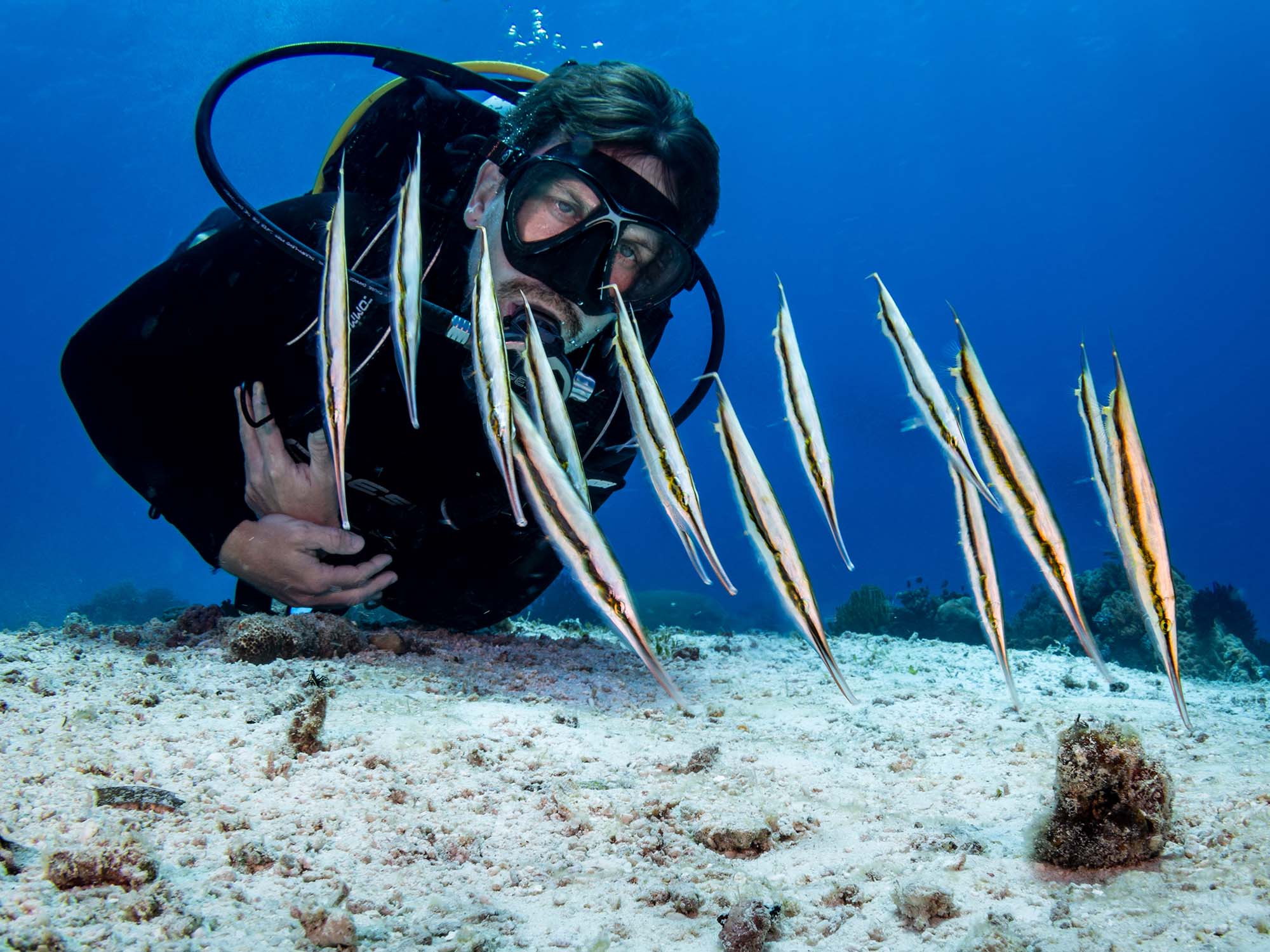
Even if the watery haze is low at a particular site, the sheer number of fish will often occlude vision. © Jeff Milisen
2 | Variable conditions
Challenge: The Galapagos will test your adaptability like nowhere else. The first question most divers ask has to do with water temperature. The same island may have one side that is bathed in tropical water, while the opposite side may be a tooth-shattering 50ºF (10ºC). You’re going to want to be ready to experience both extremes and everything in between. The same goes for subject size. The Galapagos are known for big animals, but the number of fish species found nowhere else is incredible. There are even a few species of endemic nudibranchs.
Opportunity: The advantage of variable conditions is that you will come home with a huge variety of images against a menagerie of backgrounds. The downside is that the Galapagos will find a use for every piece of equipment you own. I packed 3 wetsuits with gloves and a hood and used all of them. Photography, however, is where you can be economical. Don’t ignore macro, but save critical space in your luggage by leaving the snoot, extension tubes, and multiple macro lenses at home. You will want to prioritize wide-angle equipment by bringing the best mid-range wide lens and dome port you have available. Strobes will be a must.
Get as close to your subject as you reasonably can, reducing the amount of haze or backscatter between your lens and the creature. © Jeff Milisen
3 | Visibility
Challenge: Localized upwelling in the area drives an insane amount of productivity. Don’t be surprised if you get less than 40 feet (12 meters) of visibility. The plankton that is reducing visibility is also feeding the multitude of life around you. Even if the watery haze is low at a particular site, the sheer number of fish will often occlude vision.
Opportunity: During the first production I helped with, I was shocked when the underwater videographer noted that 20-30 feet (6-9 meters) of visibility would be plenty for him. I’ve since learned some crucial techniques for
shooting through low visibility, many of which are similar to concepts for any successful shot. First, shoot at an upward angle. The sun will create drama and help hide backscatter that would otherwise be visible in the strobes. Second, get as close to your subject as you reasonably can, reducing the amount of haze or backscatter between your lens and the creature. Third, you want to put your strobes (roughly) as far away from the lens as the subject. In other words, when shooting a nudibranch 4 inches from the end of your lens, bring your strobes in tight. If you are shooting a shark 20 feet away, extend your strobe arms as far as they can go. This is where arm extensions come in handy.

Finding a fresh perspective on a ubiquitously photographed subject can be hard, sometimes including the wider scene can help set your shot apart from the rest. © Jeff Milisen
Sometimes, however, the haze will be minimal, but it is the sheer volume of life that is getting in the way. If you are dead-set on getting that perfect, distraction-free portrait, then you will have to wait and hope that the fish move on before your subject. My preferred approach is to evaluate and compose the scene, incorporating the whirlwind of life and giving the subject a setting to live in. For example, there are probably a million whale shark portraits online today, but by including your buddies, the creole fish, and maybe some reef, you will produce an image that not only appeals to your friends, but is unique from all of the other whale sharks out there!
Wide-angle photography requires thinking intentionally about composing the whole scene to tell a story. © Jeff Milisen
4 | Fast-action, unpredictability
Challenge: Life in the Galapagos comes at you fast and often from angles you aren’t expecting.
Opportunity: A LOT is happening underwater. Even with your head on a swivel, you’re certainly going to miss something. You can try to compose a snapshot on-the-go, but there are more thoughtful ways to compose a shot where life seems to be everywhere. I try to find a benthic foreground subject like a prominent rock or coral in a productive area, take some tests to balance my exposure with my strobes, and then camp out waiting for something exciting to happen. In a place as exciting as Wolf or Darwin, your patience will be rewarded.
The Galapagos is full of life, there's no need to chase animals for "the shot." Instead, compose yourself and your shot and wait for something exciting to happen. © Jeff Milisen
5 | Shy subjects
Challenge: Many of the headlining subjects in Galapagos, such as Mola molas and hammerheads, are notoriously shy and will react to exhaust bubbles or strobes. In addition, the Galapagos attracts people who insist on chasing wildlife in pursuit of “the shot.” When people chase wildlife, everyone suffers, and the only shots are usually tails swimming away.
Opportunity: It is exciting to be surrounded by megafauna, but don’t get lost in the action. The first step is to take a moment to control your own actions. Make sure you aren’t the one chasing animals away. Find a productive outcropping or watch for a behavioral pattern and let the animals come to you. Slow your breathing by drawing out the exhale. Mola molas seem to be especially sensitive to strobes, so consider shooting the scene with ambient lighting. If there is an incessant wildlife chaser in your group, talk to your guide. They are the ones who should talk with troubling individuals, and they have strategies to help manage, contain, and reduce the impact of frustrating behavior.
When creating a scene in your viewfinder, make conscious choices about what elements you want to include, and perhaps more importantly, what elements you don’t. © Jeff Milisen
6 | Finding a single subject
Challenge: The first time I went to the South Pacific, I studied and drew out the shots that I wanted to take, but when it came time to execute my vision, I struggled to isolate a subject from the masses of life. The Galapagos is very similar. The cacophony of life complicates singling out a single animal.
Opportunity: An ocean packed with life is a beautiful place to be, but it can lead a beginner to utter the phrase “a photo won’t do it justice.” A lot of the advice above will help. Find a benthic object to help ground your image. Get close. Wide-angle photography requires thinking intentionally about composing the whole scene to tell a story, and the Galapagos is a fertile training ground. When creating a scene in your viewfinder, make conscious choices about what elements you want to include, and perhaps more importantly, what elements you don’t.
Finally, I sometimes need a drastic change in perspective to help me think more productively about subject orientation. I struggled to find my footing on the first day at Darwin, so to shake my frustration and get the creative juices flowing on day 2, I spent a dive at Darwin shooting portraits of fish and hammerhead faces through my 100mm macro lens. You can ALWAYS find something to shoot with a macro lens. I couldn’t have been happier with the pics! The nontraditional approach caused a change in mindset that helped immensely for the rest of the trip.
You can ALWAYS find something to shoot with a macro lens, even a shark. © Jeff Milisen
Conclusion
The islands of Galapagos are unlike anywhere else on earth. The expense of traveling to the Galapagos puts big expectations for amazing ocean encounters and prime photographic opportunities. That can put a lot of pressure on underwater photographers to perform. Don’t be surprised when you find yourself reevaluating your technique in unfamiliar conditions. If you can master shy subjects in low viz, high currents, and variable conditions, you can shoot anywhere! I hope that these six opportunities will help you think about photography differently and end up with the best images you can muster.
Additional Viewing
Diving the Galapagos with the Canon R8: Why You Need a Small Camera to Dive in Current
Whale Shark Photography Underwater Camera Settings
Why You Need Strobes Underwater
How to Shoot Underwater in Low Visibility and Backscatter
BURST shooting // Using Drive Mode to your advantage underwater [VIDEO]
 Ambassador Jeff Milisen is an internationally acclaimed underwater photographer who has specialized in blackwater photography since 2009. He is a recent addition to the Ikelite ambassador team. His upcoming book, a Field Guide to Blackwater Diving in Hawaii, will help both newbies and seasoned blackwater veterans identify the strange animals they encounter. He currently shoots with a Canon EOS 7D Mark II and dual Ikelite strobes. Read more...






![R3D Underwater Color Grading in DaVinci Resolve // Nikon ZR [VIDEO]](http://www.ikelite.com/cdn/shop/articles/r3d-raw-editing-davinci-resolve-blog-cover-final_1e10dbf2-d992-4f02-992d-19c4f3b26c03.jpg?v=1769615952&width=2000)