

By Douglas Klug
For an underwater photographer, nothing captures the feeling of being underwater better than a good wide angle shot. Many shooters consider a fisheye lens the champion of these types of shots. A fisheye lens adds a pleasing roundness to the edges of an image, making it look circular, as if seen from a “fish” perspective. A fisheye lens differs from other wide angle lenses by being capable of capturing an almost 180 degree view while focusing very close to the lens. This allows for broad sea-scapes or, in other cases, extreme close focus on even large sized animals. The ability to get close and still capture a large animal or broad section of reef is a huge advantage for an underwater shooter, because the farther away you shoot from, the more water and particulate matter are between the camera and the subject.
I wanted to test the lens with the three types of wide angle shooting I usually do: ocean sea-scapes, medium to large animals, and close focus wide angle. I also picked up some lessons when working with a “super” fisheye like the RF 7-14mm. Here’s what I came back with.

8mm • 1/80 • f/8 • ISO 800 // Sea lion. © Douglas Klug
Features
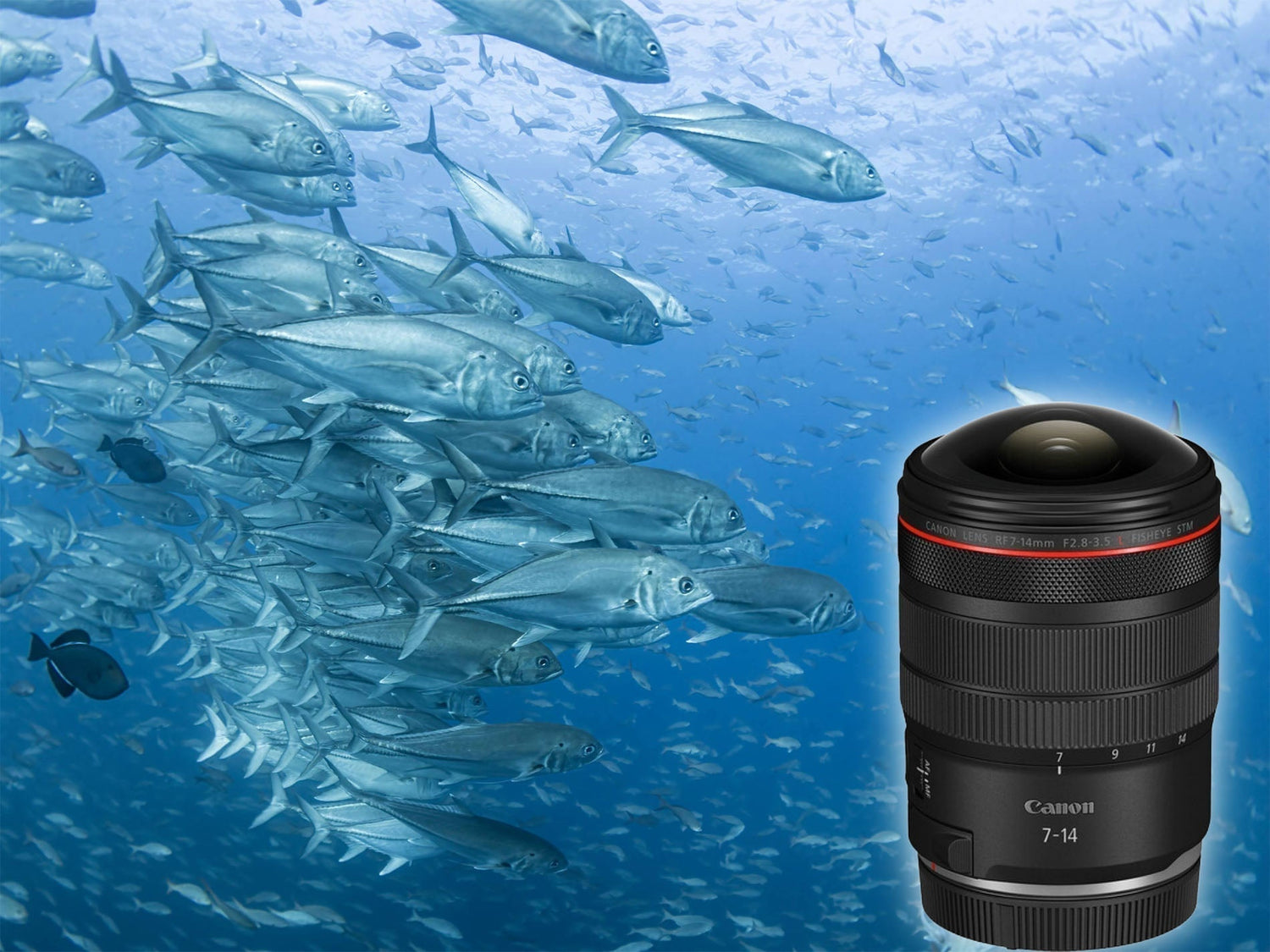
For the RF mount cameras, Canon recently released a new powerful tool in the wide angle world… the RF 7-14mm f/2.8-3.5 L Fisheye STM Lens. The lens is considered a “fast” lens, with an aperture down to f/2.8 at the widest setting of 7mm, and f/3.5 when shooting from 8-14mm allowing the shooter to work at lower ISOs and faster shutter speeds even in low light situations.
The lens' additional claim to fame is its close focus capabilities and edge-to-edge sharpness when shooting behind a dome port underwater. It’s definitely an investment lens - the "L" designation means it is built to higher-quality, more durable standards with enhanced weather sealing, premium optics, and a higher price-point.

9mm • 1/160 • f/11 • ISO 1000 // At the top of my shot list was the chance to dive with and shoot the endemic marine iguanas of the Galápagos Islands. It was challenging to shoot in low visibility and strong surge, but the 7-14mm let me get the lens less than foot away from this feeding iguana to get the shot. © Douglas Klug
Size & Weight
The 7-14mm measures 3.03" (77mm) in diameter and 4.29" (109mm) in length. The zoom mechanism is internal so the length doesn't change when zooming. It comes with a detachable lens hood which should be removed before putting it in a housing.
It's similar in size to its rectilinear sister the RF 10-20mm f4 L, and quite a bit larger than the crop sensor APS-C cousin the RF-S 10-18mm f/4.5-6.3.
Handling in Difficult Conditions
I recently put the RF 7-14mm lens to the test while diving on a wide angle shooters dream trip, the Galápagos Islands. My Canon R7 and 200DLM/D housing are particularly well suited to this type of diving, where a compact system is a big advantage in the strong currents.

The Canon RF 7-14mm on an EOS R7 camera body is a system that punches above its weight, particularly in tough diving conditions.
For the dome port I used the DLM 6 inch Dome Port with Zoom which supports the full zoom range of the lens and doesn't sacrifice optical performance. This is my preferred dome port for shooting because of its low-profile size and easy mobility underwater.
Diving along the tropical rocky reefs, I encountered sharks, schooling fish, seals, sea lions, sea turtles, and even the famous endemic marine iguanas. While there were wide angle shooting opportunities, the visibility wasn’t pristine most of the time. Having a lens that would let me get close opened some shooting possibilities I wouldn’t have otherwise had.
Close Focus Wide Angle
This large green sea turtle let me close the distance and get this shot with the focus distance of less than a foot away. The 7-14mm lens filled the frame with the subject but allowed enough reef and sky into the image to set a pleasing background.

8mm • 1/125 • f/5 • ISO 320 // Green Sea Turtle © Douglas Klug
Isabella Island had colorful gorgonians that added beauty to the reef. By shooting from about 1 foot (.3 meteres) away, the 7-14mm let me fill the frame with this healthy gorgonian while showing off the blue water, sunlight, and clouds of tiny fish in the background.

8mm • 1/125 • f/5 • ISO 500 // Gorgonian, Isabella Island. © Douglas Klug
Ocean Sea-Scapes
Diving Wolf Island, the typical sea-scapes included Scalloped Hammerhead and Galápagos sharks cruising just over the rocky reefs. Shot from a distance of about 7 feet (2 meters) this image shows off how much area the 7-14mm lens can capture. 
8mm • 1/80 • f/3.5 • ISO 100 // Scalloped Hammerhead and Galápagos sharks, Wolf Island. © Douglas Klug
Wolf Island had sunny skies, but the light was blocked by millions of schooling creole fish. With the closest fish just inches from my dome port, the 7-14mm was capable of taking in the entire cloud of fish between me and the surface.

9mm • 1/60 • f/18 • ISO 400 // Schooling creole fish, Wolf Island. © Douglas Klug
Medium to Large Animals
While diving Isabella Island, this school of fish tightened up nicely as I drifted in. From a distance of about 2 feet (.6 meters), the 7-14mm let me fill the frame with the entire school.

8mm • 1/125 • f/5 • ISO 200 // Schooling fish, Isabella Island. © Douglas Klug
At Santiago Island, the white-tipped reef sharks were plentiful in the shallows, but the water was somewhat surge-y. This pair of sharks swam past me, and from a distance of about 3’ feet (.9 meters) I was able to easily capture both their bodies against the reef. The close shooting distance reduced the amount of backscatter from silt stirred up by the surge.

9mm • 1/100 • f/3.5 • ISO 160 // White tipped reef sharks, Santiago Island. © Douglas Klug
At Isabella Island we encountered Galápagos sea lions that frolicked in front of us with the colorful rocky reefs as a backdrop. From about 2 feet (.6 meters) away, I was able to capture the young sea lion as it posed. The fisheye lends provided a pleasing roundness to the edges of the reef and gorgonians in the background.

8mm • 1/100 • f/8 • ISO 1250 // Galápagos sea lions, Isabella Island. © Douglas Klug
Effects of Aperture on Edge Sharpness
Though a fisheye generally performs better than a rectilinear lens underwater, it is not immune to corner sharpness issues at wide open apertures. Even so, I frequently shot at f/3.5 and was very happy with the results. For example the edge softness is used in this photo to focus the viewer's attention on the shark hiding amongst the coral.

9mm • 1/100 • f/3.5 • ISO 320 © Douglas Klug
Sharpness will be worst for objects that are closer to you than your focus point. Keep this in mind when composing an image if edge sharpness is critical to your shot.
I found the whole image area was tack sharp at smaller apertures of f/8 to f/11 and above. You can see that the corners of the next image are super crisp since I was shooting at f/11.

9mm • 1/160 • f/11 • ISO 1000 // Galápagos Islands Marine Iguana © Douglas Klug
Lens Lessons
The power of a true fisheye lens at its maximum width is the circular image the lens creates when used on a full frame camera. The RF 7-14mm does this shooting at 7mm. By zooming in above 7mm, it returns to square image.
The R7 camera has a "cropped" APS-C sensor which isn't able to capture the whole circular frame. After the crop from the APS-C sensor of the R7, the focal range of the 7-14mm lens is effectively 11.2-22.4mm, which is still wider than anything else out there.
Here’s an example:

These images of fish schools were taken less than 15 seconds apart. The first image was taken zoomed in at 9mm, while the second circular image was zoomed out to 7mm. If used on a full frame camera like the R5 or R6 series, the 7mm image will be a complete circle.© Douglas Klug
At the 7mm setting, the dome shade will be visible at the top and bottom of the image. However, if you're planning to shoot this lens ultra-wide it's easy to avoid this by removing the dome shade. Watch Canon RF 7-14mm Fisheye Setting it Up // Zoom Gear Installation [VIDEO] to learn how.
Final Thoughts
All in all, the RF 7-14 mm is a powerful wide angle choice, providing ultra-wide shooting and the ability to zoom in when needed, while also shooting great close focus wide angle. For shooters wanting a true fisheye image, this newly released lens is the top choice for Canon mirrorless systems.
Equipment Used
- Canon EOS R7
- RF 7-14mm F2.8-3.5 L Fisheye STM
- 200DLM/D Underwater Housing for Canon EOS R7 # 69746
- DLM 6 inch Dome Port with Zoom # 5516.16
- Zoom Gear # 5509.62
- Dual RC232 TTL Underwater Strobes with Video Light # 40123US
Additional Viewing
Canon RF 7-14mm Fisheye Setting it Up // Zoom Gear Installation [VIDEO]
Finally a New Fisheye for Underwater! // Introduction the Canon RF 7-14mm Lens [VIDEO]
Faster, Brighter, Fiber Optic // Introducing RC232 Strobe + Video Light Hybrid [VIDEO]
TT5 Canon TTL Fiber Optics Transmitter Review & Results
Rectilinear vs Fisheye Lenses for Underwater Wide Angle Photography [VIDEO]
Diving the Galapagos with the Canon R8: Why You Need a Small Camera to Dive in Current
Evolving Your Underwater Photography in the Galápagos

Douglas Klug has been diving California’s Channel Islands for over 30 years as a SCUBA diving instructor and underwater photographer in Santa Barbara, CA. Doug specializes in underwater photography within the kelp forest environment. His photo-essays have been published in print world-wide, including articles in California Diving News, DAN Alert Diver, and Dive Training. Doug’s images have been used in many publications and by the US National Park Service, US National Marine Sanctuary, the Monterey Bay Aquarium, Google, and Microsoft. Doug even does live talks on underwater photography for dive clubs and museums in Southern California. See more...
![Sony a7 V Underwater FIRST Footage & Photos from the Pacific Northwest // 200DL Housing [VIDEO]](http://www.ikelite.com/cdn/shop/articles/sony-a7v-cover-1_c4342f69-e2c4-4171-a86a-ffd3ce6275ae.jpg?v=1777032884&width=1280)
