




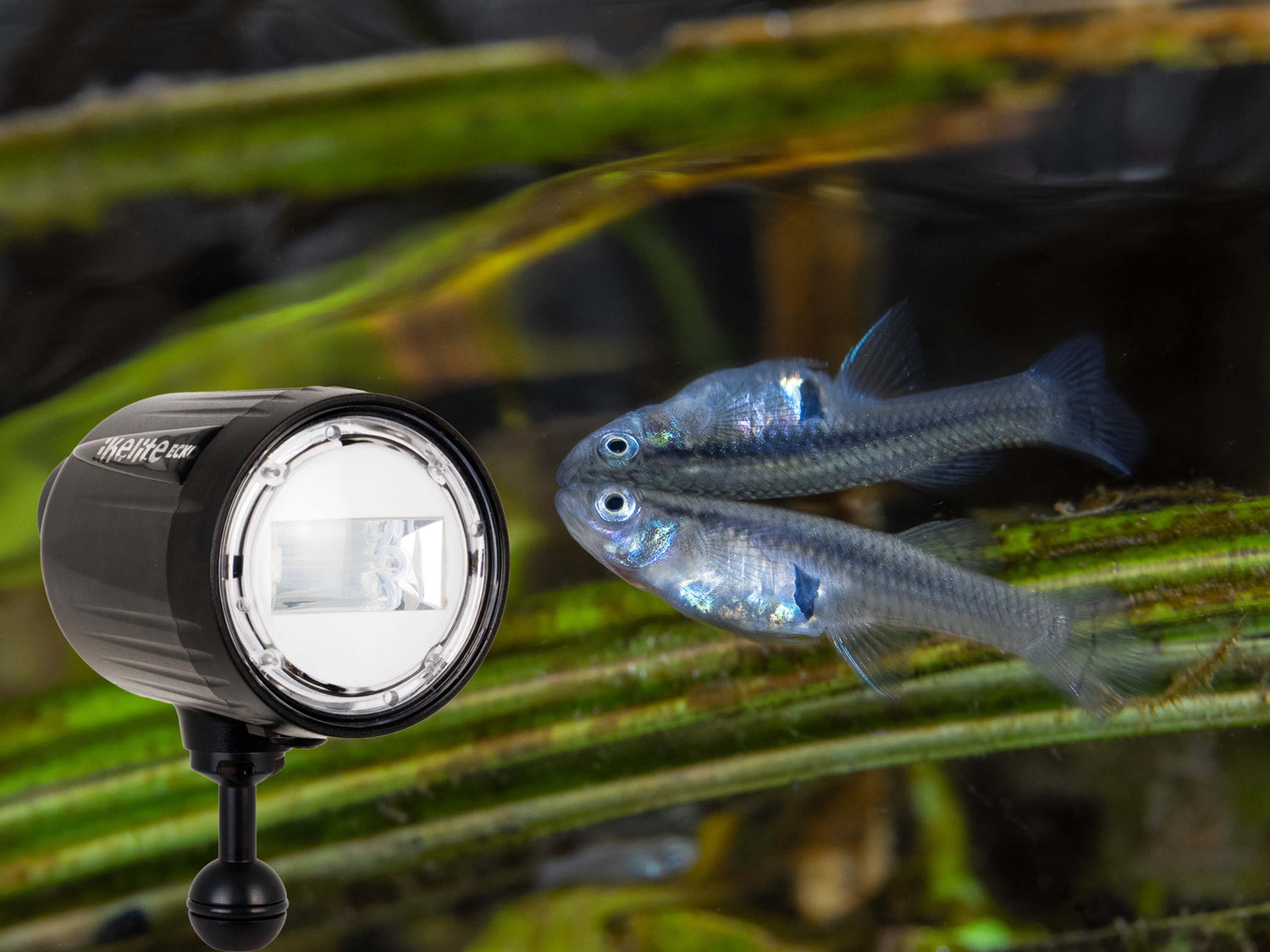
Over the past few weeks, I have had the pleasure of testing out Ikelite’s new Ecko strobes. These are the newest strobes in their lineup, designed to be lightweight, powerful, and versatile.

I have been very pleased with my Ikelite DS232 strobes but was curious about the Ecko strobes for when I need something smaller to travel with. As soon as I had a pair in my hands, I knew the size was exactly what I was looking for but I wanted to put them to the test to see if they can support my usually shooting style.
With any pair of strobes, I am looking for soft, even lighting for natural looking photos, a versatile power range so I can shoot both wide-angle and macro scenes, ergonomic size for travel and close-quarters shooting, and a fast recharge rate for rapid shooting. Over the past few weeks, I have tested each of these variables in different conditions, and can already say, without a doubt, that I will be picking up a pair for my arsenal!

Shot with Sony 90mm Macro Lens • 1/125 • f/11 • ISO 640 © Bill Hawthorne
Soft Beam Angle for Natural Looking Photos
With the included diffuser, these strobes throw a very soft 140° beam angle. Compared to other strobes I have used, the light is soft, gentle, and even throughout the spread. This helps images look much more natural while still maintaining great colors.
I wanted to see how far I could take this while photographing an Escambia Map Turtle in southern Alabama. I positioned my strobes high and centered and lowered the power to try and imitate natural light as best as I could. I then moved the strobes backwards and tried to just barely kiss the turtle with the light. I am really happy with how the image turned out; the strobe’s soft light really helped the lighting look as natural as possible.

An Escambia Map Turtle in a southern Alabama creek. With beautiful light rays in the background, I positioned my strobes high and centered, and used a low power, to give a soft, natural light feeling to the image. Photographed with a Sony A7CR and Sony 90mm Macro in an Ikelite DLM/A Housing with dual Ecko strobes. 1/20s, f/13, ISO 320. © Bill Hawthorne
Full Coverage Power for Wide Angle and Macro
Despite their small size, the Ecko’s throw off an impressive 50 watt-seconds of flash energy. This makes them extremely versatile for both wide angle and macro. I wanted to test this out in with some larger subjects to see how the light performed when subjects were further away. Thankfully, I had just the chance while snorkeling a Florida Spring with a large alligator. I positioned my strobes far out to the sides, turned up the power, and started snapping away. Again, I tried to just barely touch the subject with the light to try to make the image look as natural as possible. While not even at full power, the strobes were able to nicely light the scene, helping the colors pop and the subject look sharp and clear.

An American Alligator pokes his head out from underneath a large cypress tree. For this image, I positioned my strobes far out from the sides of my camera. Photographed with a Canon 7d Mark II and Canon 8-15mm fisheye in an Ikelite DL Housing with dual Ecko strobes. 1/40s, f/13, ISO 100. © Bill Hawthorne
Compact Form Factor
Much to my delight, these strobes are quite small. Size and weight has become one of my major priorities when picking out new gear. It is easier to travel with, easier to get lower and closer to the subject, much more comfortable to swim around with in the water and overall makes me want to go outside shooting more often.

Shot with Sony 90mm Macro Lens • 1/50 • f/11 • ISO 1000 © Bill Hawthorne
I really appreciated the size of these strobes while trying to photograph one of my favorite animals – cave crayfish. I spent a weekend trying to find some of these bizarre creatures to photograph; over a couple days I did multiple long hikes through difficult terrain. I was able to easily fit my entire setup in my backpack, and the low weight was greatly appreciated on the long walks. After searching a variety of sinkholes and springs, I arrived at a small puddle of crystal-clear aquifer water swarming with nearly 20, ~1 inch (2.5 centimeters) white crayfish. I pulled my setup out of my backpack and began shooting. Almost immediately, I ran into an issue - the ground was super silty and stirred up with even the smallest movements. The small size of my setup made it really easy to maneuver through the water and prevent silting. I turned down the power of my strobes, brought them in close to the port, and began shooting. I was really excited with how this image turned out.
The small size of my setup allowed me to get close, maneuvering through a fallen tree without hitting branches or stirring up stilt. Since cave crayfish are all white, they are normally very reflective and hard to light but I was extremely pleased with the soft, natural feeling of the Ecko strobes; this image certainly wouldn’t have been possible without them.

A Woodville Karst Cave Crayfish eats algae off a decaying branch. For this image, I brought my strobes close to the port and as forward as possible. Photographed with a Sony A7CR and Sony 90mm Macro in an Ikelite DLM/A Housing with dual Ecko strobes. 1/6s, f/11, ISO 320. © Bill Hawthorne
Rapid Recharge Rate
Finally, I wanted to test the recharge rate of these strobes. I headed back to the springs and searched for the perfect subject. It wasn’t long before I spotted a small Loggerhead Musk Turtle. I used a medium power on my strobes, opened up my aperture, and swam down to the turtle’s eye level, with the goal of capturing a nice portrait. Musk turtles are usually quick to scare, so I fired off shots rapidly as I slowly approached. The recharge rate on the Ecko strobes was easily able to keep up with my rapid-fire shooting and helped me capture a great image from as close as possible.

A Loggerhead Musk Turtle chows on some algae at the bottom of a Florida spring. Since this image was taken from a few feet away, I used a medium power on the strobes and “bunny ear” positioning. Photographed with a Sony A7CR and Sony 90mm Macro in an Ikelite DLM/A Housing with dual Ecko strobes. 1/25s, f/8, ISO 320. © Bill Hawthorne
Final Thoughts
Overall, I have totally fallen in love with Ikelite’s new Ecko strobes. I found the quality of light to be soft and even, the power was versatile enough for macro and wide angle, the small size was extremely nice for travel and maneuvering underwater, and the recharge rate and battery life easily supported my style of shooting.
Compared to the Ikelite DS232 strobes that I usually shoot, there are definitely tradeoffs. The DS232 strobes are much brighter and therefore more suited to large, wide-angle scenes and subjects that are further away. They have a focus light which can be very useful in lowlight conditions, and the battery packs can support my photography for days without needing charge.
However, I strongly believe the Ecko strobes fill an important gap in my shooting style: they are perfect for when I am looking for something small and lightweight that still retains a beautiful light quality and is versatile enough for macro and wide-angle. As soon as I started shooting with them, I knew I wanted a pair in my kit; I am already envisioning the new photo opportunities that these strobes can make possible.

Sony PZ 16-35mm f/4 G Lens at 16mm • 1/160 • f/11 • ISO 100 © Bill Hawthorne
Equipment Used
Additional Viewing
Upgrading to Fiber Optic TTL // Shooting the Canon R5 with Ecko Fiber and RC165 Strobes
Ecko Fiber a Year in Review // Compact TTL Underwater Strobe [VIDEO]
Underwater Photography Tips in Freshwater Florida Springs [VIDEO]
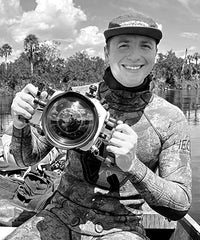
Bill Hawthorne is an aquatic ecologist specializing in the study of the freshwater springs of Florida. Bill focuses his studies and photography on freshwater species, most notably turtles. By sharing his underwater images, Bill hopes he'll expand his viewers' passion toward these unique environments and animals. Check out more of his work on his website, Instagram @billhawthornephotography, TikTok, and YouTube.