

By Douglas Klug
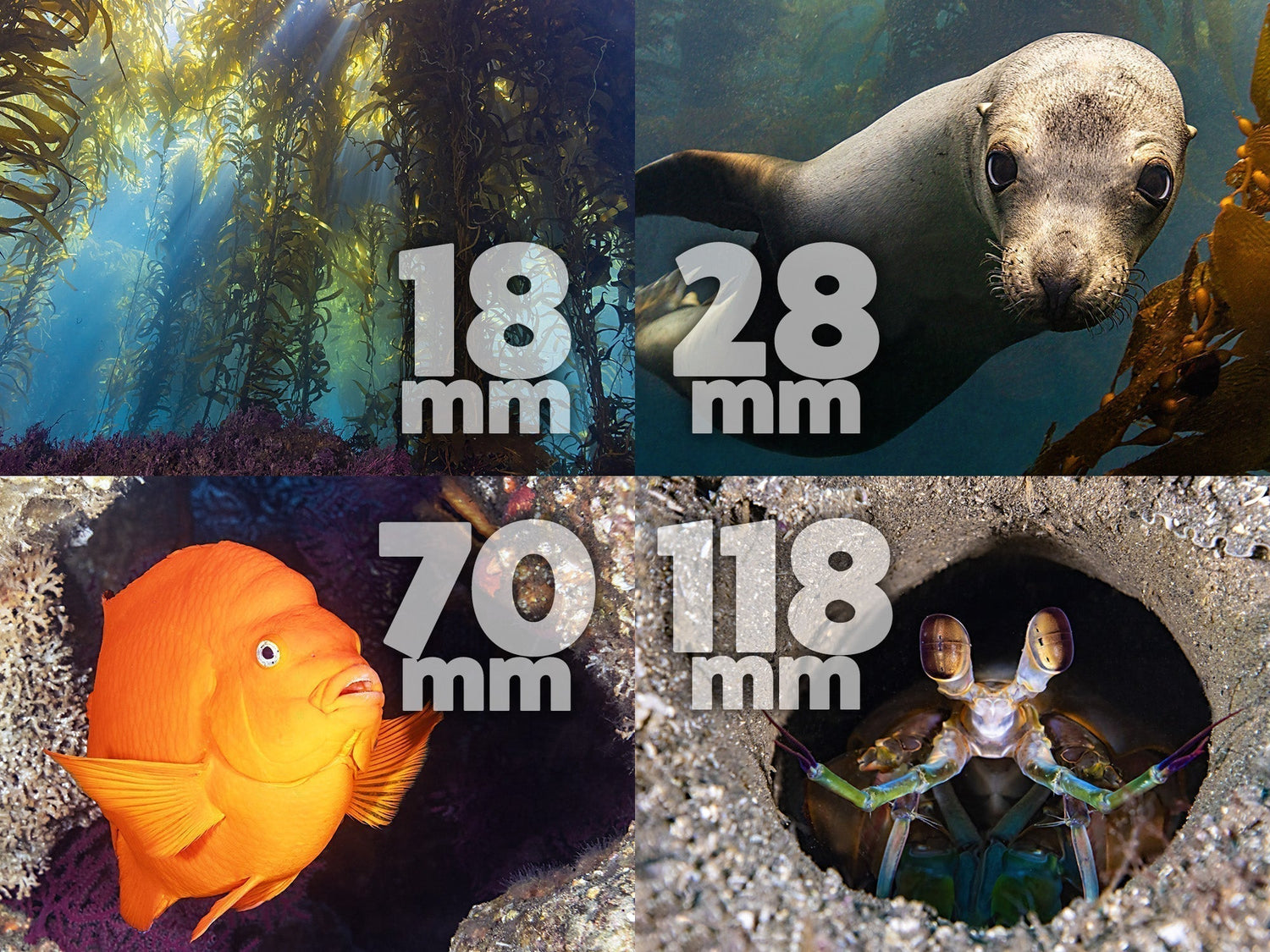
Through years of talking to divers and helping them through the beginnings of underwater photography, there has been one constant: “If you want to shoot a full-control manual camera, you have to decide,” I’ve always told them, “whether to shoot macro or wide-angle before you get into the water.” All that changed with the Canon RF-S 18-150mm F3.5-6.3 IS STM zoom lens. Ikelite's port and extension combination supports the true wide to macro shooting in a form factor that's lighter and easier to handle underwater compared to removable wet lenses.

Two scenes shot during the same 70 minute dive at Anacapa Island in the Channel Islands National Park, California, United States. © Douglas Klug
Needless to say when I first saw Matt Dowse’s images and article on One Dive One Lens, I was intrigued. Could that lens help me in the kelp forests of Southern California, where I routinely encounter breathtaking shows of sunlight sliding through surface canopy, inquisitive marine mammals, nudibranchs and even tiny colorful fish all on the same dive? The photographic opportunities in my regular diving areas are endless, but the old rules placed limits on how I could shoot them. Maybe this lens would change those rules.
I spent the last two months shooting the Canon RF 18-150mm with a Canon R7 body. I shot the lens/camera combination in a DLM housing using the recommended port and extension, with dual DS232 hybrid strobes. The results were pleasantly surprising.

Sea lion comes in for a closeup in Southern California's Kelp Forest.
28mm • 1/160 • f/14 © Douglas Klug
Shooting With a +4 Diopter
I already knew that this lens required the use of a +4 diopter to reduce the minimum focus distance and that the system couldn’t be used for “split shot” photography due to that diopter. Since the small dome port isn’t ideal for those “over/under” shots anyway, I wasn’t really concerned with that limitation. Adding the diopter also decreases the depth of field at a given aperture. When using a diopter, most photographers will shoot at a higher aperture to make up for this, and a slower shutter speed to allow more light in.

This nudibranch image was cropped about 15% to zoom in a bit more on the subject.
100mm • 1/125 • f/13 © Douglas Klug
Shooting at Mid-Range
Using these shooting practices, I was curious how the lens would let me transition from big to small shots throughout the dive. My first test was to shoot broadly focused scenes on my local reefs using the lenses wide and mid-range settings. In these wide and mid-range areas, the lens truly excelled.

Over the first few dives, I spent some time learning how the lens captured colorful southern California reef scenes like these gorgonian colonies, where there was no particular focal point. At 18mm, the lens produced colorful and pleasing results when shot from 2-3 feet away.
18mm • 1/125 • f/13 © Douglas Klug
Shooting Macro
The final learning curve with the lens was to work with macro shooting. I find these types of shots are inherently more difficult because they require crisp focus on a tiny subject among a myriad of distractions on the reef. The lens performed well in that respect, locking in nicely on the smallest subjects. At wide and medium settings, I was shooting from 2-5 feet (.6-1.5 meters) away from my subject. When shooting with the zoom at 100mm or greater, the minimum focus distance was the only limitation I found. Even with the +4 diopter, the minimum focus distance was closer to 9 inches (22.8 centimeters) than the 6 inches (15 centimeters) minimum focal distance I’ve grown used to using Canon’s fixed 100mm f/2.8 macro lens. For truly small subjects, I found images shot with this lens required a little crop in post editing. Since the focus on the subject was crisp, cropping didn’t hurt the image.
The 18-150mm has a reproduction ratio of 1:2.7 (0.44x magnification) so subjects won't look as large in the frame compared to a "true to life" 1:1 macro lens, or the magnifying effect of the RF 100mm Macro with a 1.4:1 reproduction ratio (1.4x magnification). So while it isn't ideally suited for the extremely tiny “super macro” subjects, I found it delivered exceptional images without cropping when shooting small subjects in the 3-4 inch (7.6-10 centimeters) long size.

This blue-leg mantis shrimp in its burrow, about 3” across, was the optimum size for macro shooting with the 18-150mm. The zoom feature also allowed me to take the shot from a distance, which helped because this particular species of mantis shrimp are notoriously shy and quickly retreat into their burrows when anything looms over them.
118mm • 1/125 • f/11 © Douglas Klug
Best Focal Distance Performance
Once I sorted out the big and small shooting, the lens was absolutely a winner for single-lens multi-subject shooting on the same dive. Its best focal distance, for all types of shooting, seemed to be in the 2-5 feet (.6-1.5 meters) range. At those distances, images are crisp, sharp, and provide ample background. At these distances, shooters using strobes will also find they’re shooting at the perfect distances to light up the subject nicely.

At these medium focal lengths, the lens performed best shooting subjects 2-5 feet (.6-1.5 meters) from the lens. • 70mm • 1/125 • f/13 © Douglas Klug
Conclusion
While there’s still a place for a true macro lens or a true wide-angle fisheye lens in underwater photography, the diver looking to just dive with a single lens will find this one fits that niche nicely. After spending time with this lens, I’ve determined that Canon’s 18-150mm lens is definitely one that will live in my camera bag and accompany me on trip after trip and dive after dive into the future.

On medium sized reef subjects like this octopus, I found the lens performed well in the 40mm-80mm range.
44mm • 1/125 • f/13 © Douglas Klug
Equipment Used
- 200DLM/D Underwater Housing for Canon EOS R7 # 69746
- DLM 6 inch Dome Port with Zoom Extended .375 Inch # 5516.16
- DLM 1.2 Inch Port Extension # 5516.65
- Zoom Gear # 5515.17
- +4 Diopter
- Dual DS232 TTL Underwater Strobe with Video Light # 40232
Additional Viewing
One Dive, One Lens // Canon RF-S 18-150mm Lens Review for Underwater [VIDEO]
Canon RF-S 18-150mm f/3.5-6.3 IS STM Lens Micro-Review & Results
Canon R10 with 18-150mm Setting It Up // 200DLM/D Fiber Optic Underwater Housing [VIDEO]
Canon RF 100mm F2.8L Macro and Canon R7 Underwater Micro-Review & Results
More Power, Smaller Package: Moving to Mirrorless with the Canon R7

Douglas Klug has been diving California’s Channel Islands for over 30 years as a SCUBA diving instructor and underwater photographer in Santa Barbara, CA. Doug specializes in underwater photography within the kelp forest environment. His photo-essays have been published in print world-wide, including articles in California Diving News, DAN Alert Diver, and Dive Training. Doug’s images have been used in many publications and by the US National Park Service, US National Marine Sanctuary, the Monterey Bay Aquarium, Google, and Microsoft. Doug even does live talks on underwater photography for dive clubs and museums in Southern California. See more...
![Panasonic LUMIX S1 IIE Underwater Video Results // 200DL Underwater Housing [VIDEO]](http://www.ikelite.com/cdn/shop/articles/Lumix-S1-II-e-results-blog-cover.jpg?v=1774011256&width=1280)

