

By Jennifer Ross
At Solitude Lembeh Resort, the world’s most unassuming seabed transforms into a stage for extraordinary encounters—captured through precision, patience, and trusted equipment.

Mandarin Fish. A mating pair of mandarinfish, Synchiropus splendidus, photographed a split second before spawning. Shortly after sunset, male and female mandarinfish perform an elaborate courtship display, rising together into the water column in perfect synchrony before simultaneously releasing eggs and sperm into the surrounding water for external fertilization. This spectacular reproductive behavior lasts only a few seconds each evening and is one of the most sought-after natural history events for underwater photographers and divers. Renowned for its brilliant blue, orange, and green coloration, the mandarinfish is considered one of the world's most beautiful reef fishes. © Jennifer Ross
At the Crossroads of Biodiversity
Located within the heart of the Coral Triangle—the global epicenter of marine biodiversity—the Lembeh Strait is a place unlike anywhere else on Earth. This narrow channel, shaped by currents flowing between the Pacific and Indian Oceans, creates one of the richest muck diving environments in the world.

Wonderpus. A close-up photograph of a small wonderpus octopus, Wunderpus photogenicus. This remarkable Indo-Pacific cephalopod is renowned for its striking reddish-brown and white bands and its exceptional camouflage, blending seamlessly with sandy bottoms and rubble habitats. Unlike the mimic octopus, which actively impersonates a variety of venomous marine animals, the wonderpus relies primarily on disruptive coloration, body posture, and subtle changes in skin texture to avoid predators. Highly intelligent and curious, wonderpus octopuses emerge from their burrows to hunt small crustaceans and fishes, using dexterous arms and keen eyesight to locate prey. © Jennifer Ross
It was into this extraordinary setting that we arrived at Solitude Lembeh Resort—a destination that strikes a rare balance between understated luxury and purposeful design. Freestanding A-frame bungalows cascade along the gently sloping grounds, each thoughtfully positioned within lush tropical surroundings, many with uninterrupted views of the sea. The aesthetic is warm, natural, and quietly refined—never excessive, always intentional.

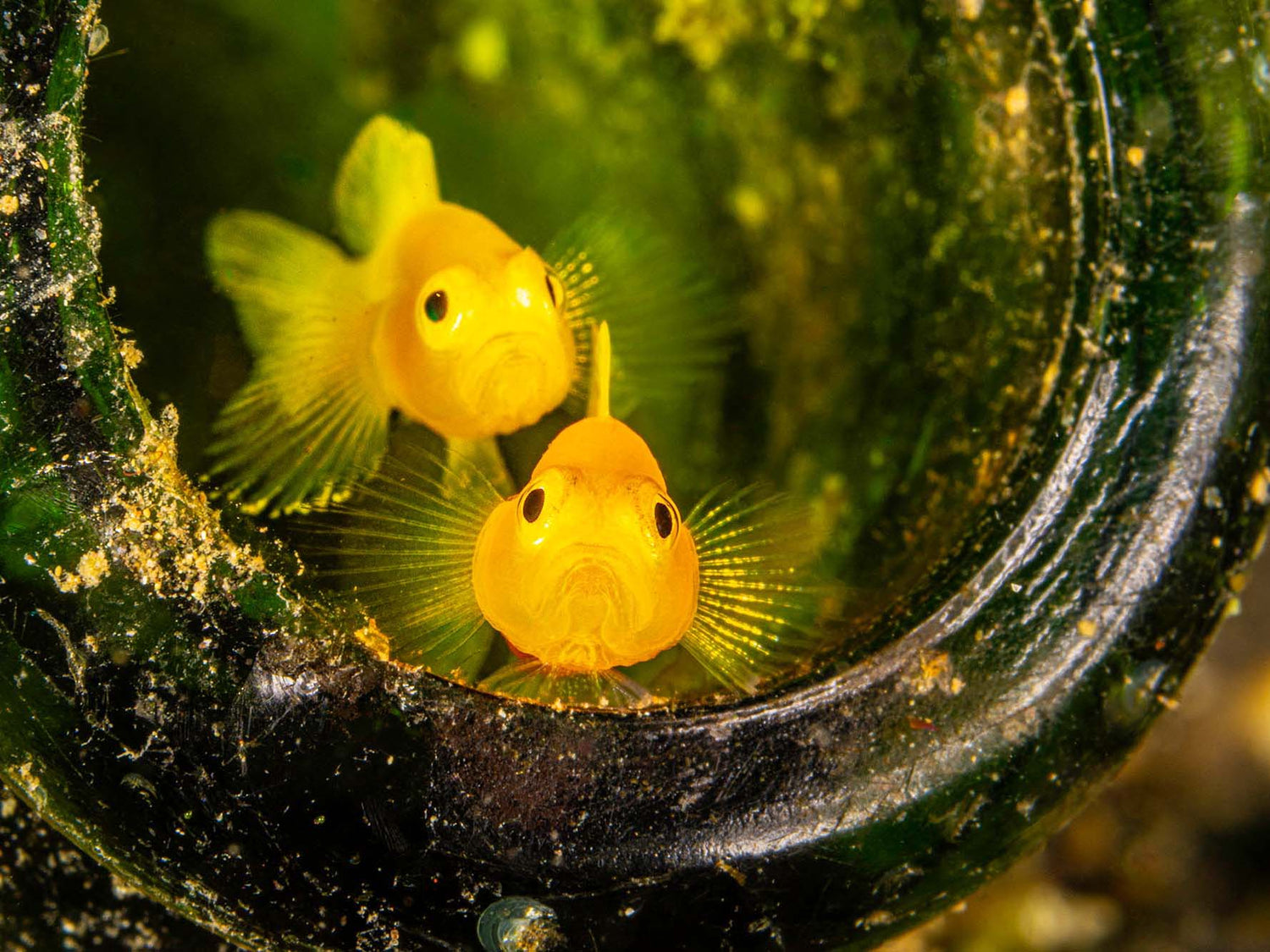
Yellow Gobies. A pair of yellow pygmy gobies, Lubricogobius exiguus, occupy the opening of a discarded bottle on the seafloor. These tiny, cryptic reef fish have adapted to use artificial debris as shelter. © Jennifer Ross
A Volcanic Canvas of Illusion
Beneath the surface, Lembeh reveals its true identity.
The seabed is a dark volcanic canvas. At first glance, it appears barren—almost lifeless. But that illusion dissolves quickly. A subtle shift in texture becomes a rhinopias scorpionfish. A pair of eyes emerges from the sand—a stargazer, a snake eel. You hover, you wait, you look closer.
And when the moment arrives, everything depends on readiness.

Ambon Scorpionfish, Pteroidichthys amboinensis. This fish has amazing camouflage abilities. Its body is covered with fleshy appendages called cirri that resemble algae, seaweed, or debris. Combined with its mottled colors, it can disappear almost completely against algae-covered rocks or sandy bottoms. © Jennifer Ross
A System Built for the Moment
For me, that readiness began with my camera system.
I was shooting a Canon R7 mirrorless camera housed in the Ikelite DLM system—noticeably more compact and lightweight than Ikelite’s DL housings. That reduced footprint mattered from the moment I packed in Guam. Traveling with underwater gear is always a balancing act, and the DLM housing allowed me to streamline without sacrificing performance.

Squid. A bigfin reef squid, Sepioteuthis lessoniana, also known as an oval squid, hovers gracefully in the darkness during a blackwater night dive. This intelligent cephalopod is known for its ability to rapidly change color and pattern using specialized skin cells, allowing it to communicate, hunt, and camouflage with remarkable precision. Its large fins run along the length of its body, giving it a distinctive oval shape and smooth, hovering movement in the water column. © Jennifer Ross
Underwater, the R7 delivered exactly what Lembeh demands: speed, precision, and confidence. Its autofocus system is fast and decisive, allowing me to pre-compose shots—framing a patch of sand, anticipating behavior, and waiting for the subject to enter the scene. When it did, the camera locked instantly, capturing the moment with pinpoint accuracy. In muck diving, where subjects are small, unpredictable, and fleeting, that responsiveness is everything.

Coryphellina exoptata. This striking aeolid nudibranch is recognized by its slender body, elongated oral tentacles, and vibrant cerata, which are used for respiration and defense. Like many aeolid nudibranchs, Coryphellina exoptata feeds primarily on hydroids, storing the stinging cells from its prey within the tips of its cerata as a defense against predators. Lembeh Strait is renowned for its exceptional marine biodiversity and world-class muck diving, offering underwater photographers opportunities to encounter rare and unusual invertebrates such as this beautiful sea slug in their natural habitat. © Jennifer Ross
The Treasure Hunt Begins
Diving in Lembeh is often described as a treasure hunt—and it’s an apt comparison.
Each stay at Solitude begins with a simple question: “What’s on your wish list?” From that moment forward, the dive team is fully invested in making it happen. With up to four dives a day—including optional night and blackwater dives—the opportunities feel endless.

Cleaner shrimp on a yellowmargin moray eel, Gymnothorax flavimarginatus. Their fascinating relationship with cleaner shrimp is a scene I could watch all day! These confident little shrimp march in and out of the eels intimidating jaws lined with rows of formidable teeth, enjoying a meal for themselves while providing necessary hygiene for the eel. © Jennifer Ross
Our guide, Eddy, was exceptional—not only as a critter spotter, but as a skilled camera handler. For underwater photographers, that combination is invaluable. The ability to locate elusive subjects while understanding the needs of a camera system elevates every dive.

Fang Blenny Pair. A pair of short-head sabretooth fang blennies, Petroscirtes breviceps, have adopted a discarded glass bottle as a refuge on the sandy seafloor of Lembeh Strait, North Sulawesi, Indonesia. These small combtooth blennies are known for occupying empty shells, bottles, cans, and other cavities that provide protection from predators. Despite their diminutive size, sabretooth fang blennies possess enlarged canine teeth used for defense and territorial disputes. The image also highlights the adaptability of marine life in utilizing artificial objects as habitat while serving as a reminder of the lasting presence of human debris in the ocean. © Jennifer Ross
Designed for Photographers
That same level of thoughtful design extends to the resort’s camera facilities.
The camera room at Solitude Lembeh is among the best I’ve experienced—spacious, well-lit, and air-conditioned, with ample room for multiple large camera rigs. There is no shortage of outlets or USB ports, and two compressed air hoses keep equipment clean and dry.

The camera room at Solitude leaves nothing to be desired, more than ample amenities for underwater photographers. © David Fleetham
Once your system is assembled, the dive team carefully transfers it to the boat. After the dive, your camera is returned either to the rinse tanks or back to the camera room—seamlessly and safely. It’s a workflow designed with photographers in mind.

Mating Cuttlefish. A pair of cuttlefish, Sepia sp., photographed during courtship. Remarkably, this mating pair was observed only a few feet away from a pair of spawning mandarinfish, creating a rare opportunity to witness the reproductive behavior of two very different marine species at the same dive site. Cuttlefish are highly intelligent cephalopods renowned for their rapid color changes, complex body patterns, and dynamic courtship displays used to attract mates and communicate with rivals. Following mating, females lay clusters of eggs that are attached to corals, algae, or other submerged structures. © Jennifer Ross
Power, Endurance, and Reliability
Efficiency continued underwater.
The combination of the Canon R7 and Ikelite strobes delivered exceptional battery performance. I consistently completed multiple 60–70 minute dives on a single battery, shooting approximately 70% stills and 30% video. Even during extended video sequences—often while waiting patiently for specific behaviors—the camera never overheated inside the housing.
In an environment where timing is everything, reliability becomes critical—and this system delivered without compromise.

Shells with mantle. Two tiny allied cowries, Diminovula punctata, sit perfectly camouflaged on a soft coral, Dendronephthya sp. These small marine snails, less than one centimeter long, are an excellent example of natural mimicry. Their color and texture closely match the soft coral on which they live, providing effective camouflage from predators. Cowries like this often feed on their host coral and spend their lives closely associated with it. © Jennifer Ross
Lighting the Impossible
In the volcanic darkness of the Lembeh Strait, light defines everything.
I shot the entire trip with twin DS165 TTL Strobes, and over three weeks of continuous diving, they proved to be exceptionally dependable. There is nothing more frustrating than preparing your system, test firing in the camera room, and discovering underwater that your strobes fail to fire when it matters most. With the Ikelite system, that concern never arose. Every press of the shutter produced a consistent, reliable response. That level of trust allows you to stay fully present with your subject.

Anemonefish eye, Clark’s anemone fish, Amphiprion clarkii. This species of anemone fish has a mutualistic relationship with its host anemone nest. The fish enjoys protection from predators as the nest makes a safe and secure place to sleep and reproduce, while the anemone receives defense from butterfly and other anemone predators, removal of parasites, nutrients from the fish’s waste, and improved water circulation as the fish constantly swims through the tentacles. © Jennifer Ross
The TTL system was a standout feature throughout the trip. Exposure remained consistently accurate, even in the unpredictable conditions that define muck diving. Subjects appear suddenly and move erratically—you often have only seconds to react. TTL removes the need for constant adjustment, allowing you to focus entirely on composition and timing.

Fimbriated Moray Eel. A juvenile fimbriated moray, Gymnothorax fimbriatus, peers cautiously from beneath a fallen leaf. This cryptic moray eel uses natural cover to remain concealed while watching for passing prey and avoiding larger predators. Like other moray eels, the fimbriated moray is an ambush predator that feeds primarily on fishes and crustaceans, relying on its keen sense of smell and rapid strike to capture prey. Hidden among the sandy substrate and scattered debris of Lembeh Strait's renowned muck-diving sites, this species exemplifies the remarkable camouflage and secretive behavior of many tropical reef inhabitants. © Jennifer Ross
Small details made a big difference: a clear battery life indicator, a ready light confirming full recycle, and a built-in modeling light that assists with focus and composition in low light. Together, these features create a system that feels intuitive, responsive, and dependable.

Benggai cardinalfish, Pterapogon kauderni. This striking fish is endemic to the Banggai Archipelago in central Sulawesi, Indonesia. Its natural range is incredibly small, making it one of the most geographically restricted marine fishes on Earth. Due to the aquarium trade and multiple accidental releases over the years, this fish is now seen in other locations, including the Lembeh Strait. © Jennifer Ross
A Seamless Dive Experience
Back on land, the dive operation continues to impress.
After each dive, you return not only to rinse tanks, but to a dedicated wetsuit room equipped with multiple hot showers, soap, and a powerful ventilation system that keeps gear drying efficiently. Each diver has an assigned space organized by bungalow number—simple, effective, and remarkably well thought out.
Everything flows. Everything works.

Hypselodoris Infucata. This striking chromodorid sea slug is recognized by its translucent bluish-white body adorned with yellow and blue markings, orange-tipped rhinophores, and vividly colored gill plume. Like other members of the family Chromodorididae, Hypselodoris infucata feeds primarily on marine sponges and acquires defensive chemical compounds from its prey, making it unpalatable to many predators. Widely distributed throughout the tropical Indo-Pacific, this beautiful nudibranch is a favorite subject of underwater macro photographers. © Jennifer ROss
Critters, Color, and Constant Discovery
Lembeh’s reputation is built on diversity—and it delivers in extraordinary ways.
Nudibranchs in endless variation. Flamboyant cuttlefish pulsing across the sand. Mantis shrimp peering from their burrows. Frogfish in every imaginable size and color. And octopus—so many octopus. Blue-ring, mimic, coconut, algae, hairy, long-armed, day octopus, and the endlessly charismatic wonderpus—all checked off the list.

Blue ringed octopus, Hapalochlaena lunulata. One of the ocean’s most beautiful, and most venomous, animals. The blue rings are a warning signal. When relaxed, the rings are faint and nearly invisible but once the octopus feels threatened or excited it rapidly flashes dozens of brilliant electric blue rings across its body. © Jennifer Ross
Among the many highlights, one stood out in a quieter, more unexpected way: tunicates. Not just any tunicates, but colonies displaying colors so surreal they seem almost unreal. Brilliant shades of orange, sharply contrasted against black and white. Fluorescent pastels in shades of greens, blues, and pinks, seemingly glowing from within. Electric yet delicate.
It was the kind of moment that stops you mid-dive and reminds you exactly why you picked up a camera in the first place.

Vibrant Tunicates. A close-up look at a striking pair of sea squirts, or tunicates, Rhopalaea sp., displaying vivid green and blue color patterns. Although they resemble simple marine plants, tunicates are sessile marine invertebrates belonging to the subphylum Tunicata, making them among the closest living invertebrate relatives of vertebrates. These colorful filter feeders draw seawater through an incurrent siphon, extracting microscopic plankton before expelling the filtered water through a second siphon. Their brilliant colors and intricate surface patterns make them popular subjects. © Jennifer Ross
Beyond the Dive Deck
Above water, Anna and Patrick have created something genuinely special.
Their approach to hospitality is personal without being intrusive. They join guests for meals, occasionally for dives, and consistently anticipate needs before they’re expressed. It feels less like a resort and more like being welcomed into the home of exceptionally capable friends.

Colonial tunicates, from the genus Botrylloides, form thin encrusting mats that spread across rocks, dead coral, and sponges. Hundreds or even thousands of tiny filter-feeding individual animals called zooids are embedded in a shared gelatinous coating known as the tunic. The zooids are arranged in beautiful winding rows or striking mosaic-like patterns, like this one. © Jennifer Ross
The culinary experience is equally thoughtful. Meals are fresh, balanced, and deeply satisfying—a true farm-to-table approach that fuels long days of diving without heaviness. There is always something to look forward to, something carefully prepared, something that sustains both energy and enjoyment.

Juvenile sweetlips. At this early stage of development, this harlequin sweetlips, Plectorhinchus chaetodonoides, displays a delicate creamy white body with muted orange to tan markings and elongated fins. Juveniles exhibit a distinctive undulating swimming motion that causes them to resemble drifting leaves or a toxic flatworm or nudibranch, a remarkable example of protective mimicry that helps reduce predation. As they mature, harlequin sweetlips undergo one of the most dramatic transformations among Indo-Pacific reef fishes, developing into large adults with bold black spots covering a silvery body. © Jennifer Ross
Anna and Patrick’s commitment to the marine world extends well beyond the resort itself. They are active supporters and partners of iNaturalist.org, an organization dedicated to building a global community focused on understanding and sustaining biodiversity through the observation and documentation of wild organisms. Guests are encouraged to upload their images and sightings, transforming each dive into a meaningful contribution to science. In a place as biologically rich as Lembeh Strait, this collaborative effort helps identify new species and deepens our understanding of those already known.

Nudi with emporer shrimp. A tiny imperial shrimp, Periclimenes imperator, clings between the rhinophores of a colorful nudibranch, Ceratosoma trilobatum, in the rich muck-diving waters of Lembeh Strait, Sulawesi, Indonesia. This shrimp species is a well-known symbiotic hitchhiker that lives on sea cucumbers and nudibranchs, gaining protection and mobility from its host while feeding on organic particles and mucus. © Jennifer Ross
The Perfect Ending to Each Day
At the end of the day, the saltwater infinity pool offers one final indulgence.
Naturally warmed and gently buoyant, it feels less like a pool and more like an embrace—an extension of the ocean itself. After hours beneath the surface, it’s the perfect place to remain connected, just a little longer.

Ghost Pipe Fish. A pair of robust ghost pipefish, Solenostomus cyanopterus, demonstrate exceptional camouflage on a tropical reef. Masters of disguise, ghost pipefish mimic the color, texture, and form of surrounding crinoids, soft corals, algae, or seagrasses, making them remarkably difficult for both predators and prey to detect. Unlike true pipefishes, ghost pipefish belong to the family Solenostomidae and are closely related to seahorses. Females carry their eggs in a specialized brood pouch formed by their enlarged pelvic fins until the young hatch. © Jennifer Ross
Into the Jungle: Tangkoko’s Big Three
For those willing to venture inland, Solitude offers excursions to Tangkoko Nature Reserve, home to North Sulawesi’s “Big Three.”
The Celebes crested macaque, highly social and expressive, moves comfortably through the forest. The bear cuscus—a slow-moving marsupial—rests high in the canopy. And the spectral tarsier, tiny and otherworldly, captivates with enormous eyes and the ability to rotate its head nearly 180 degrees.
Indeed, the biodiversity of this region extends far beyond the reef.

A rare and intimate close encounter with a spectral tarsier, Tarsius tarsier, in Tangkoko National Park, North Sulawesi, Indonesia. Endemic to Sulawesi, this tiny nocturnal primate is among the smallest in the world and is instantly recognizable by its enormous eyes, elongated fingers, and delicate, agile body. Often described as “alien-like” due to its striking facial features, the spectral tarsier is a master of the nighttime rainforest, using exceptional vision and silent movement to hunt insects. © David Fleetham.
Final Reflections
In the end, Lembeh is not simply another Indonesian dive destination.
Lembeh is a place that quietly reshapes the way you see the underwater world. What first appears empty reveals itself, layer by layer, to those willing to slow down, look closer, and trust the process. At Solitude Lembeh Resort, it becomes something even more—a carefully curated experience, and an opportunity to participate in meaningful scientific research. A place where world-class diving, sustainability, thoughtful design, and reliable photographic opportunities come together seamlessly.

Sexy Shrimp. A close-up look at a pair of sexy shrimp, Thor amboinensis, also known as commensal shrimp. These tiny, brilliantly colored crustaceans are famous for their distinctive habit of raising and rhythmically wagging their abdomens, a behavior that inspired their common name, "sexy shrimp." They typically live in close association with sea anemones and other cnidarians, gaining protection among the host's stinging tentacles while feeding on small food particles and organic debris. Their striking orange bodies, accented with patches outlined in blue, make them a favorite subject for underwater macro photographers. © Jennifer Ross
Equipment Used
- Canon EOS R7 Mirrorless Camera
- Canon RF 100mm F2.8 Macro IS USM Lens
- 200DLM/D Underwater Housing for Canon R7 # 69746
- DLM 2.2 Inch Port Extension # 5516.70
- DLM Flat Port 3.2-Inch # 5516.51
- DS165 TTL Underwater Strobe # 40165
- DL5 DS Link Canon TTL Converter # 46074
Additional Viewing
How Muck Diving Can Improve Your Underwater Photography
Photographing Spawning Mandarinfish in Lembeh
More Power, Smaller Package: Moving to Mirrorless with the Canon R7
Diving the Ghost Fleet: Descending into History in Truk Lagoon
Canon EOS R100 Underwater in Micronesia
Black Sand and Ghosts of Coral: A Photographer's Dive into Tulamben
Macro in Lembeh Strait with the Nikon 60mm and Kenko 1.4x Teleconverter

Jennifer Ross found her passion for underwater photography after spending years in front of the camera, swapping out commercial and catalog work for backrolls and dive tables. In 1986 Jennifer was introduced to scuba diving and earned a number of dive certifications while working in the dive industry in Guam. During an extended surface interval Jennifer ran a successful private medical practice while raising her family. In 2021 she began taking photos underwater and two years later she won her first photography award at MantaFest. While in Yap at MantaFest Jennifer met renowned underwater photographer David Fleetham. Fast forward a year and a half and the two now call Guam home, the perfect launch pad for exploring Asia and Micronesia's breathtaking dive sites.
![Florida Underwater // How I Shot Sturgeon in the Suwannee River [VIDEO]](http://www.ikelite.com/cdn/shop/articles/Sturgeon_Florida_Underwater_Bill_Hawthorne_2_d2b6f5c2-b34f-432c-b069-d951d44800f4.jpg?v=1784289874&width=1900)