



By Jennifer Ross
To close out 2025, my partner David Fleetham and I hopped on the Odyssey liveaboard dive boat to welcome the new year in one of the most historically significant bodies of water on Earth: Truk Lagoon, Chuuk in the Federated States of Micronesia.
Often referred to as the Ghost Fleet, Truk Lagoon is the final resting place of dozens of Japanese ships and aircraft sunk during Operation Hailstone in February 1944. Today, the WWII wrecks - now more than 80 years old - lie scattered across the lagoon at depths ranging from a diver-friendly 65 feet (20 meters) to many hundreds of feet below the surface, preserved in eerie stillness.
READ MORE: Underwater Museums: What Remains of WWII in the Pacific

Navigation equipment on the deck of the Kensho Maru: a Japanese auxiliary transport ship resting in 140-160 feet (42-48 meters) feet of water, upright on the sea bed. © Jennifer Ross
Life Aboard the Odyssey
Our home for this journey is the Odyssey, a 132 feet (40 meters) purpose-built scuba diving liveaboard that was, quite simply, exceptional. The vessel blends technical capability with comfort, pumping Nitrox and mixing advanced gases to support deeper wreck exploration. A hydraulic lift off the stern allows divers to enter and exit the water gently - an absolute gift when handling underwater camera equipment, which David and I had brought specifically to document these historic sites.

Navigation equipment in the wheel house on the Momokawa Maru. She rests upright and remarkably intact at depths ranging from 80-120 feet (24-36 meters). © Jennifer Ross
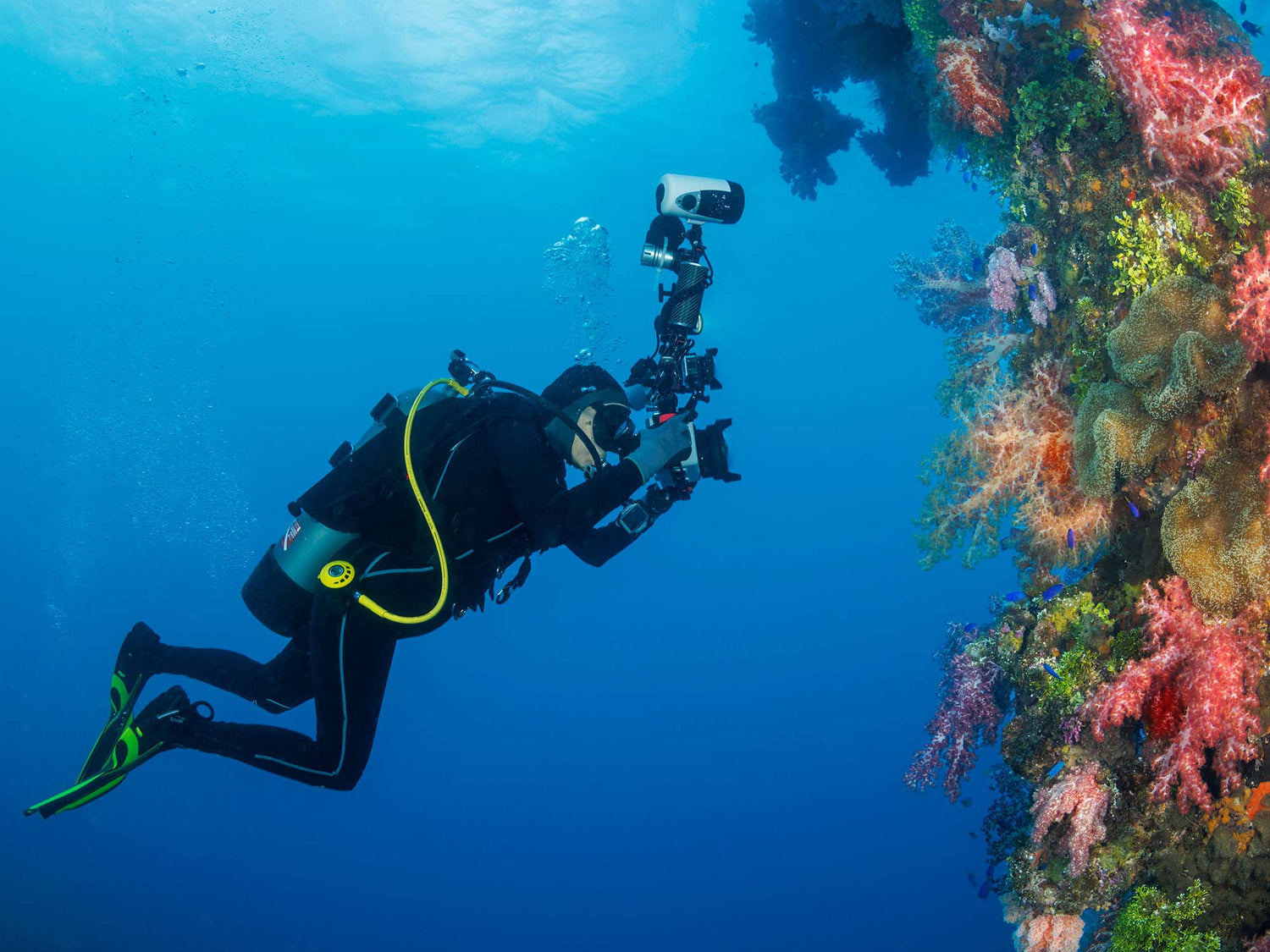
For this trip, I shot a Canon R7 camera paired with a Canon 10-18mm wide-angle lens. The wide field of view allowed large portions of the wrecks to be captured at close working distance while maintaining color and contrast.
The camera was installed in an Ikelite compact DLM housing with twin Ikelite DS230 strobes using the Ikelite TTL system, which consistently produced accurate exposures across changing distances and reflective metal surfaces.
The Odyssey is also equipped with a hang bar off the stern, where divers can complete safety and decompression stops. Hovering there, suspended in blue water as the massive ship gently swings on its mooring, turned even routine decompression into an exhilarating ride.
Descending into History
While these wrecks have been explored extensively over the decades, they still hold powerful reminders of the lives lost here. Visible human remains are long gone, but artifacts remain: sake and beer bottles, gas masks, bullets, unexploded ordnance, oil barrels, war tanks, vehicles, small aircraft - and occasionally, something deeply personal, like a lone shoe, or piece of clothing. These small, intimate objects bring the human story into sharp focus and make it impossible to forget that these ships became tombs in 1944.
READ MORE: How To Get the Best Shots When Shooting Wrecks

Sake bottles, beer, bottles, bowls, and other signs of human life strewn across the deck of the Fujikawa Maru. © Jennifer Ross
Inside the wrecks, ambient light levels drop quickly. The wide-angle lens allowed entire compartments and passageways to be documented in confined spaces. Autofocus performance remained consistent in low contrast areas during swim-throughs.
The strobes provided even illumination across larger scenes such as engine rooms and cargo holds, and the TTL exposure system maintained balanced lighting without repeated adjustment throughout the dives.

Telegraph and navigation equipment in the wheelhouse of the Nippo Maru: a Japanese auxiliary, tanker/transport ship that carried fuel and supplies critical for logistics to the fleet. © Jennifer Ross
Marine life has reclaimed the wrecks in quiet abundance. We marveled as schools of batfish, jellyfish, barracuda, and dog tooth tuna swirl and sweep past the superstructures. Reef fish and glorious soft corals in an array of dazzling colors blanket decks, railings, and masts. The anemones were particularly striking; healthy, vibrant, and among the largest I’ve ever seen, flourishing where machinery and artillery once stood.
Some engine rooms have begun to collapse with time and corrosion, making them unsafe to enter. Others remain intact enough for careful swim-throughs, revealing engines, gauges, and controls still frozen in place. The crew on the Odyssey make careful and regular inspections of these wrecks to monitor their condition and ensure the safety of their guests.

A pair of coral groupers on the Shinkoku Maru. She is one of the crown jewels of Truk Lagoon. © Jennifer Ross
The Singing Guide
One of the most unexpectedly moving elements of the trip was our dive guide, Ken. From the moment he entered the water, he sang - loudly and continuously through his regulator. His singing, he explained, was a personal and cultural practice; a way of announcing his presence, showing respect, and offering peace to any spirits that might still linger among the wrecks.
For me, the effect was profound. Visibility and structural components often blocked my line of sight to him, and the interiors of the ships could be dark and disorienting. But I could always hear Ken’s voice somewhere nearby. That constant, human sound became a source of comfort and reassurance, grounding me in an environment heavy with both history and reverence.

Ken, the singing guide, peering through a frame of soft and hard corals on the Fumitzuki Maru: a Japanese Destroyer ship sunk during Operation Hailstone on February 17 - 18th, 1944. © Jennifer Ross
The Pleasure of Camaraderie
The Odyssey is designed to accommodate 16 divers in 9 ensuite cabins. We were remarkably fortunate to share this adventure with only three other guests: a trio of young U.S. Marines stationed in Okinawa, all under the age of 25. Their enthusiasm for diving and WWII history combined with their zest for life was contagious. Captain Mike and our dive concierge Dannie frequently joined us for meals in the salon, sharing stories from their years in the dive industry. In no time we were all fast friends and enjoying fascinating and often hilarious conversations involving the variety of life experiences and perspectives our generational gaps provided.

A large, beautiful anemone gracing the deck of the Fujikawa Maru. © Jennifer Ross
Dannie’s well-researched dive briefings always included a video or two of each ships history: including its origins and role in the Japanese Imperial Navy. The wrecks range from merchant supply vessels, to hospital ships, as well as Cruisers, Destroyers, and armed auxiliaries. Some videos showed the actual footage of the bombing and sinking of specific ships. To see a vessel in all her glory at sea and then to descend on her deck and see her listing on her port side, solemn on the ocean floor was just… stunning.

A grouper facing into the current and surrounded by soft corals on the Nippo Maru: she sits upright on a sandy bottom between 85-110 feet (26-33 meters) © Jennifer Ross
Life Between Dives
Above water, the Odyssey continued to impress. Meals were outstanding - healthy, varied, and deeply satisfying - with no shortage of creative snacks and desserts throughout the day. I still have fond memories of the chocolate lava crinkled cupcakes! As we enjoyed these refreshments there was a loop of excellent photography, courtesy of Captain Mike, playing in the salon. These professional images were not only educational and entertaining to view, they also provided us with ideas for image making of our own.

Soft coral grows in abundance on the railings of the Kiyosumi Maru: a Japanese auxiliary transport ship sunk during Operation Hailstone in February 1944. She rests at depths ranging from 95-140 feet (29-42 meters). © Jennifer Ross
The Odyssey’s camera room is a dedicated, well-lit, air conditioned workspace on the dive deck level, designed for serious underwater shooters. It features ample counter space for securely setting up rigs, plenty of electrical outlets and LiPo safe bags for charging lithium ion batteries safely.
Weather conditions in the lagoon were ideal during our stay; calm seas and mild winds. With so few guests, there were no bells dictating rigid schedules. We woke naturally, dove when we wished, and were gently rocked to sleep each night. It was a rare, unhurried way to ring in the new year.

Corallimorph or false coral grows abundantly along the sides of a cargo hold on the Hoki Maru. She rests upright, but heavily damaged at depths ranging from 105-135 feet (32-38 meters) on the lagoon floor. © Jennifer Ross
Why Truk, Why Now
For anyone with an interest in WWII history, or simply a desire to experience one of the most haunting and significant wreck-diving destinations in the world - Truk Lagoon is endlessly compelling. These wrecks will not last forever. Time, corrosion, and collapse are already taking their toll, and accessibility will only diminish. While many of these wrecks are in deep waters, they are so large that most of them have soft-coral covered masts that ascend to depths between 20-60 feet (6-18 meters) making deco and safety stops more interesting.
READ MORE: My Top 5 Favorite Wrecks of Truk Lagoon

The telegraph on the Shinkoku Maru: a Japanese fleet oiler and repair ship sunk during Operation Hailstone on February 17, 1944. © Jennifer Ross
The wide-angle lens was particularly useful on these shallower sections where large structures and divers could be included in the same frame during safety stops.
Diving from a liveaboard like the Odyssey allows unparalleled access. Instead of long daily boat rides from shore, the ship moors directly over the sites. You are lowered from the mothership into history and return to it afterward - effortless, immersive, and unforgettable.

Soft Coral on the Shinkoku Maru. She rests upright and remarkably intact between 105-125 feet (32-38 meters) of water. © Jennifer Ross
Final Reflections
Our time in Truk Lagoon was nothing short of extraordinary. The Odyssey and her crew delivered an experience that balanced technical precision with deep respect - for the history, the site, and the privilege of visiting it.
For underwater photographers and those drawn to wrecks that tell stories, the Ghost Fleet remains one of the most compelling destinations on Earth. The Canon camera system provided consistent focus and framing, while the Ikelite housing, controls, and TTL lighting delivered repeatable exposures across repetitive multi-dive days.
If you’re going to dive it, doing so from the Odyssey may just be as good as it gets.
Equipment Used
Additional Viewing
My Top 5 Favorite Wrecks of Truk Lagoon
Cruising Sea Turtle in Mexico with the Canon EOS R7 and Ikelite Housing [VIDEO]
Canon R7 10-18mm Underwater in 4K at Magdalena Bay [VIDEO]
More Power, Smaller Package: Moving to Mirrorless with the Canon R7
Canon EOS R100 Underwater in Micronesia
Underwater Museums: What Remains of WWII in the Pacific by Brandi Mueller

Jennifer Ross found her passion for underwater photography after spending years in front of the camera, swapping out commercial and catalog work for backrolls and dive tables. In 1986 Jennifer was introduced to scuba diving and earned a number of dive certifications while working in the dive industry in Guam. During an extended surface interval Jennifer ran a successful private medical practice while raising her family. In 2021 she began taking photos underwater and two years later she won her first photography award at MantaFest. While in Yap at MantaFest Jennifer met renowned underwater photographer David Fleetham. Fast forward a year and a half and the two now call Guam home, the perfect launch pad for exploring Asia and Micronesia's breathtaking dive sites.
![How to Become an Ikelite Ambassador [VIDEO]](http://www.ikelite.com/cdn/shop/articles/how-to-become-an-ikelite-ambassador-video-blog-cover_934ecefc-b6f7-44f4-9238-e0ce8b4b8fbe.jpg?v=1787668790&width=2000)