

I visited Mexico for the first time last year. First, I wanted to see the sardine run with the marlins at Magdalena Bay with my own eyes, then we traveled 450 kilometers (280 miles) from Cabo San Lucas out into the Pacific to the Revillagigedo Islands.

Sea lions were searching for food. It was impressive to watch their elegance as they swam. // Canon R5 II with 15-35mm lens at 24mm • 1/320 • f/7.1 • ISO 640 © Fritz Liechti
The idea of swimming after a marlin with a camera and snorkeling gear wasn't that cool for me. I'm a diver, not a snorkeler, and marlins are one of the fastest fish species, reaching speeds of up to 70 kph (44 mph). But my curiosity for this adventure was too great. I had already thought about what camera settings would be ideal for a rocket-powered marlin while I was still at home. The thought of being impaled by a marlin made it harder for me to sleep at night, but as big and bad swimmer as I am, a marlin surely can't mistake me for a sardine.

Hungry marlins looking for sardines // Canon R5 II with 15-35mm lens at 35mm • 1/400 • f/9 • ISO 1000 © Fritz Liechti
Sardine Run at Magdalena Bay
We sailed from Cabo San Lucas to Magdalena Bay on a liveaboard, and from there we set out early in the morning in small boats about 10-15 kilometers (6-9 miles) out into the Pacific.
Birds (or other boats) reveal the location of sardine shoals. Once at the school of sardine (bait ball), the guide decides whether it is stationary or moving quickly. If the bait ball is stationary, it's immediately “Go go go!” and you jump head first into the water with your camera and swim like crazy in the specified direction.

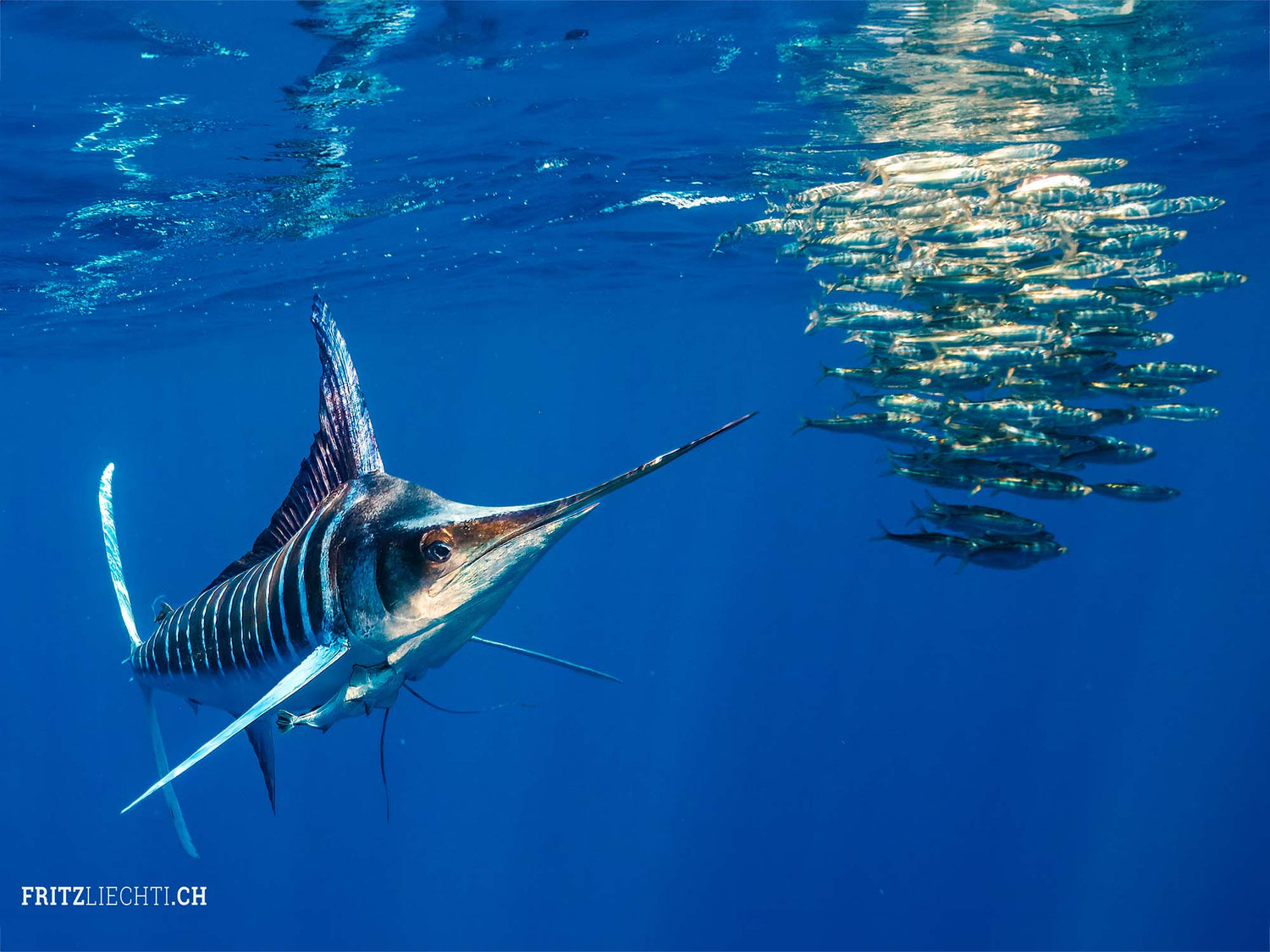
A striped marlin hunting in a big bait ball of sardines. Sardines and marlin change direction at lightning speed. // Canon R5 II with 17-40mm lens at 17mm • 1/640 • f/10 • ISO 1250 © Fritz Liechti
Yes, it's exhausting to keep jumping into the water, maybe take a few photos, or see no fish or sea lions at all because they've already gone, and then swim and climb back into the boat. During the briefing, the guide clearly stated that we shouldn't get too close to the sardines, otherwise the marlins would disappear, or the sardines would seek shelter around the photographers. Well, this is not so easy. I often swam away from the bait ball and the sardines followed me. I also didn't want to be impaled by a marlin when they shot through the shoal at high speed. The marlins were about as big as me and often looked at me with angry eyes because I was stupidly standing in their way during their attack.

School of burrito grunt. // Canon R5 II with 24-70mm lens at 24mm • 1/125 • f/8 • ISO 400 © Fritz Liechti
We were really fortunate on one of the last days. My colleague said, “There's a whale!” I switched to video, and seconds later a huge whale shot out of the depths toward us like an express train. Six to eight meters (19-26 feet) in front of us, it shot through the school of sardines with its mouth open, rose a few meters into the air, and crashed back into the water on the other side of the school. Mathilde, another diver in our group, was hit on the shoulder by the whale. It was a fin whale, about 15 meters (50 feet) long, weighing about 14-18 tons. Mathilde was really lucky she wasn't seriously injured.

A few times I also saw a humpback whale swimming beneath me. // Canon R5 II with 15-35mm lens at 15mm • 1/200 • f/9 • ISO 500 © Fritz Liechti
Sharks at Revillagigedo Islands
We then took another dive safari boat far out into the Pacific to the Revillagigedo Islands. These consist of three islands (Socorro, San Benedicto, and Roca Partida) and are located about 450 kilometers (280 miles) southwest of Cabo San Lucas in the Pacific.

Galápagos shark. Yes, I know - never cut the tail off when you take a picture of a fish but when they are so close it's hard to get a photo of the whole fish. // Canon R5 II with 24-70mm lens at 35mm • 1/160 • f/11 • ISO 500 © Fritz Liechti
There, I was finally able to dive and take photos in peace without having to swim around like crazy in the sea. Unfortunately, the water was mostly cloudy and visibility wasn't very good. So, I set the ISO high and reduced the exposure time slightly so that the strobes could operate at low power and the backscatter was less illuminated.
READ MORE: How to Shoot Underwater in Low Visibility and Backscatter

White tip reef sharks are tired during the day as they hunt mostly at night. With the big waves and the current it's not easy to take pictures. // Canon R5 II with 15-35mm lens at 24mm • 1/100 • f/7.1 • ISO 400 © Fritz Liechti
The current and waves were quite strong at times, but after a few thousand dives, you can handle that too. We saw several species of sharks, including Galápagos, silky, hammerhead, white tip reef, and tiger sharks. In between we were visited by dolphins and often had large manta rays around us.

A big black/white manta ray. Autofocus was happy to have these white parts on the belly, otherwise it would be difficult to focus on a huge black fish in front of me. // Canon R5 II with 15-35mm lens at 18mm • 1/200 • f/7.1 • ISO 400 © Fritz Liechti

As a special challenge I was asked by a Swiss watch manufacturer to do a shoot with a new type of dive watch that features a mechanical decompression display (Bühlmann Decompression 02). // Canon R5 II with 15-35mm lens at 15mm • 1/125 • f/9 • ISO 400 © Fritz Liechti
Tips for Shooting the Sardine Run
- If you can, visiting in October/November to see the sardine run is a must. It’s amazing to see striped marlins and sea lions hunting. Join Brandi Mueller on her expedition to Magdalena Bay in November 2026.
- To photograph super-fast marlins nearby, you need a Tv-setting (Shutter Priority) of approximately 1/500 – 1/800, otherwise you will get motion blur. If the fish are further away or slowly swimming, you can use a slower shutter speed, lower ISO, and higher aperture.
- Program different basic settings in your camera to your custom settings so you can super-fast change fast action to slower shots and back again.
- Check that your camera has positive buoyancy, like that you are not worrying to drop it. You can also use a small lanyard on your arm.
- For lenses, I first used the 8-15mm. However, the fish were then too far away. After that, I mostly used a 15-35mm to bring the details closer.
- With apnea (freediving) fins you are a faster swimmer than with heavy diving fins. You will be swimming a lot!
- Keep a distance to the bait ball of approximately 6 meters (20 feet) or more, otherwise you will scare the marlins away. Don’t freedive under the bait ball. Otherwise the marlins and sea lions are gone.
- When you see a whale near the sardines, swim away as fast as you can. You don’t want to be the guy swallowed by a whale.

My buddy Stephane, a young French Ikelite photographer diving in Socorro. He's a great photographer. // Canon R5 II with 15-35mm lens at 15mm • 1/125 • f/9 • ISO 500 © Fritz Liechti
Additional Viewing
Underwater with the Sardine Run at Magdalena Bay with Brandi Mueller [VIDEO]
Return to Revillagigedo: A Research Expedition with Marine Megafauna Foundation
Behind the Lens: Pelagic Sharks in Cabo San Lucas with Josh Blank
River Junkie: Underwater Photography in the Freshwaters of Switzerland
Looking for the Beauty and the Beast: A Trip to Raja Ampat and West Papua Indonesia
Diving into the Verzasca River, Switzerland [VIDEO]
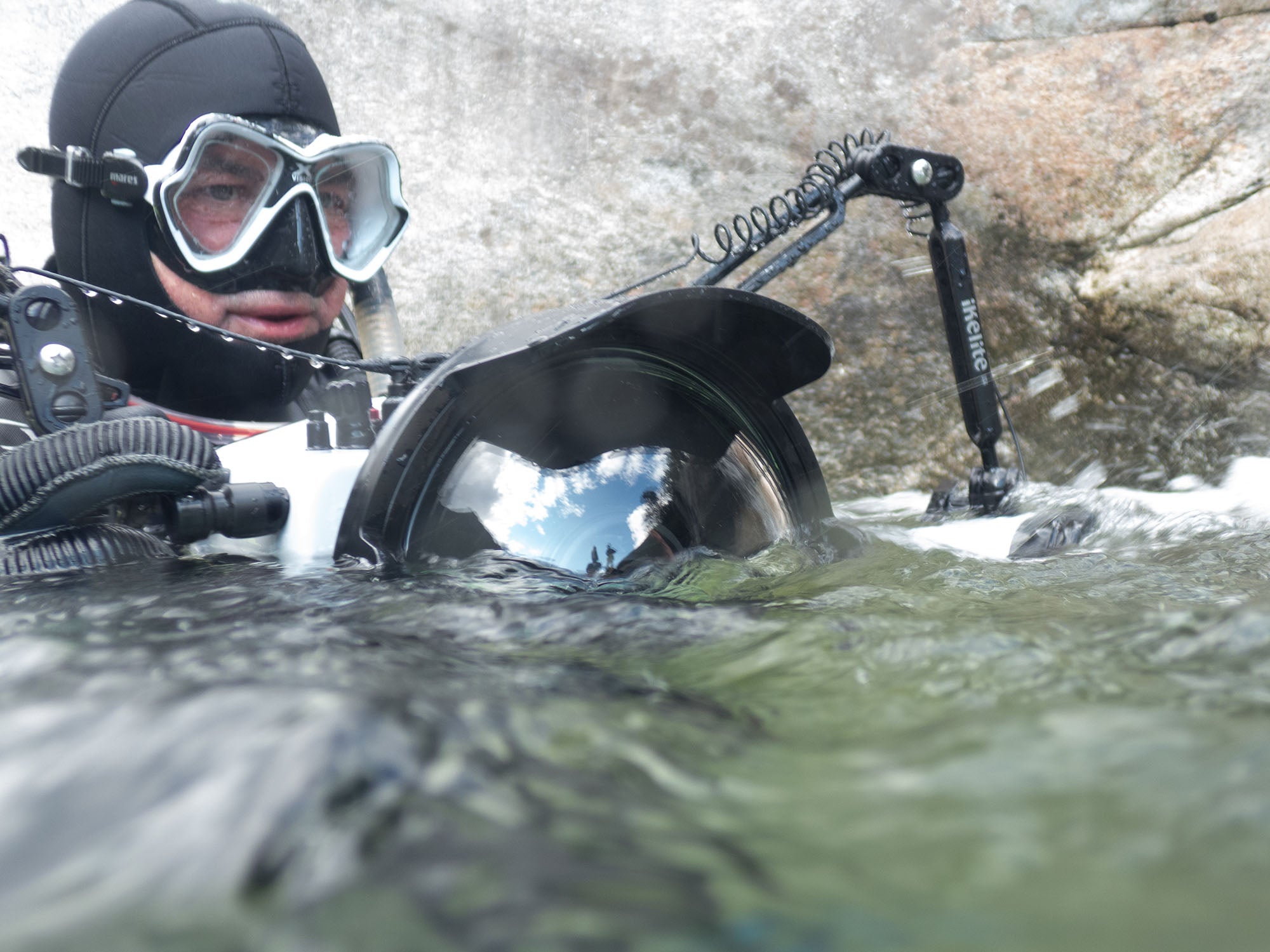
 Fritz Liechti of Switzerland started diving in 1986 and rarely goes into the water without a camera. He particularly enjoys diving in Switzerland's rivers, especially at night. He travels the world and teaches underwater photography as a CMAS (World Confederation of Underwater Activities) Diving and Underwater Photo Instructor. He has had his work published in several magazines and represented Switzerland in the 2019 CMAS Underwater Photo World Championships. See more of his work at www.fritzliechti.com