
By Gary Burns
Recently my dive buddies and I embarked with our families on a vacation to Belize in Central America. Personally, this was our first trip to Belize, we stayed at the beautiful Hamanasi Dive Resort about 2 hours south of Belize city. The plantation type accommodation site focuses on underwater diving and on unique land adventures.
Belize was once the heartland of the Mayan civilization; the country changed its name from British Honduras to Belize in 1973. The country is a top diving destination with the world's second-longest barrier reef stretching 185 miles, offering warm waters, good visibility, and diverse marine life year-round.

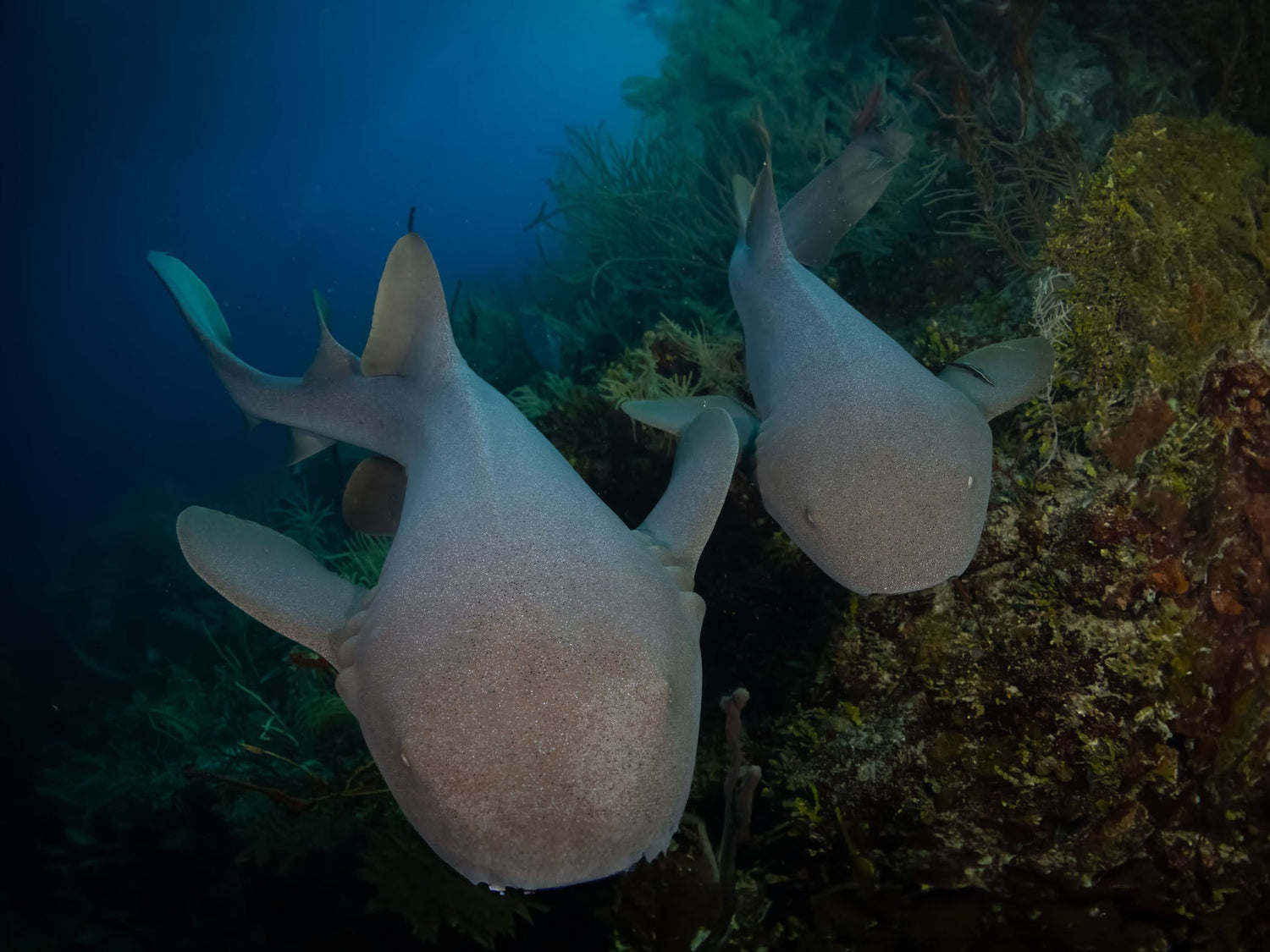
Nurse shark swims over the reef. Image taken with Canon R5 with dual RC165 strobes. © Gary Burns
The Belize barrier reef has been named a UNESCO site world heritage site in 1996. The main recreational diving attraction, and diver’s bucket list dive, is the iconic 10,000-year-old “Blue Hole”. The coral reef features many species of marine life, including nurse sharks, reef sharks, loggerhead turtles and eagle rays.

Nurse sharks make great photographic subjects. In Belize they're quite used to divers so expect them to get close. Image shot with Canon R5 and Ecko Fiber strobes. © Gary Burns
The dive resort is ideally suited for recreational divers and is well orientated for organized boat diving. This gave my dive colleagues and I the perfect opportunity to review and experience the new compact Ecko Fiber Strobe to the professional end RC165 Strobe. Both strobes feature native fiber optic compatibility.
SEE MORE

Even in less-than-perfect conditions, you can still get incredible shots by angling your strobes to minimize backscatter and using good editing software and techniques in post. Read my article First Results // Topaz Photo AI Enhancement of Underwater Images to learn more about my editing techniques. © Gary Burns
Shark Encounters
I was advised by the dive master that large nurse sharks would be present throughout the dive profile.
Jumping overboard, then having the camera being passed down, we headed 60 feet (18 meters) down to the ocean floor. As per the diver master’s instructions we soon encountered a 10 foot (3 meters) long nurse shark, followed by four of its family members that were even larger sharks.
After several deep breaths to calibrate myself into this unique environment, surrounded by sharks, I started taking my first shots using the new optical system. The nurse sharks are very good photographic subjects and are not shy. They approach you from all directions in ones and twos. At first, the bombardment of large sharks can be quite intimidating as they can be unpredictable, but you eventually understand that they are used to being around divers.

Though less docile than the nurse sharks, reef sharks were photogenic all the same. Image shot with dual RC165 strobes. © Gary Burns
Eventually, I realized that we would be followed throughout the dive by a 13 foot (4 meter) equivalent of a golden retriever, who was very inquisitive to every action, while trying to focus on smaller creatures in the coral beds. So, I decided to focus directly on the nurse sharks to see what different and creative image settings I could take to showcase these magnificent creatures and the RC165 strobe lighting performance.

On the third day my dive buddies experienced an interesting encounter with two reef sharks. In the past diving with reef sharks has been a cautious and enlightening experience. However, during this dive, my dive buddies and I experienced some aggressive behavior of the two sharks. We noticed that the larger of the two sharks demonstrated a twitching motion and came close to each diver individually. Collectively, we all moved from the scene, as we believed that this was a territorial display of dominance.
 The shark in question was kind enough to allow me to take his picture and is shown above. © Gary Burns
Camera Settings for Sharks
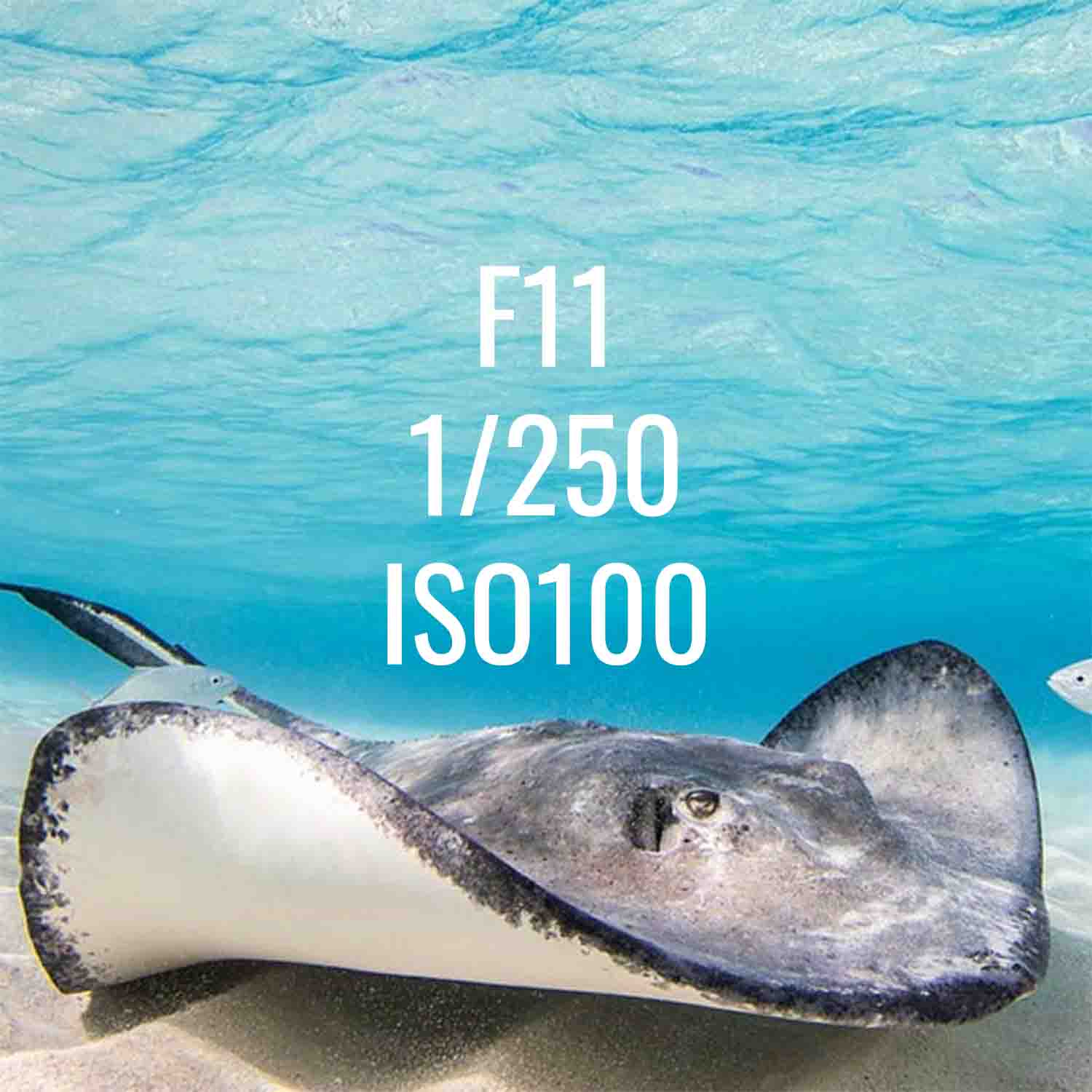
Strobe position and camera exposure is key to finding the optimal settings to capture the agile and extremely fast-moving sharks. I started with the following camera settings: shutter speed 1/160, aperture f/11, ISO 100 this has always been my baseline, boiler plate setup. However, I did change mainly the aperture setting based on the lighting and depth of field situations.

My dive buddy Scott Shew snapped this photo as I was photographing a large nurse shark using the Canon R5 with Ecko Fiber strobes. © Scott Shew
The conditions in Belize were good, however there was a lot of particulates in the water, which is the nemesis of any underwater photographer due to backscatter in the resulting images. Fortunately, with today’s modern software tools backscatter can be removed to a degree within post processing editing of the images.
Equipment Used
- 200DL Underwater Housing for Canon EOS R5 Mirrorless Digital Camera # 71764
- RC165 TTL Underwater Strobe Fiber Optic # 40116
- Ecko Fiber Underwater Strobe # 40101
- TT5 Canon TTL Fiber Optic Transmitter for DL and DLM Underwater Housings # 44701
Additional Viewing
Upgrading to Fiber Optic TTL // Shooting the Canon R5 with Ecko Fiber and RC165 Strobes
Ecko Fiber a Year in Review // Compact TTL Underwater Strobe [VIDEO]
Advice from the Pros // Photographing Sharks Underwater [VIDEO]
Featured Customers | Kevin Quischan Belize My Travels
Photographing the Ethereal Egg-Yolk Jellyfish
First Results // Topaz Photo AI Enhancement of Underwater Images
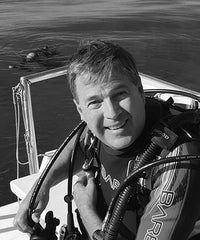 Ambassador Gary Burns is an underwater photographer and Senior Engineering Fellow at Safran Engines in France. His work discipline has taken him from his homeland of the UK to Canada and the USA to work with leading aerospace engineering teams, developing corporate aircraft, cabin interiors, and state of the art aircraft engine power plants. During his working career he was involved in development flight testing, which is very much like scuba diving. The discipline requires very dedicated rules, which provides unique personal experiences that drives curiosity, a sense of adventure and creativity. Since then his professional aerospace career has taken him to Southern California where he dove on a regular basis in the Channel Islands off Santa Barbara and Catalina. The protected dive sanctuaries and Pacific Ocean kelp forests provide the chance to sharpen photography skills from wide-angle to close-up macro with a wealth of sea life and sunlight beaming through kelp. Read more...