




By Glenn Ostle
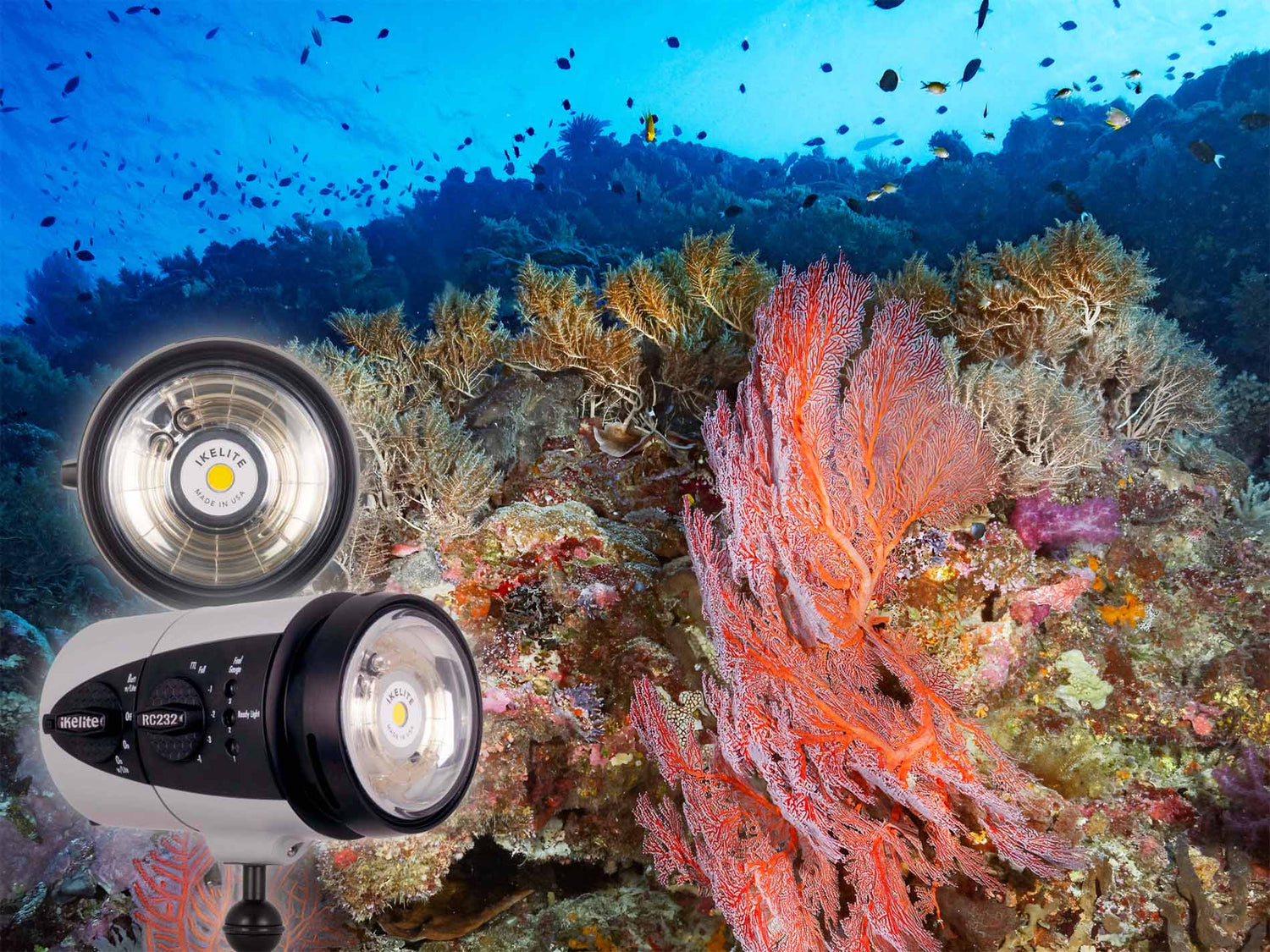
I have been diving with Ikelite strobes (and lights) for more than thirty years and have always been pleased with the amount and quality of light they provide underwater. So, I was delighted to have the opportunity to try out a set of Ikelite’s new RC232 TTL Fiber Optic Strobes with Video Light, on a recent trip to Palau.

Located in the western pacific, Palau is made up of more than three hundred limestone rock islands that are home to some of the most biologically diverse waters on the planet. Here reside some of the world’s richest populations of marine life including more than 1,500 species of fish and 700 species of corals.

My Setup
I currently use a Nikon Z6 camera in a 200DL Underwater Housing and prefer to manually set exposure settings on my DS160 strobes (yep, another old guy who is slow to change!). So, I was anxious to try out the new Ikelite strobes with new improved features.


My rig was already set up to shoot in fiber optic mode which lightens and simplifies my load and makes it easy and safe to detach the strobes when working in or around the water.
The new RC232 strobes support fiber optic TTL shooting for several compatible camera system. But I am a Nikon guy so I couldn’t take advantage of the TTL capability as this feature is not yet available for Nikon or Sony cameras. But Ikelite hopes to soon have TTL Fiber Optic capability for both model cameras by the end of the year. For this trip I set strobe power manually.

Why Palau?
It turned out that Palau was the perfect place to try the powerful new RC232 strobes.
During our days we dove over and around underwater plateaus, up and down walls, in caves and caverns, on World War II wrecks, and through assorted tunnels, channels and holes. We were often delighted to encounter huge schools of fish swimming leisurely by for great image possibilities.

Palau is also home to a large shark population. In 2009 it became the world's first shark sanctuary by banning commercial fishing of the more than 130 local shark species found there. As a result, we saw a lot of sharks on our dives, but many kept their distance. However, the new RC232 strobes were often able to deliver light to some that were quite far away.

I often used the RC232 strobes at their highest setting and they provided all the power I needed, with the ultra-wide 120’ beam angle covering each scene with a pleasing daylight-balanced color temperature.

A mix of Two-spot banded snappers and Goldspot Seabreams over the reef. // Nikon Z6, Nikkor 14-30mm lens • 1/180 • f/8 • ISO 400 © Glenn Ostle
For close-up shots of turtles, corals or small fish, I manually switched to lower settings. And while I didn’t shoot much video, it was convenient to have the option of the RC232 strobe’s on-board 2500 lumens video lights.

A large turtle swims over a coral head beautifully illuminated. // Nikon Z6 • Nikkor 24-70mm lens • 1/125 • f/11 • ISO 560 © Glenn Ostle
Overall, I found the strobes, with their long-lasting time proven NiMH batteries, to be reliable and powerful enough even when pushed to illuminate distant subjects.
Taking burst shots, the strobes recycled quickly providing a number of shots for later sorting. They are a great addition to the Ikelite line and will help many photographers take better underwater photos!

To learn more about the RC232 Fiber Optic with Video Light strobes, I'd strongly recommend Josh Blank’s article 5 Reasons Why I Switched to RC232 Fiber Optic Strobes + Video Light for more insights.


Glenn's Gear
- Nikon Z6 Mirrorless Camera
- 200DL Underwater Housing for Nikon Z6 # 71063-DLX
- NIKKOR Z 14-30mm f/4 S Lens
- NIKKOR Z 24-70mm f/4 S Lens
- Dual RC232 TTL Underwater Strobe with Video Light [Fiber Optic] # 40123
- Manual Fiber Optic Transmitter # 44700-G2
Additional Viewing
Faster, Brighter, Fiber Optic // Introducing RC232 Strobe + Video Light Hybrid [VIDEO]
Sony a7R VI + RC232 Underwater in Truk Lagoon // AMAZING First Results
Nikon Z 24-70mm f/4 S Lens for Underwater Photography Review & Results
Nikon Z 14-30mm f/4 S Lens for Underwater Photography Review & Results
Cousteau's Aquarium | Sea of Cortez with the Nikon Z6
 Glenn Ostle is an Ikelite Ambassador. He and his partner, Pam Hadfield, live in Charlotte, North Carolina, and travel the world to scuba dive and photograph wildlife. His articles have appeared in a number of publications and his photos have appeared on the covers of a number of magazines. His photos can be viewed at featherandfins.smugmug.com, and he posts photos regularly on Instagram @ostleglenn. Read more...
![Canon R6 V FIRST RESULTS Underwater 7K Footage // 200DL Housing [VIDEO]](http://www.ikelite.com/cdn/shop/articles/canon-r6-v-results-blog-cover_cacc1557-be95-47df-9e68-87626ebd6632.jpg?v=1786111841&width=1280)
![Canon RF 20-50mm PZ FIRST RESULTS // Underwater with the R6 V & R6 III [VIDEO]](http://www.ikelite.com/cdn/shop/articles/Canon-RF-20-50mm-PZ-blog-cover_bb09f07a-b601-4191-b445-a5e3e44bceb3.jpg?v=1787321518&width=2000)
