
By Matt Dowse
After diving in Tulamben, Bali, in 2024, I suggested that we return for another dive holiday, this time with a group of underwater photographers. What started as a small group quickly grew, eventually reaching around 20 people. With that many photographers heading to the same destination, we knew we were in for a fantastic week of diving and underwater photography.
We booked our stay with Matahari Tulamben, a beachfront dive resort located approximately 500 metres (.3 miles) east of the famous USAT Liberty shipwreck. Matahari arranged for their own bus to collect us from Kuta and transport us north to Tulamben. The journey took around four hours, passing through numerous villages and towns as we travelled along Bali’s eastern coast.

Sunrise at the Matahari © Matt Dowse
As we headed further north, the roads became narrower and increasingly busy, so full credit goes to our driver, who handled the journey with impressive skill.
When we finally arrived at Matahari, we were shown to our rooms and had a few hours to unpack, settle in and, more importantly, start preparing our equipment. With ten days of diving, there was plenty to get ready. Cameras, housings, strobes and batteries all needed to be checked before we could finally relax.

Kadek, our expert dive guide // Canon R7 + Tokina 10-17mm Lens at 10mm • 1/100 • f/9 • ISO 320 © Matt Dowse
Tulamben sits on the north-east coast of Bali at the foot of Mount Agung, Bali’s highest mountain and an active volcano rising to 3,031 metres (9,944 feet or 1.8 miles). The mountain provides an impressive backdrop to the area, and we were fortunate to have a fantastic view of it from the resort’s restaurant.
At around 6 pm, we headed down for dinner, where we met the Matahari team who would be looking after us during our stay. After dinner, we were introduced to our dive guides. Ray and I were paired with Kadek, who would be looking after us throughout the trip. We quickly discovered that we had been matched with an excellent guide. Kadek was always ready to help, understood exactly what we were looking for as photographers and had an incredible ability to find even the smallest and best-hidden critters.

My dive buddy, Ray // Canon R7 + Canon RF-S 18-150mm Lens at 18mm • 1/100 • f/8 • ISO 640 © Matt Dowse
Diving
Our check-out dive was on the house reef directly in front of the resort. Entry can be a little challenging because of the rocky shoreline and small waves, particularly when carrying a fully assembled camera system. Fortunately, our guides were always there to help us in and out of the water with our equipment.
The house reef soon became one of our favourite afternoon dives. The amount of small marine life was incredible, and almost every dive produced something new to photograph. For macro photographers, it was a fantastic site, with nudibranchs, shrimp, crabs, squat lobsters and an assortment of small reef fish hiding among the rocks, corals and artificial reef structures.

Royal hitchhikers // Canon R7 + Canon EF 100mm Macro Lens • 1/80 • f/8 • ISO 100 © Matt Dowse
We quickly settled into a routine for the trip. Our first dive was usually around 6:30 am, followed by breakfast. The second dive was around 10:30 am, then we would have lunch before heading back into the water for our final dive at approximately 2:30 pm.
After the afternoon dive, it was time to relax, download and back up our images, charge our camera equipment, prepare everything for the following morning. This became almost as much a part of the daily routine as the diving itself.

Mantis shrimp with eggs // Canon R7 + Canon RF-S 18-150mm Lens at 135mm • 1/80 • f/9 • ISO 100 © Matt Dowse
House Reef
The house reef was surprisingly productive. An artificial reef structure had been installed to encourage marine life to establish itself, and it certainly appeared to be working. The reef was packed with life, and Kadek seemed to possess an almost supernatural ability to find creatures that were virtually impossible to see.
Among the highlights were tiny nudibranchs, squat lobsters, shrimp and a wide variety of reef fish. There was also a turtle that seemed to make an appearance whenever we had our macro lenses.

Hairy squat lobster // Canon R7 + Canon EF 100mm Macro Lens • 1/100 • f/7.1 • ISO 100 © Matt Dowse
The site was particularly well suited to slow, patient photography. Rather than covering a large area, we could spend an entire dive concentrating on a small section of reef, searching for subjects and waiting for interesting behaviour. This suited us perfectly, as we could work at our own pace without feeling rushed.
This is my type of diving and can be incredibly rewarding. You never quite know what you are going to find, and spending time looking closely at the reef often revealed subjects that would otherwise have been completely missed.

Redlip blenny with Randall's pistol shrimp // Canon R7 + Canon EF-S 60mm Macro Lens • 1/100 • f/16 • ISO 200 © Matt Dowse
USAT Liberty Shipwreck
The USAT Liberty was one of the major attractions of the trip and certainly lived up to its reputation. Although the wreck is no longer intact in the way that some famous wrecks elsewhere in the world are, the amount of marine life that has made the Liberty its home is exceptional.
The wreck is spread across a relatively large area, and it is well worth making multiple dives to explore its different sections. Every dive revealed something different, whether it was a new opportunity for interesting fish behaviour or another part of the wreck that we had not previously explored.

Coral rockfish // Canon R7 + Canon RF-S 18-150mm Lens at 50mm • 1/100 • f/7.1 • ISO 400 © Matt Dowse
One of the highlights for me was the number of fish-cleaning stations around the wreck. These provided excellent opportunities to photograph natural behaviour, particularly when larger reef fish arrived to have parasites removed by cleaner fish and shrimp. Waiting beside a cleaning station and watching the interaction between the cleaner and its client could easily occupy an entire dive.
There were also plenty of opportunities for wide-angle photography. The bow and stern provided some excellent compositions, particularly when combined with divers or schools of fish to provide a sense of scale.
On one of our morning dives, visibility was better than 25 metres (82 feet), which completely transformed the wreck. The clear blue water, good available light and the structure of the Liberty disappearing into the distance created some spectacular wide-angle images. It was easy to understand why the Liberty is considered one of Bali’s premier dive sites.

USAT Liberty // Canon R7 + Tokina 10-17mm Lens at 12mm • 1/100 • f/7.1 • ISO 640 © Matt Dowse
One important tip when diving the Liberty is to get there early. The wreck becomes increasingly busy as the morning progresses, with divers and snorkellers arriving throughout the day. An early morning dive not only provides better photographic opportunities but also gives you a much better chance of having sections of the wreck relatively to yourself.
Drop Off
The Drop Off was another site that quickly became a favourite. The reef wall drops away dramatically, providing a completely different environment from the house reef and the Liberty.
The wall was covered in marine life, with sponges, corals and sea fans providing plenty of places for smaller creatures to hide. It was a great site for both macro and wide-angle photography, depending on what we encountered during the dive.
On this trip, just before the drop-off wall started, we encountered a spectacular fish tornado made up of schooling bigeye trevally. The huge school moved as one, creating an incredible underwater spectacle and some fantastic wide-angle photographic opportunities.

Bigeye trevally fish tornado // Canon R7 + Tokina 10-17mm Lens at 12mm • 1/100 • f/7.1 • ISO 100 © Matt Dowse
As with many of the sites around Tulamben, the key was to slow down and let the reef reveal itself. Rather than simply swimming along the wall, we spent time searching the coral and sponges for small creatures. Kadek was particularly good at spotting tiny subjects that most of us would have swum straight past.
The Drop Off also provided excellent opportunities to photograph the reef environment, with the wall disappearing into the blue.
Wreck Slope
The Wreck Slope offered yet another completely different photographic environment. The sloping reef was scattered with marine life and provided plenty of opportunities for macro photography.
As we moved slowly across the slope, we encountered a mixture of nudibranchs, crustaceans and small reef fish. The site rewarded patience, with many of the best subjects being extremely well camouflaged against the reef.

Olivar's squat lobster // Canon R7 + Canon EF-S 60mm Macro Lens • 1/100 • f/29 • ISO 200 © Matt Dowse
The Wreck Slope was another site where Kadek’s experience really made a difference. He would locate a tiny subject and then spend time pointing out its position so that we could all get a chance to photograph it. For a underwater photographer, having a guide willing to spend time finding and showing tiny subjects was invaluable.
Batu Niti
Batu Niti provided another productive dive site and continued the theme of Tulamben’s incredible variety of small marine life. The bottom topography offered plenty of hiding places for critters, and once again the key was to slow down and carefully examine the reef.

Warty anglerfish // Canon R7 + Canon EF 100mm Macro Lens • 1/100 • f/11 • ISO 250 © Matt Dowse
It was the sort of dive where you could cover very little distance but still come back with a full memory card. Every rock, sponge and patch of coral seemed to have the potential to contain another photographic subject.
This was exactly the type of diving we had come to Tulamben to experience.
Seraya
Seraya was another highlight for macro photography. We had been told that there were pygmy seahorses at the site, so we were particularly keen to find them.
At around 27 metres (88 feet), Kadek pointed out a pair of pygmy seahorses living on a sea fan. Finding them was certainly the highlight of the dive. At that depth, however, we did not have a great deal of bottom time, so we had to make the most of the opportunity and work quickly to get our images.

Pygmy seahorse // Canon R7 + Canon EF-S 60mm Macro Lens • 1/100 • f/16 • ISO 100 © Matt Dowse
Seraya also offered the artificial reef in the shallower water. Rather than looking for a spectacular coral formation, we were searching for tiny animals that are hidden in the reef and could be remarkably difficult to spot.
Once again, Kadek’s ability to find subjects was invaluable. What initially appeared to be an empty patch of artificial reef could suddenly produce a nudibranch, shrimp or another tiny creature.
The dark sand also provided excellent photographic backgrounds, allowing the subjects to stand out and making it possible to create clean, uncluttered images.

Harlequin shrimp // Canon R7 + Canon RF-S 18-150mm Lens at 150mm • 1/80 • f/8 • ISO 200 © Matt Dowse
Melasti
Melasti provided another change of scenery and was another enjoyable site to explore with our cameras. We had come to Melasti specifically looking for the donut nudibranch, which Kadek was able to locate easily.
On our second dive, we had the challenge of photographing Shaun the Sheep nudibranchs. This proved much more difficult due to their tiny size and the current, which had picked up at the site. Keeping the subjects in the frame and maintaining focus while dealing with the movement of the water certainly tested our patience and photography skills.
During our safety stop, we encountered an octopus, which was a great way to finish the dive.

Mosaic longarm octopus // Canon R7 + Canon EF-S 60mm Macro Lens • 1/100 • f/16 • ISO 320 © Matt Dowse
One of the great advantages of spending ten days in the same area was that we could return to sites and look for subjects we had missed previously. We were not simply trying to see everything in one dive; we had the luxury of time to slow down and explore.
Boat Dives to Alam Anda
The boat dives to Alam Anda gave us the opportunity to explore reefs that were not accessible from shore.
After several days of shore diving, getting onto a boat was a welcome change. It also allowed us to explore sites that would otherwise have been difficult to reach.

Line-legged hermit crab // Canon R7 + Canon EF-S 60mm Macro Lens • 1/100 • f/16 • ISO 320 © Matt Dowse
The diving continued to provide plenty of photographic opportunities, with a mixture of reef life and larger environmental scenes. On our second dive, Kadek showed us another pygmy seahorse living on a sea fan at around 20 metres (65 feet).
The shallower depth gave us considerably more time with the seahorses, allowing us to slow down and compose our images more carefully. Because we had been told beforehand that we were likely to encounter pygmy seahorses, we had changed to our macro lenses before the dive, which proved to be the right decision.

Geometric goniobranchus nudibranch // Canon R7 + Canon EF-S 60mm Macro Lens • 1/100 • f/29 • ISO 100 © Matt Dowse
The Photography
One of the best things about travelling with such a large group of underwater photographers was the amount of experience within the group. Everyone had different interests and approaches to photography, and it was fascinating to see how people interpreted the same subject in completely different ways.
Some photographers concentrated almost entirely on tiny macro subjects, while others were looking for larger reef scenes, fish behaviour or wide-angle. The same dive could therefore produce completely different collections of images.

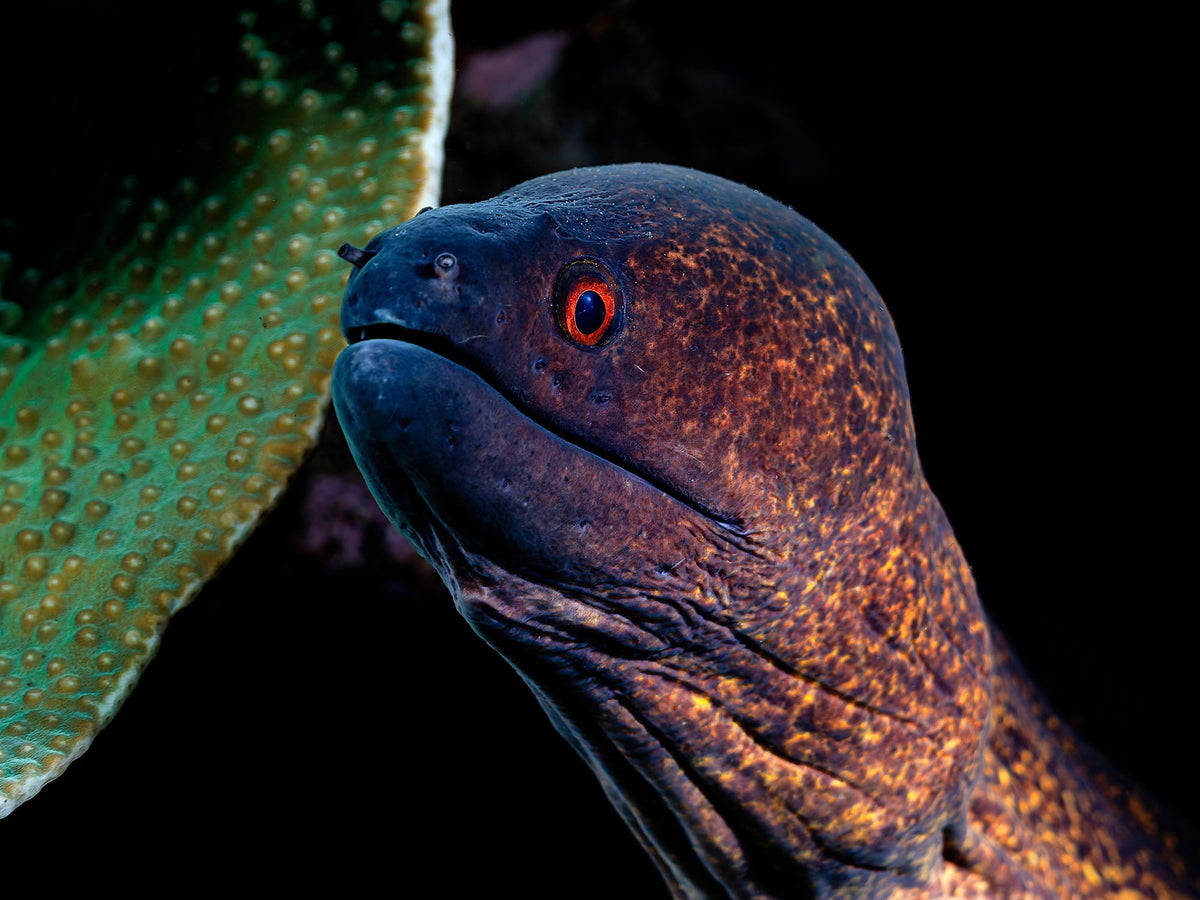
Yellowmargin moray eel // Canon R7 + Canon RF-S 18-150mm Lens at 79mm • 1/80 • f/8 • ISO 100 © Matt Dowse
For me, the combination of macro and wide-angle opportunities was one of the biggest attractions of Tulamben. One dive could involve searching for a tiny nudibranch, while the next could involve photographing the Liberty in more than 25 metres (82 feet) of visibility.
There was also plenty of time over dinner to discuss, compare and help each other solve problems that come with underwater photography. With around 20 photographers carrying a huge variety of cameras, there was always someone with an idea or solution.
The trip was also a great reminder that underwater photography is not just about the final image. A large part of the enjoyment comes from the search, the interaction with the marine life, the challenge of getting the shot and sharing the experience with others.

Two-horn box crab // Canon R7 + Canon EF 100mm Macro Lens • 1/100 • f/11 • ISO 100 © Matt Dowse
Final Thoughts
Overall, the diving around Tulamben proved to be exactly what we had hoped for. With easy access to the Liberty, a highly productive house reef, the Drop Off, muck sites and numerous other nearby locations, there was more than enough variety to keep a group of underwater photographers busy for ten days.
And, of course, Matahari guides made a huge difference. They quickly learned what each of us was looking for and seemed to know where every small critter was hiding. For photographers, having a guide who understands that you might spend ten minutes photographing a subject that is only a few millimetres (less than 1 inch) long is invaluable.

Skeleton shrimp // Canon R7 + Canon EF-S 60mm Macro Lens • 1/100 • f/22 • ISO 200 © Matt Dowse
The staff at Matahari also played a huge part in making the trip so enjoyable. From the accommodation and restaurant to the dive operation and support staff, everything worked together to make life easy for such a large group of photographers.
What started as a small idea for a return trip to Tulamben had turned into a large group adventure, but it proved to be a good decision. Great diving, incredible marine life, endless photographic opportunities and, most importantly, a great group of people made Tulamben 2026 a trip I will remember for a long time.
After ten days of diving, 3.5k of images and plenty of stories to take home, I think it is safe to say that Tulamben had once again delivered. The only real question now is, when do we go back?

Trumpetfish and grouper // Canon R7 + Canon RF-S 18-150mm Lens at 70mm • 1/100 • f/7.1 • ISO 400 © Matt Dowse
Matt's Gear
- Canon EOS R7 Mirrorless Camera
- Canon RF-S 18-150mm F3.5-6.3 IS STM Lens
- Canon EF-S 60mm f/2.8 Macro USM Lens
- Canon EF 100mm f/2.8L Macro IS USM Lens
- Tokina 10-17mm f/3.5-4.5 Fisheye Zoom Lens
- 200DLM/D Underwater Housing for Canon EOS R7
- DS160 and DS161 TTL Underwater Strobes
Additional Viewing
Featured Customers | Matt Dowse From the Canon 7D to the Canon R7
From Sunbursts to Sea Slugs: The Versatility of Canon RF 18-150mm Underwater
Beqa Island: An Underwater Photographer's Dive into Fiji's Wild Side
Canon RF-S 18-150mm Lens Underwater Photo Gallery // North Solitary Island, Australia
Black Sand and Ghosts of Coral: A Photographer's Dive into Tulamben

Matt Dowse is an electrician, diver, and underwater photographer. He has been diving since 1990 and completed his PADI Divemater's course in 2008. He's been a Canon DSLR 7D shooter since 2010 and recently upgrade to the Canon R7 mirrorless system which he pairs with the Ikelite DS160 dual strobes. When he's not traveling to dive you can find him at the Swansea Bridge. Follow Matt on Instagram @matt.d71, watch Matt and his colleague Pete's underwater videos on their YouTube channel, Vimeo, or check out Matt's Redbubble page.

