
By Gary Burns
Some of my most memorable moments and experiences underwater in the Caribbean islands have come from encounters with octopuses. Octopus are not always easy to find in the underwater landscape. One moment I can be looking directly at a section of reef and see nothing unusual then, suddenly, I notice two eyes looking back at me.
This occurred recently on a trip to Grand Cayman. We were exploring a part of the Turtle Reef dive site at Macabuca Tiki Bar . The area was an underwater coral garden that we could swim through and observe the local fish species, when we came upon a rock formation.
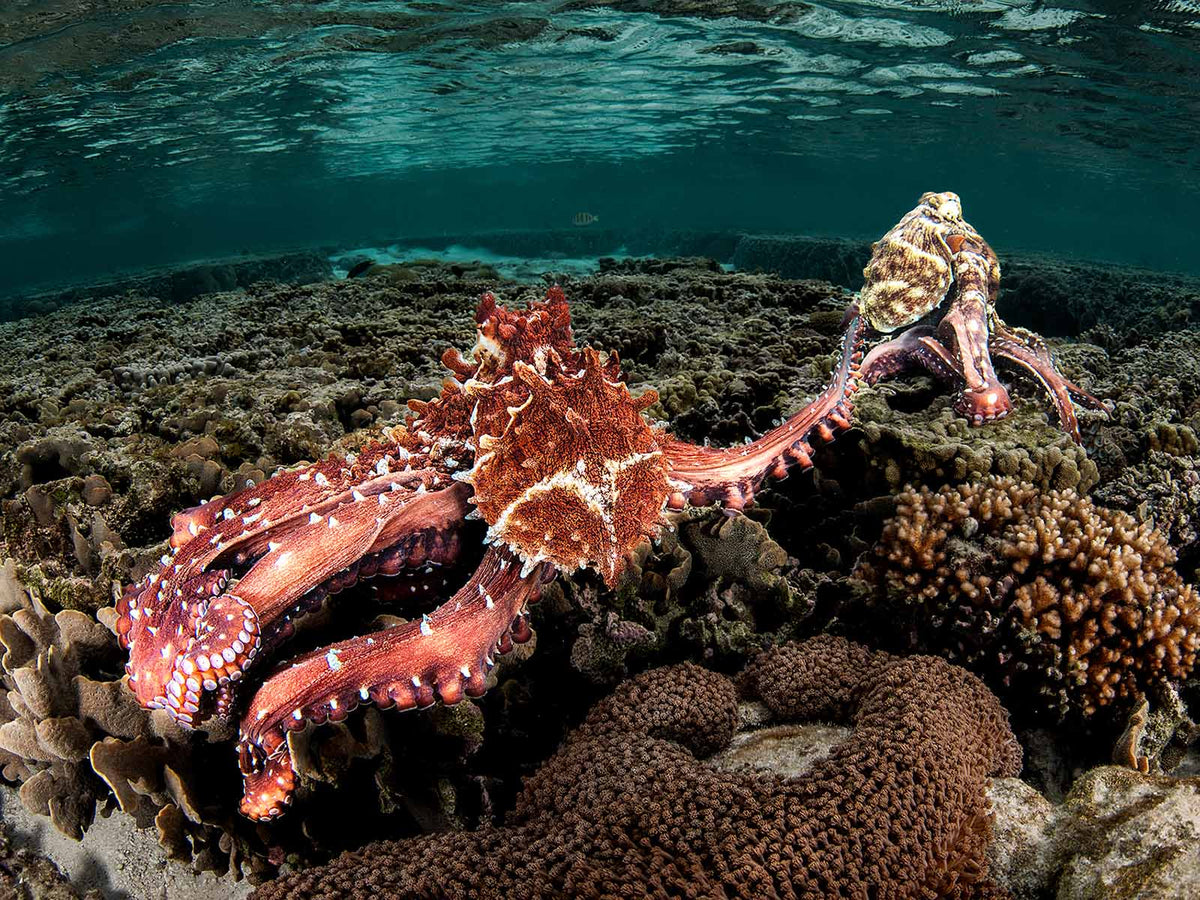
The octopus perched on top was so well camouflaged that it was difficult to see until dive buddy pointed it out. This gave us the opportunity to photography the octopus who was very happy to be a model for a short period while it swam from coral head to coral head.
SEE MORE: How to Take a Great Octopus Photo [VIDEO]
During another dive at the same site, my dive buddy pointed out an octopus den in the shallows. The entrance to the den was marked by broken shards of beautiful shells, which can be a good sign that an octopus has made its home nearby. We had the opportunity to capture the octopus during its afternoon nap. However, we also became aware that there was more than one octopus in the surrounding neighborhood. It was displaying all of its tentacles prior to going out to hunt for prey.

An octopus adventures out on the reef while blending in with its sandy surroundings. © Gary Burns
Octopus's Garden
Octopuses are really amazing builders, their “nests” are better described as dens, or shelters. Many octopuses choose a natural rocky hole, or a crevice, in the reef as a home. Skillfully, they then modify the local area around the entrance to create their own designed garden. For this, they'll collect pieces of broken shells, coral fragments, rocks. I also believe that the shells are the remnants of a previous juicy meal. Using their arms and suckers, they carry and position these objects around the den, to customize their own personality. The rock or shell garden forms a protective wall or barrier, making the entrance smaller and more difficult for predators. It also provides the octopus camouflage for blending into the surrounding reef. I am to understand that an octopus may repeatedly rearrange its shelter, particularly after feeding or when it feels threatened.

An octopus hides stealthily in a rocky crevice. © Gary Burns
Octopus Anatomy and Life Cycle
An octopus is a marine invertebrate, which means it has no backbone. It belongs to the cephalopod group of mollusks, along with squid, cuttlefish, and nautiluses. Its soft body, eight flexible arms, and highly developed eyes make it one of the most fascinating animals on the reef.
Each arm is lined with suckers that help it grip surfaces, explore its surroundings, and handle food. Octopuses are carnivores and usually hunt crabs, shrimp, lobsters, small fish, and other shellfish. They may use their arms to pull prey from cracks in the reef, or they may ambush it while hidden by camouflage. Their sharp beak can break through the shells of crustaceans, while their saliva helps subdue and digest prey.

An octopus goes on a walkabout on the reef. © Gary Burns
Octopuses generally have short lives. Depending on the species, many live for only about one to two years, although some larger species may live longer. Their life cycle is intense: they grow quickly, mature, reproduce, and then die soon afterward. In many species, the female guards her eggs without eating until they hatch, and she dies shortly after the young emerge.

If you're interesting in learning more about octopuses, My Octopus Teacher is a great documentary that I learnt a lot from the experiences the documentary described. © Gary Burns
Photographing Octopuses
Photographing an octopus with the Canon R5 inside the 200DL Underwater Housing is a very different experience from photographing a stationary subject. The octopus is constantly watching, changing, and reacting to its surroundings. Its skin can change color and texture almost instantly, allowing it to disappear against the reef or sand. Its arms move independently, creating an endless variety of shapes and expressions.
When I am lucky enough to spot an octopus, I try not to rush to take its picture. I have found if you settle down a short distance away, adjust the camera and strobes, and simply watch how the octopus moves, in a lot of cases, they will swim to another rock formation and change their appearance. However, the key to success is patience. If I move too quickly, the octopus may retreat into a hole or become difficult to photograph. If I remain still, it often becomes curious and continues with its normal behavior.

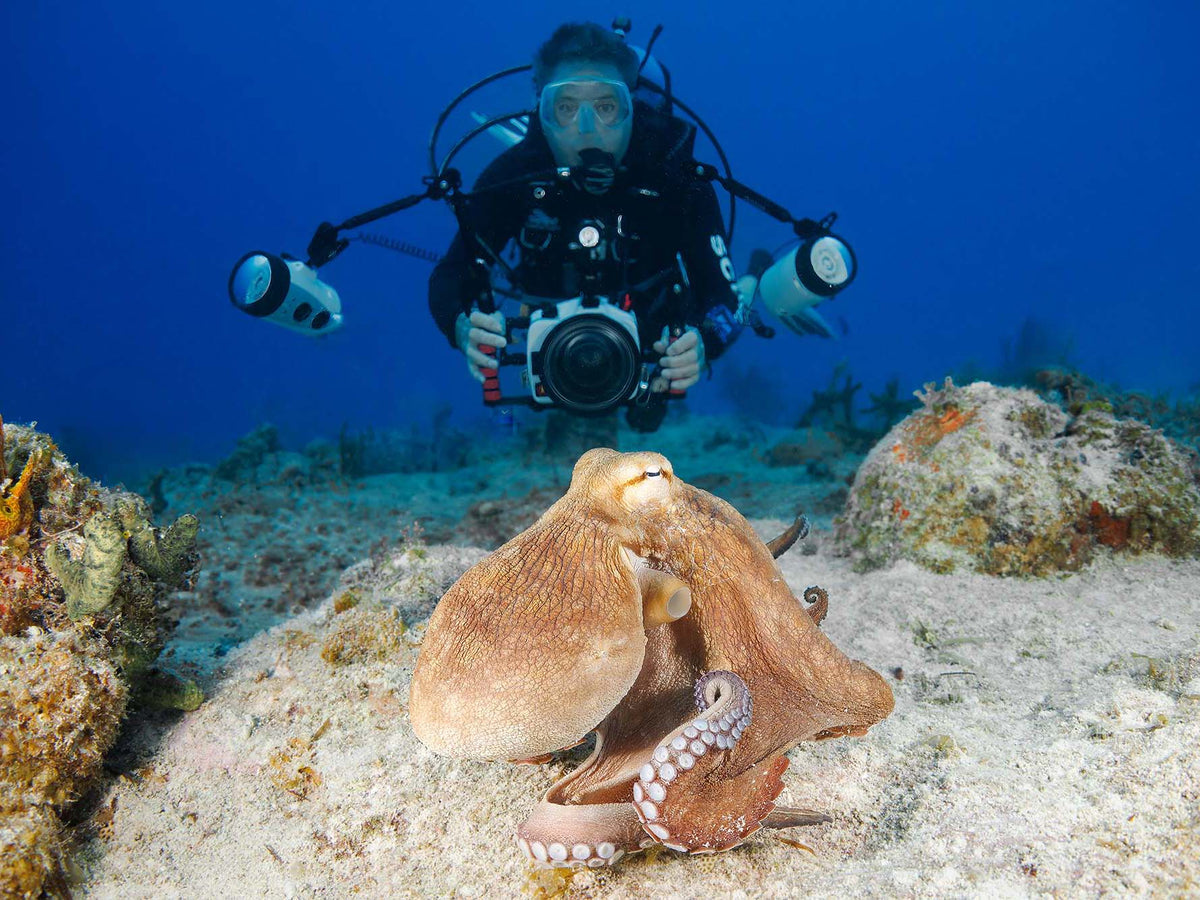
Patience is the key to a good octopus image. Approach slowly and give the octopus time to warm up to your presence. © Gary Burns.
The Canon R5 and RC232 TTL Underwater Strobes allows me to capture details that are difficult to appreciate while diving — the texture of its skin, the remarkable detail around its eyes, and the subtle changes in color running across its body. With the strobes positioned correctly, those details come alive against the blue, Caribbean water.
What I find most fascinating is the octopus’s ability to seemingly transform itself. It can blend into a rock one moment and then become almost completely different as it moves across the reef. Watching this through the viewfinder while trying to anticipate the right moment for a photograph can be both challenging and exciting.
For me, the best octopus photographs are not necessarily the technically perfect ones. They are the photographs that capture a moment — an eye looking directly into the lens, an arm reaching across the reef, or an animal revealing itself after being almost invisible. Those encounters are what keep me looking carefully at the reef on every Caribbean dive. You never know when two eyes are going to appear and remind you that you are sharing their world.

You may find an octopus curled up in a crevice or sprawled like an umbrella on the reef. Their many shapes and colors are what make photographing them so interesting. © Gary Burns
Additional Viewing
How to Take a Great Octopus Photo [VIDEO]
Understanding Octopuses for a Friendly Photographic Experience
Octopus Underwater Camera Settings and Technique
Upgrading to Fiber Optic TTL // Shooting the Canon R5 with Ecko Fiber and RC165 Strobes
Trading up from the Canon EF 8-15mm to the RF 7-14mm Fisheye Lens
 Gary Burns has spent his life exploring two very different worlds, united by a common curiosity: understanding how things work and discovering what lies beneath the surface. His aerospace engineering career began in Canada in 1979 with Canadair, continuing with Bombardier Aerospace until 2015 and now with Safran Engines located in France. His other lifelong passion is scuba diving and underwater photography beginning in 1976. As an Ikelite Ambassador Gary enjoys documenting marine life, especially octopuses, sharks, and turtles. Every encounter is a reminder of how much there is to learn about the natural world. Whether investigating the complex physics of aerospace engineering or photographing marine life in the Caribbean, Gary is driven by the same curiosity and finds there are always opportunities to share the extraordinary things he encounters along the way.