


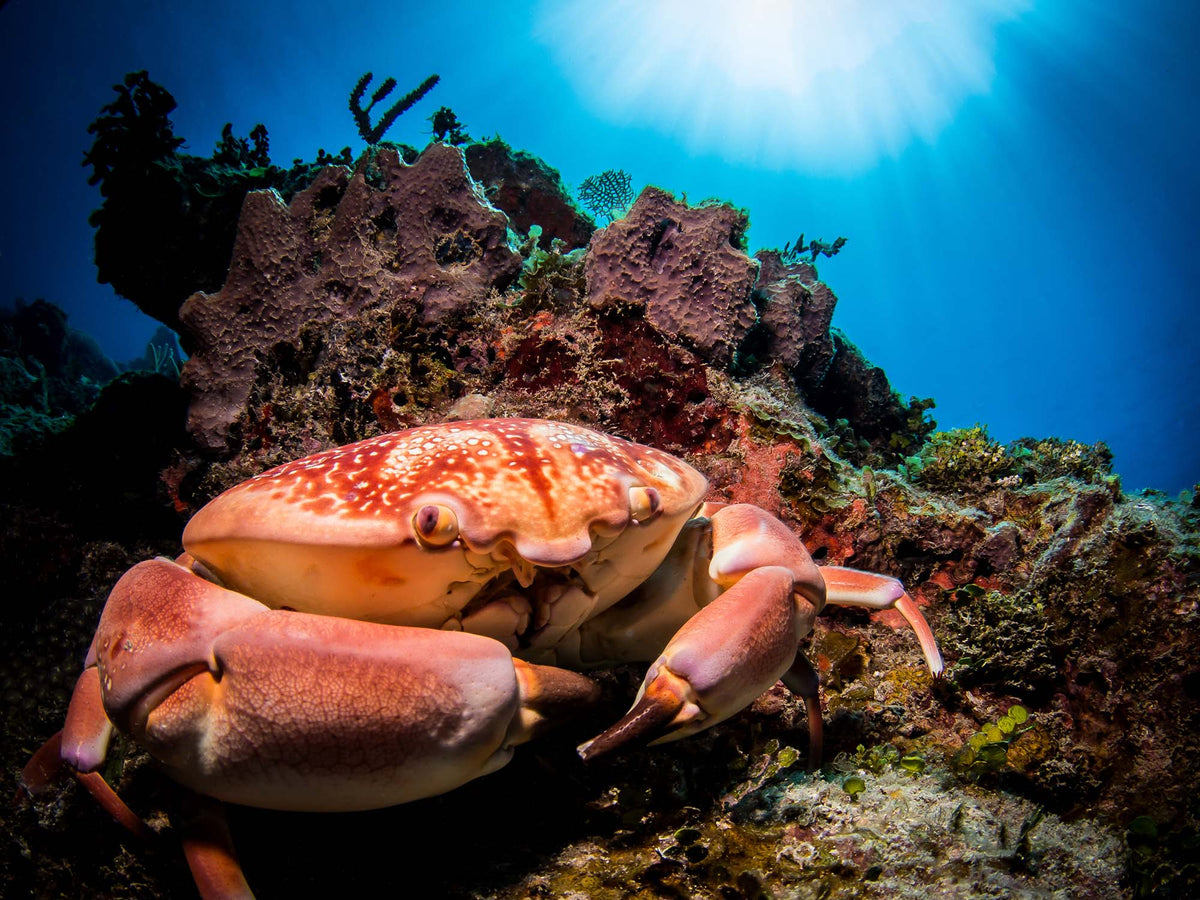
Crabs come in many different sizes, colors, and shapes, from the giant spider crabs you might see on a night dive, to tiny coral crabs the size of a pencil eraser. Use these camera settings, tips, and techniques to make your next encounter with a crab picture perfect.

1/100 • f/32 • ISO 200 © Steve Miller
Where
While most crabs are found primarily in saltwater environments, about 15% of crab species can be found in freshwater. There are even a small number of species that live predominantly on land and return to the ocean only to release their eggs. You're most likely to find crabs along shallow coastlines, intertidal rocky areas, jetties and piers, rocky crevices, holes in reefs, anemones, in brackish estuaries, and some of the bigger species inhabit the colder, deep sea.

1/100 • f/32 • ISO 200 © Steve Miller
DSLR + Mirrorless
Mode: Manual camera, TTL strobes
ISO: 100-200
Aperture: F/8 to F/22
Shutter Speed: 1/125th second
Lens: Macro or super macro for smaller varieties, super wide or fisheye for larger varieties
Strobes: TTL
Point + Shoot
Mode: Auto or AV
ISO: 200-400
Aperture: F/8 to F/22
Shutter Speed: 1/60th to 1/125th second
Strobes: TTL

1/400 • f/18 • ISO 250 © Steve Miller
Technique
Most crabs are nocturnal (though some can be seen during the day), so if you're looking to get some crab images don't skip a night dive. Scan a small area where they typically hide like crevices, under ledges, within sponges, anemones, or within seagrass. Some crabs are great at camouflage so keep your eyes peeled for slight movements that will differentiate them from their immobile surroundings. Approach slowly, once they sense you're not a danger you're in for a treat and they may even lead you to other crabs. The challenge of shooting a well-camouflaged crab is discerning the eye, this is where a macro lens will really come in handy. Get as close as you can without disturbing the animal and aim your camera at an upward angle.
Strobes
Crabs are often spotted in, or next to, some type of cave or crevice that they can retreat to quickly. This means creative lighting and shadow creation is mostly impractical. The challenge will be to even get your light onto them since the strobes are usually off to the side, chances are the substrate around will block your lights. For this reason, the safest way to get your capture is to have the light pointing right down the barrel of your lens port. Start with your strobes this way, then if you get lucky - and the crab is out in the open - you can move your strobes around for back or side-lighting. Don't expect to see this situation often though.

1/100 • f/32 • ISO 200 © Steve Miller
Additional Viewing
3 Lightroom Edits to Make Macro Subjects POP [VIDEO]
Macro Minded: Creating Meaningful Underwater Macro Photo and Video
How to Find Something to Photograph Underwater