
Contributed by Kathleen M. Dudzinski, PhD and John Anderson
Imagine this: Two people and each has an underwater housing in their hands, ready to film dolphins. Same environmental conditions. Same cooperation from the wildlife. Do the goals for their recording purpose make a difference in how they film?
Kathleen: I’ve been recording dolphins on video since 1991. The species has varied, the setting has varied, my goals have been the same: recognize individual dolphins and record their interactions with each other for as long as they are in view. When they leave my view, shift to the next individual or group. This is a “focal follow” method.
John: I’ve been filming wildlife, especially dolphins, underwater since 1995. Like Kathleen, the species and setting may change, but my drive to capture compelling scenes remains.

© John Anderson, Dolphin Communication Project
Indeed, underwater filming of dolphins is how we met - on the first film shoot for the Dolphins IMAX film from MacGillivray Freeman Films, in The Bahamas, in 1997.
We’ve both been drawn to the ocean and her inhabitants, albeit from differing perspectives, for decades. Of course, some documentary films can be very useful to scientists and a scientific perspective in some recordings can be beautiful and can (and has!) made it into entertainment projects. But the two (science and documentary) aren’t always fully interchangeable.

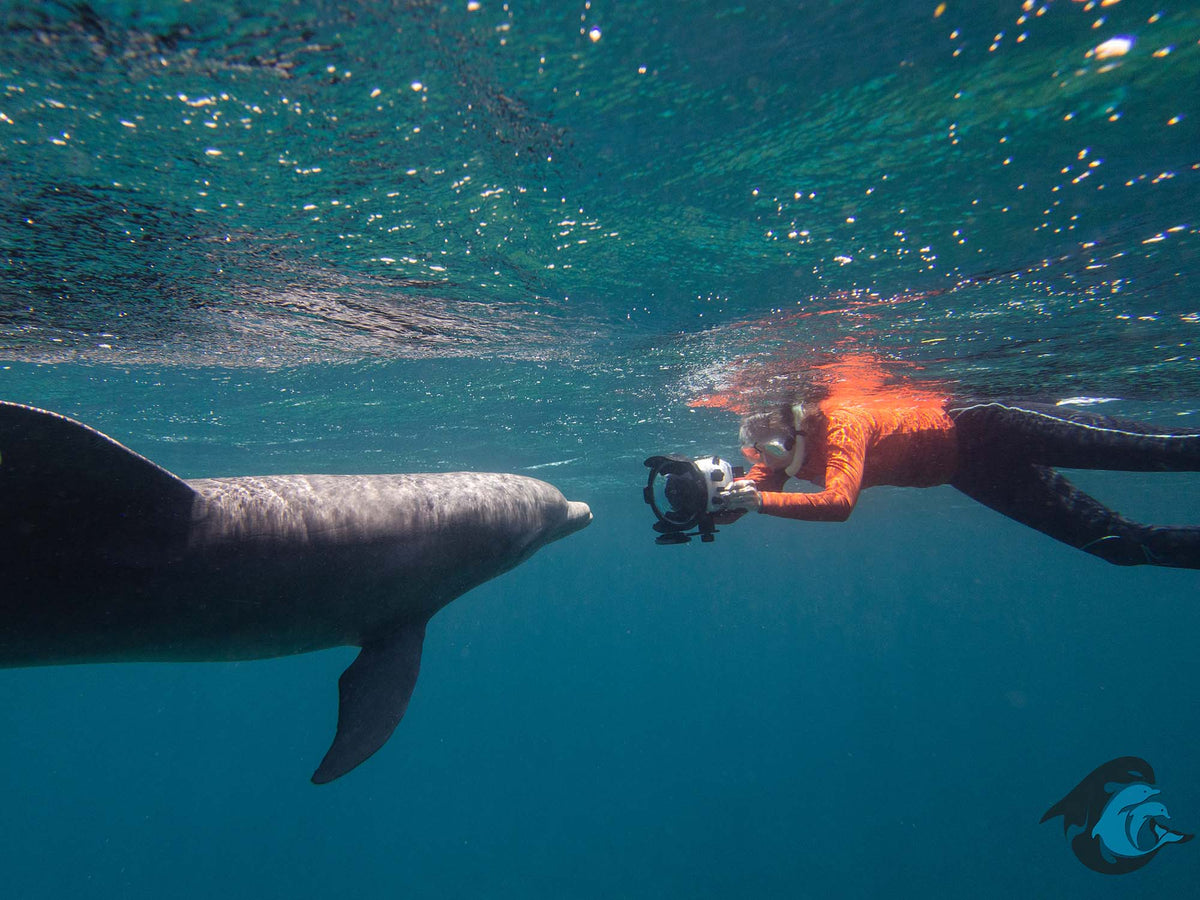
Kathleen filming a dolphin in Roatan, Honduras. © Dolphin Communication Project
Filming for Research
1. Get close, but not too close! We don’t want to impact the animals we observe and record. We also want to see a wider view of the situation, not just super close of one individual or body part.
2. Be sure to film identifying marks. We must be able to tell individual dolphins apart. Knowing who is who facilitates understanding dolphin exchanges and relationships, which are the building blocks of their society.
3. Completely document behavioral exchanges, as often as possible. The light might not always be great, or the composition of the shot might not be feature-film perfect but if you’ve got shared contacts or interactions, keep filming until you can no longer see the animals (that’s the focal follow method mentioned above). This way you can document a sequence for analysis and understanding. In other words, try to get the beginning, middle, and the end.
4. It often looks like two dolphins are touching, but are they? Getting the best angles to confirm touch or posturing and gestures between two animals, or a small group, is important for scientific accuracy. We should never assume a behavior is happening unless we can 100% confirm it on the screen.
These are just a few examples of how film or video recording can aid in science and scientific inquiry.

Kathleen and Manon Themelin on the boat and ready for underwater action with their Ikelite housings. © Dolphin Communication Project
Filming for Documentary or Feature Film
1. Get close. When you think you’re close, get closer! This is often a tool filmmakers try to use (the closer you get, the cleaner your shot) but very often this can fall flat, especially to novice filmmakers because they don’t have the time in the field or an understanding of the animal’s behavior. I’ve been able to accomplish this with dolphins because of my work with Kathleen and Dolphin Communication Project and more than 25 years in the field.
2. Center-of-frame is often a goal for the subject you’re filming but not always. Sometimes shots are intentionally offset, such as when a subject in the foreground is in focus but there’s an additional subject in the background out of focus. This is a perspective shot and it’s one story-telling tool. It lends itself well to a focus-pull where you rack focus from one subject to the other.
3. Pretty is the priority over individual IDs or confirming contact. Compelling imagery will keep a viewer’s attention. You want viewers to stay tuned in so you have time to get your message across.
4. Filmmakers often use high-speed film capture that allows presentation of footage at slow speed. This makes for dramatic sequences that will retain the audience’s attention. Remember, keeping the audience engaged means your message is more likely to be received.
At the end of the day, what scientists and filmmakers need from a video, film, or photo frame may be different, but we hope our work provides the public with both the information and the inspiration needed to protect individual species and their habitats.

© Dolphin Communication Project
Learn More About the Dolphin Communication Project
Dolphin Communication Project blends the goals and mission of both scientific and documentary underwater filmmaking. Learn more via DCP's online educational materials:
Additional Viewing
From Research to Outreach: Underwater Photography as a Tool for Science
Illuminating the Technology of Coral Reef Research
Ocean Conservation in Action // Be an Environmental Influencer [VIDEO]
The Power of Underwater Photography for Ocean Conservation

Kathleen M. Dudzinski, PhD has been studying dolphin communication since 1990 and is the Director of DCP. Her research spans decades and hemispheres and has been featured in films, books, and numerous magazines. John Anderson is a filmmaker and founder of Terramar Productions. He's worked on both IMAX films "Dolphins" and "Amazing Caves". When he's not working on the commercial side of things, John dedicates his time to supporting conservation both terrestrial and underwater. Kathleen and John are married, living on the coast with their beagle. Learn more about Terramar Productions on their website. Learn more about the Kathleen's efforts with the Dolphin Communication Project on the DCP website, and follow their journey on Instagram @dolphincomunicationproject.
![What to Expect When Shooting Underwater at Night [VIDEO]](http://www.ikelite.com/cdn/shop/articles/DUPE_Night_Diving_1_1a6477c4-4074-40a7-bdaa-9ec243dc36b8.jpg?v=1789743906&width=2000)
