

By Jeff Milisen
The serious photography world was once divided into two sides: Canon and Nikon. Then Sony produced the E-mount series, a headfirst jump into mirrorless, which quickly produced the first full-frame mirrorless camera in 2013. The big event came in 2014 when Sony released the a7 and a7R, two cameras that were so good, so revolutionary that they broke the traditional two-party system. Overnight, the photography world divided itself into three competing groups: Canon, Nikon, and Sony photographers. Sony has remained an industry leader ever since.
Sony again reset the standard for mirrorless cameras with the release of the a1 by including a 50MP sensor, 8k video, 30fps continuous shooting, and hyper-advanced autofocus tracking. The a1 II is an improvement on that by way of an articulating screen, pre-capture functionality (taking photos after they happened!), and an AI-assisted autofocus system that claims to be 30% better at recognizing humans and animals and 50% better at recognizing birds. The a1 family has some great genes, and I wanted to trial this newest member somewhere special.
"I’ve used many different cameras in some of the world’s most remote and challenging underwater environments, and the Sony a1 II is a technological wonder."

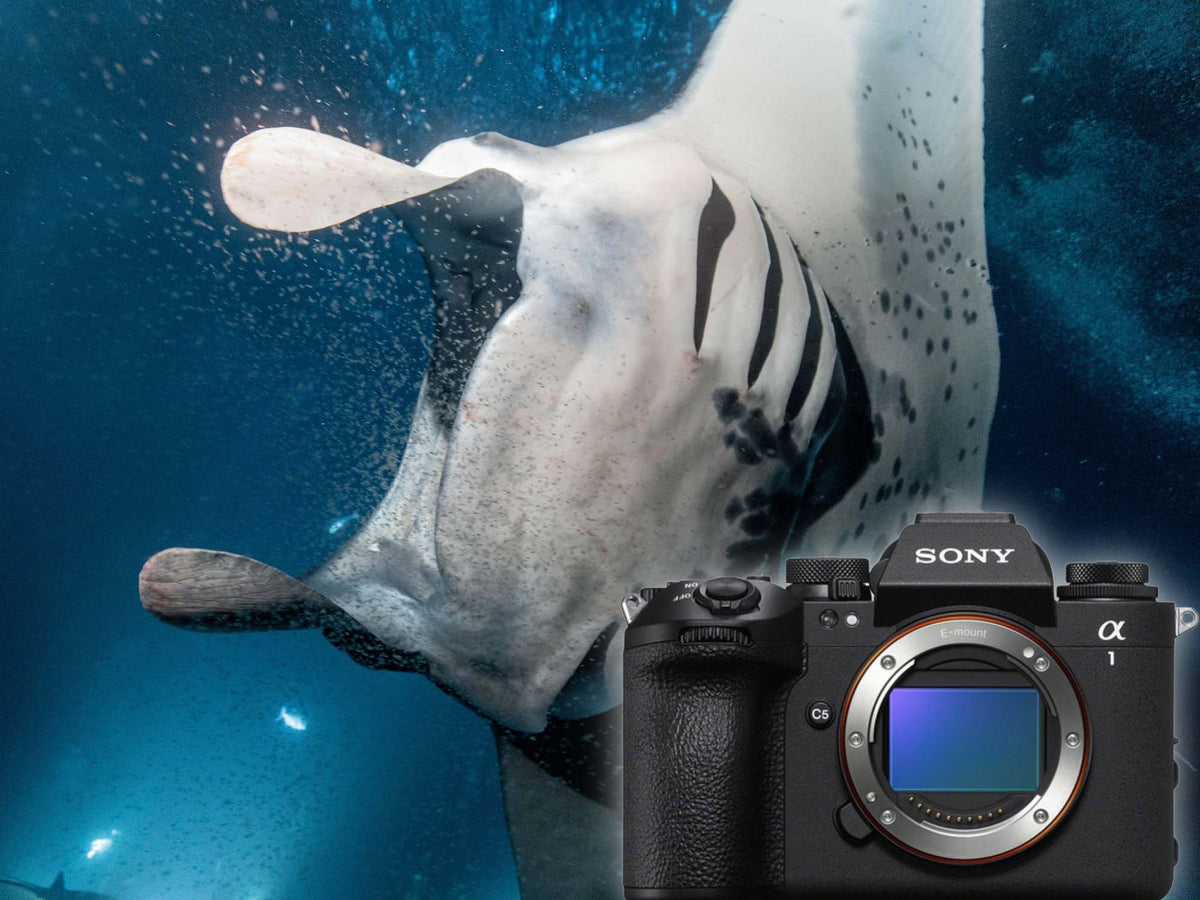
The details preserved in this image not only show a crisp manta ray at night, but also the plankton it was feeding on! Sony FE 16-35mm PZ Lens at 16mm • 1/160 • f/4 • ISO 3200 © Jeff Milisen
Forbidden Island: A Photographer's Dream
The Main Hawaiian Islands are often referred to as the “Main 8,” and most of us are familiar with Hawaii, Maui, Lanai, Molokai, Oahu, and Kauai. If you are counting along, you’ll notice that two islands are missing. KahoʻOlawe was used for extensive bombing practice and is covered in unexploded ordnance. Ni'ihau is known as “The Forbidden Island” because it remains a critical last bastion of traditional Hawaiian culture and is only inhabited by native Hawaiians. The primary spoken language there is Olelo. Ni'ihau is also the closest main island to the esteemed Papahānaumokuākea Marine National Monument, thousands of miles of insular habitat protected for the endemic wildlife contained therein. These creatures often travel outside of the bounds of the monument and land along the shores of the nearest island: Ni'ihau. Endemic wanderers mixed near sacred land sounds like the perfect backdrop to try out the new Sony a1 II.

This is one of those images where even I have trouble figuring out where to focus my attention-are the eyes the subject? Or the teeth? I’m thankful the a1 II did the work for me here. Sony FE 90mm Macro Lens • 1/200 • f/18 • ISO 800 © Jeff Milisen
Benefits of Sony's 16-35mm Power Zoom Lens
The first dive I took the camera on was at a site known for dramatic backdrops and big creatures: Vertical Awareness. Vertical Awareness is a basalt pinnacle rising from 300 feet (91 meters). The structure is gorgeous, but the real headline here is that the site is a magnet for critically endangered Hawaiian monk seals.

Ni'ihau, and specifically Lehua rock, are famous for Hawaiian monk seals. Today, there are only around 1600 in the wild. Sony FE 16-35mm PZ Lens at 16mm • 1/200 • f/18 • ISO 800 © Jeff Milisen
I was ready with the Sony 16-35 PZ lens. Composing the image through the LCD is a new concept for a DSLR shooter such as myself, but it ensured that I could see exactly what the image would look like before clicking the shutter. One thing I really liked about this setup was that the zoom function didn’t need a zoom ring, but was instead motorized using two buttons on the back. I happily used it to zoom in on some of the rarest marine mammals in the world.
SEE MORE: POWER ZOOM Your Sony PZ Lens Underwater [VIDEO]

The a1 II handled the quintessential angle of an oceanic whitetip quite nicely. Sony FE 16-35mm PZ Lens at 16mm • 1/200s • f/18 • ISO 3200 © Jeff Milisen
Superior Autofocus and IBIS
There’s only so much real estate at the flat top of the tiny pinnacle, and we saw three resting monk seals! Being that close to endangered animals is a rare treat, but we also saw tiny Hawaiian longfin anthias (Compsanthias hawaiiensis) and Earl’s splitfin anthias (Luzonichthys earlei) and wide-angle just isn’t the right lens for these. I didn’t want to miss another opportunity in fish nerd endemic heaven, so I found a dry, quiet place in the cabin during the surface interval to throw on the 90mm macro for some portraits. The lens swap with the Drylock port system in a pinch was super easy, and the vacuum gave me extra confidence in the system.
Dive two was at a site called “Pyramid Point.” As soon as I backrolled, I was greeted at the surface by a school of Hawaiian chubs, including a striking golden chub, a color phase that is incredibly rare elsewhere in Hawaii. I spent a moment with it before descending, where I was greeted by one of Ni'ihau’s “Three Sisters,” the nickname for a trio of resident sandbar sharks that have become accustomed to divers. I usually opt for wide-angle if I expect sharks, but the 90mm was surprisingly fun.

The sandbar sharks were more fun through a 90mm lens than I expected! Some people like to underexpose the background, which helps to emphasize the subject. With sharks, especially, I prefer to balance the background exposure to see the artificial strobe light contrast with the ambient blue highlights, as it gives the skin a silky texture. Sony FE 90mm Macro Lens • 1/200 • f/18 • ISO 3200
Between the seals and the sharks, I was shocked at how fast the AI-assisted focusing mechanism found the eyes and then hung on! Tragically, unsteady hands usually keep me away from shooting video. With the 5-axis in-body stabilization, my shaky grip managed some shockingly steady shots of the sharks cruising past. I was giddy with excitement, and we hadn’t even seen the fish I was there for!

A split shot in choppy, offshore water gives me every excuse to miss the shot, but the focus drive nailed the subject and the enhanced dynamic range meant that both underwater and the blaring topside sun were beautifully exposed. Sony FE 16-35mm PZ Lens at 16mm • 1/200 • f/18 • ISO 1600 © Jeff Milisen
Morwongs: A Rare and Lucky Encounter
Our last dive was on a rocky slope at the mouth of a cave. I had some fun with the sharks and seals on the first two dives, so I really wanted to focus on my personal passion: fish. We had already seen some unusual and beautiful anthias on the first dive, but I had yet to shoot any really special bony fish. That’s where my wife, Sarah, found a treasure. We were still pretty deep at the end of the dive when I heard a familiar “tink tink.” Sarah was looking under a rock at a pair of Hawaiian morwongs (Goniistius vittatus)! These strange fish are common in the remote northwestern Hawaiian Islands, but they rarely make it this far south. These might be the only morwongs I ever see again; I was extremely lucky the fish stuck around long enough to frame 14 shots!

Hawaii is the only place in the world to see Hawaiian morwongs, and this is my first pair in main Hawaiian water. I blew through my NDL shooting these. Sony FE 90mm Macro Lens • 1/200 • f/18 • ISO 400 © Jeff Milisen
Conclusion
I’ve used many different cameras in some of the world’s most remote and challenging underwater environments, and the Sony a1 II is a technological wonder. Its technical specifications are outrageous, and when nestled in Ikelite’s housing system, it performs beautifully underwater. This camera will dazzle you. When paired with Sony’s legendary lenses and the dependability of Ikelite’s housing systems, the a1 II has a lot of potential for anyone who needs a fast underwater camera that produces incredible photos.

Once I adjusted the ambient lighting, this shot relied heavily on the Ikelite TTL to help with the balance. Sony FE 16-35mm PZ Lens at 16mm • 1/25 • f/4 • ISO 6400 © Jeff Milisen
Jeff's Gear
- Sony a1 II Camera
- Sony FE 16-35mm PZ Lens
- Sony FE 90mm Macro Lens
- 200DL Underwater Housing for Sony a1 II # 71483-DLX
Additional Viewing
Sony a1 II + DS232 Hybrid Strobes Underwater in Micronesia
Sony a1 II vs A1 // Which is Better for Underwater Photo & Videos??? [VIDEO]
Top 3 Best Lenses for Sony Full Frame Mirrorless Underwater [VIDEO]
Sony Mirrorless Lineup Explained for Underwater [VIDEO]
Sony a1 II Underwater 4K Results Diving in Raja Ampat, Indonesia [VIDEO]
 Ambassador Jeff Milisen is an internationally acclaimed underwater photographer who has specialized in blackwater photography since 2009. He is a recent addition to the Ikelite ambassador team. His upcoming book, a Field Guide to Blackwater Diving in Hawaii, will help both newbies and seasoned blackwater veterans identify the strange animals they encounter. He currently shoots with a Canon EOS 7D Mark II and dual Ikelite strobes. Read more...