





By Kaylee Greer
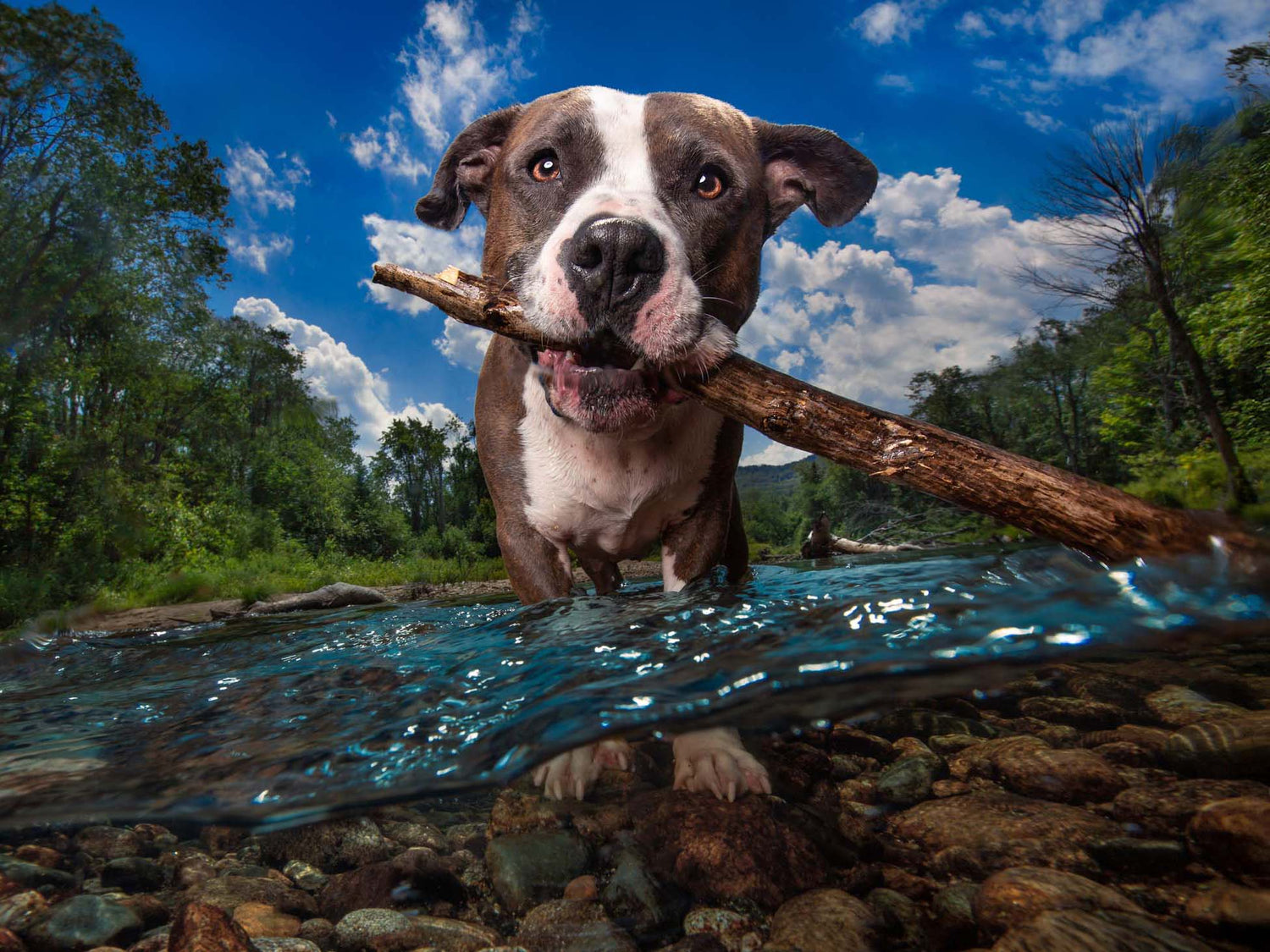
The dog explodes through the surface. Half in air. Half underwater. Suspended between two worlds. In the magic of that impossible moment, a photograph can do more than capture attention… it can change a life.

A dog perches on a submerged rock in Lake Tahoe © Kaylee Greer / The Dog Breath Foundation
Every Shelter Dog Deserves to Dream
A shelter dog sits behind the bars of its cage, often forgotten… or left behind. As the sun makes another trip across the sky and the earth spins on its axis outside of the shelter walls, they dream of the world’s wide open spaces, of fresh, swirling air, and the magic of adventure.
See, the spirit of dog was never made to be confined to a cage. No, it’s the outside air that a dog’s wild heart was made for. A rugged world where its ancestors roamed freely, across tens of thousands of miles of boreal forests, jagged mountains, wide open plains and windswept tundra. A world where dogs belong.

Posing perfectly in Banff © Kaylee Greer / The Dog Breath Foundation
And so, as they wait inside a stark, grey concrete building, staring out from behind the bars of their cages, while yet another potential family passes them by - they dream. They dream of yellow sunshine, of snouts touching water, of paw pads making contact with the fresh dirt of earth, of tails wagging through wild gusts of air. Every shelter dog deserves these dreams. And all these dreams deserve their moment to come true.
For me - these are exactly the stakes that I know balance in the ether every time I take a photo of a long-overlooked shelter dog. A dog who has been waiting months - maybe even years - for someone to finally notice him.

Wheelbur was paralyzed as a puppy after a marble table fell on his back and fractured his spine. Now, with the help of a custom wheelchair, he zooms through life on his front legs - including rolling straight into Lake Tahoe for this hero adoption photo. After waiting two years in rescue for someone to notice him, Wheelbur was adopted just one month after this image was taken and shared far and wide. © Kaylee Greer / The Dog Breath Foundation
The intense truth is that sometimes one singular eye-catching adoption photo is the only thing standing between him and his second chance. With stakes this high, I can’t afford to make choices that could result in run-of-the mill images. There’s no room for images that can have the potential to be ignored. They simply must explode off the page. Water droplets and all.

Who could resist these faces? © Kaylee Greer / The Dog Breath Foundation
The Mission of The Dog Breath Foundation
It was in the spirit of this very challenge that I created The Dog Breath Foundation - a non-profit with a mission to travel across America in search of long-term shelter dogs who desperately need their stories told. A mission to take shelter dogs out of their cages, and into the world on their ‘Greatest Adventures’. To marry the wild, untamed magic of dog with the epic, chest-thumping natural beauty of the world - to capture their true spirits in once-in-a-lifetime images that will stand to tell the magnitude of their tales. The Dog Breath Foundation was built with an unshakable belief that photography is immeasurably powerful, and within that power is the incredible potential to save a life.
The idea is this: If we can create adoption images for overlooked shelter dogs that simply cannot be ignored then photography can hold the precious power to get them seen, and ultimately to point them home.

Wheelbur splashes in Lake Tahoe © Kaylee Greer / The Dog Breath Foundation
Telling these important stories of dogs who have no voice to speak for themselves has been my life’s work. Over the course of the last 16 years, in over a dozen countries, in endless numbers of animal shelters, I found myself asking the same question over and over again: "If this photo is the singular chance for this dog to finally be seen by the world at large - then how do I shoot it with enough impact to make people care? To make them look? To make them consider this dog for a few fleeting seconds?" Because making someone stop and truly see the soul with the bright light of hope flickering inside its eyes - that is the key. That is the moment than everything can change. When someone makes space in their heart to begin to consider a dog to be worth loving. That is the beginning of a second chance.

Lake Tahoe © Kaylee Greer / The Dog Breath Foundation
How Underwater Photography Makes the Difference
With millions of photographs posted online every millisecond, what can be done to create images that stand out from the noise? How does one truly capture the spirit of canine in a way that does them justice?
It was these questions that led directly to an unexpected innovation in my dog photography. Enter: Ikelite. Suddenly, a whole new world of water, magic, refraction, and beauty was unlocked.

Behind the scenes in Banff // Kaylee shoots with a Sony a7 III inside an Ikelite 200DL Underwater Housing and a Canon 5D III inside an Ikelite 200FL Underwater Housing with Ikelite DS Strobes. © The Dog Breath Foundation
Capturing dogs in a moment that exists between two worlds - the joy of the wide open air and sky, and the mystery of the swirling blue beneath, is exactly the kind of innovation that was integral to creating scroll-stopping images that could change everything. Ultimately unleashing a power that could help empty the cages of overburdened shelter systems, and send more dogs home.

An action shot in Lake Tahoe © Kaylee Greer / The Dog Breath Foundation
Tips for Photographing Dogs Underwater
It probably goes without saying that shooting in the water with dogs is a bit of a good old-fashioned challenge. Working with dogs is completely unpredictable. Flying Paws. Soggy Snouts. Wild Splashes. Whipping Tails. Waterlogged tennis balls whizzing past your camera at 125 mph. Dodging left, right and center while the perfectly unscripted chaos unfolds before you. While dogs are one of the most fun subjects on planet earth to photograph, they certainly never made any promises that they would be still. ‘Quiet’, ‘calm’, and ‘serene’ are decidedly not adjectives I would use to describe my typical four-legged subject.

Rhett, a Coonhound mix, was found as a stray running dangerously across an active airport tarmac in northern Montana. After spending six months waiting behind the bars of his shelter cage, this adoption photo was taken at Flathead Lake near Kalispell, Montana. Two days later, Rhett was adopted. © Kaylee Greer / The Dog Breath Foundation
As the photographer, you must be nimble, quick and ready to spring at any remarkably sudden leap of joy that may organically unfold in front of your lens. Add to that the balance of managing light both above and beneath the surface, maintaining focus on a rapidly-moving subject, keeping the water line on the dome in the perfect place, and keeping your own human body above water long enough to nail the shot.
But ‘nothing worth having ever came easy’ - as they say.

Sunburst, split shot, shelter dog © Kaylee Greer / The Dog Breath Foundation
Since taking my Ikelite housing on it’s maiden voyage in 2015, I have spent countless hours refining techniques, and battling the challenges that come with working with subjects of the unpredictably wiggly, head-shaking, wave-chasing, water-spraying variety. So in that spirit, I am going to share two important tips on how to achieve epic underwater images of subjects of the canine variety:
Location is Key
I’ve traveled around the world and back again searching for bodies of water where I could make this work. Aside from a willing and water-loving dog subject, water clarity is the absolute most important element that I need to look for in order to achieve successful split images.

A dog poses in the shallows of Saco River, New Hampshire. © Kaylee Greer / The Dog Breath Foundation
The best bodies of water that I’ve found for this so far are typically glacially-fed alpine lakes. Think of places like Lake Tahoe in California, Moraine Lake in Banff, or Flathead Lake in Montana. The water needs to have an impressively low NTU (Nephelometric Turbidity Units) reading - indicating phenomenal optical clarity - for the split shot to truly work. Even lakes known for their gorgeous water, like Lake Tekapo in New Zealand, have generous amounts of ‘glacial flour’ from microscopic particles of rock ground down by surrounding glaciers. This ‘glacial flour’ or ‘rock silt’ is what can turn a body of water into that breathtaking postcard perfect turquoise color - but it simultaneously tamps down on the underwater clarity levels.
After much trial and error, I’ve discovered that certain rivers can work quite well as underwater shoot locations, especially in spots where the water is relatively shallow - say, 2 feet deep or less) and the current is moving.

Bright eyes and colorful skies in Round Valley Reservoir © Kaylee Greer / The Dog Breath Foundation
Pay Attention to the Underwater Substrate
What is on the bottom of your lake or river bed? Too much sand, silt or underwater vegetation, and your potential for an image gets blown the second your wiggly subject moves and kicks up a cloud of dirt. Which, for full disclosure, they very much will do. Continually. For the entire duration of your session.
To allow your subject to move freely and without visual consequence, you want to look for a rocky bottom to your body of water. Big, round, shiny rocks work best for keeping down the silt levels, and they photograph beautifully while adding lots of visual interest to the bottom half of your frame. Win-win!

Colorful rocks add dimension to this shot from Bob's Cove, New Zealand © Kaylee Greer / The Dog Breath Foundation
Traveling Across the World to Help Dogs Find a Home
I have packed my Ikelite tightly into a travel case and dragged it across the world, from Northern California to the South Island of New Zealand - from the sparkling glacial lakes of Montana, or the rushing crystalline waters of Banff to the cerulean blue sea of the Virgin Islands. All with one mission: To give a voice to those that have no way to speak for themselves. To rewrite the endings to their stories. And most importantly: to craft a compass that will always point them home.

Sandy noses and sunny skies in St. Croix © Kaylee Greer / The Dog Breath Foundation
Additional Viewing
How to Photograph Dogs Underwater
Tips for Shooting Split Shots with Your Underwater Housing [VIDEO]
Where Postage Stamps, Cancer Research, and the Smithsonian Museum Meet
Washed Ashore: Using Discarded Plastic to Save the Sea
The Beauty of Being Deaf: An Underwater Short Film About Disability Representation
5 Books for Underwater Photographers

Kaylee Greer is a multi-international award-winning dog photographer, bestselling author, and the star of Nat Geo WILD’s television mini-series Pupparazzi. She is one of the most sought-after ‘dogtographers’ in the world and a creative leader in her industry. Kaylee has dedicated her life to telling the stories of the dogs who have been forgotten and left behind with her non-profit The Dog Breath Foundation. Through her camera lens, her mission is to give a voice to the voiceless, and capture the endless spirit and whimsy of dog in a single photograph. Kaylee’s images grace books, magazines, products, packaging, calendar lines, greeting cards, and advertising campaigns throughout the commercial pet industry. A world-class educator, Kaylee has led sold-out workshops globally, spoken at industry-renowned national and international photography conferences, and hosted Shutterhound in Las Vegas, her own in-person, dog photography educational conference. Her signature style - explosive color, showstopping cinematic edge, and soulful expressions - has shaped the look of modern dog photography. Her unique photographic perspective is drawn directly from the inspiration she finds inside the soul of a dog. She is the bestselling author of the 5 Star Reviewed title Dogtography: A Knock Your Socks Off Guide to Capturing the Best Dog Photos on Earth, and the leader of her own online education platform for dog photographers - The Dog Breath Photo Society. Learn more...