
By Matt Jacobs
“I need to shoot some mantas, big ones, and I need to get close to them. Anywhere you can recommend?”
“Yes, get a flight here, I’ll do the rest.”
I’m speaking on the phone to Nicki Gibson, former head honcho of a dive center in South Africa, who has the knowledge and contacts to put me in front of whatever I need—be it a bull elephant in the bush or a bull shark in the blue. I don’t bother researching the location, the dive sites or the conditions and simply book my flight for a three-week stay. Such is my trust in Nicki.

If you're lucky enough to dive with these gentle giants underwater, prepare yourself to get the best shot by using this manta ray photography guide. © Matt Jacobs
Lembongan Island
Fast forward a few months and I find myself blinking in the Indonesian sun at
Bali airport, jet-lagged, confused, and exhausted 24 hours after leaving London, England. My driver greets me, laughing at the amount of sweat soaking through my inappropriately heavy European clothes. The air conditioning in his car is heavenly as he weaves through traffic against the backdrop of the slowly setting sun toward the guesthouse near the port. I’m tired as I check in but dare not sleep, lest the jet lag becomes worse. I stay up all night and find myself the next morning at the ferry terminal with a ticket booked by Nicki to Lembongan Island, a 40-minute fast boat ride across the water.

"Manta Ray Highway" © Matt Jacobs
I haven’t been to Indonesia for many years and have never dived here, only snorkelled. I’m excited. My body is screaming for sleep, but my mind is still on London time and wide awake. I check into my lodge with wonderful views across the sea and unpack. I always make sure my camera gear and housing are okay first when I unpack—anything else can be replaced. Nicki phones and says she will pick me up on her scooter for dinner. I feel a cold bead of sweat made of condensed fear run down my spine as I remember that “dinner” is Afrikaans for tequila. Lots of tequila. I’m duly picked up and engage my white-knuckle death grip, perfected on the launches in South Africa, as she takes off as if pursued by a primeval predator. I have arrived…
Lembongan Island, officially known as Nusa Lembongan, is a small tropical paradise located southeast of Bali, known for its laid-back atmosphere, pristine beaches, and crystal-clear waters. Unlike Bali’s busier tourist hubs, Lembongan offers a slower pace of life, with scenic coastal cliffs, mangrove forests, and small fishing villages adding to its charm. Diving around Lembongan is world-class, attracting divers from across the globe. The surrounding waters are part of the Coral Triangle, home to some of the richest marine biodiversity on Earth, with incredible reefs teeming with fish, manta rays, and, in the right season, the famous Mola Mola (ocean sunfish). Sites like Crystal Bay and Blue Corner are especially popular for their excellent visibility and vibrant marine life.

While the intended subjects for this trip were manta rays, there were plenty of other photogenic subjects like this sea snake. © Matt Jacobs
Crystal Bay
The first dive is a check dive with Nicki at Crystal Bay, named after the famed visibility. I’m used to the constant year-round viz of the Egyptian Red Sea, so I don’t expect too much. As I back-roll in, however, I’m shocked—it must be 50 meters (164 feet) plus here. The only viz I’ve seen like this is in Malta, where there’s no river runoff. Crystal Bay is famous for being the best place to spot the elusive and otherworldly Mola. We cruise to the corner and hang around at 30 meters (98 feet), but none are to be found today. I’m just happy to be floating in this viz, with the white sands stretching out before us.

Capture streaming light rays, like the ones in this shot, with these simple tips. © Matt Jacobs
The Ballet of the Reef
The next few dives the viz is still brilliant, and I’m greeted with reefs in incredible condition. Tiny reef fish swarm around me, turtles lazily drift by in the slow current, but it’s the sheer variety that amazes me here. Huge soft coral meadows give way to vast fields of staghorn coral, and massive coral heads thrust up from the reef, probably 6 meters (20 feet) tall. Nicki has given my guide Nyoman the brief that I’m not to be shown anything small, though the nudibranchs vie for my attention, displaying wonderful vibrancy against the dancing sun rays that skip across the reef. I ignore them and scan the blue. You can see anything here if you’re lucky—from whale sharks to schools of eagle rays, and even a great white shark, which was here a few months ago. I drift and quiver with excitement, hoping for a flash of that elusive white belly, finger on my trigger…

This image "The Ballet of the Reef", shot during this Indonesia trip, was shortlisted for the British Photography Awards. // Penida Island, Indonesia © Matt Jacobs
Manta Point
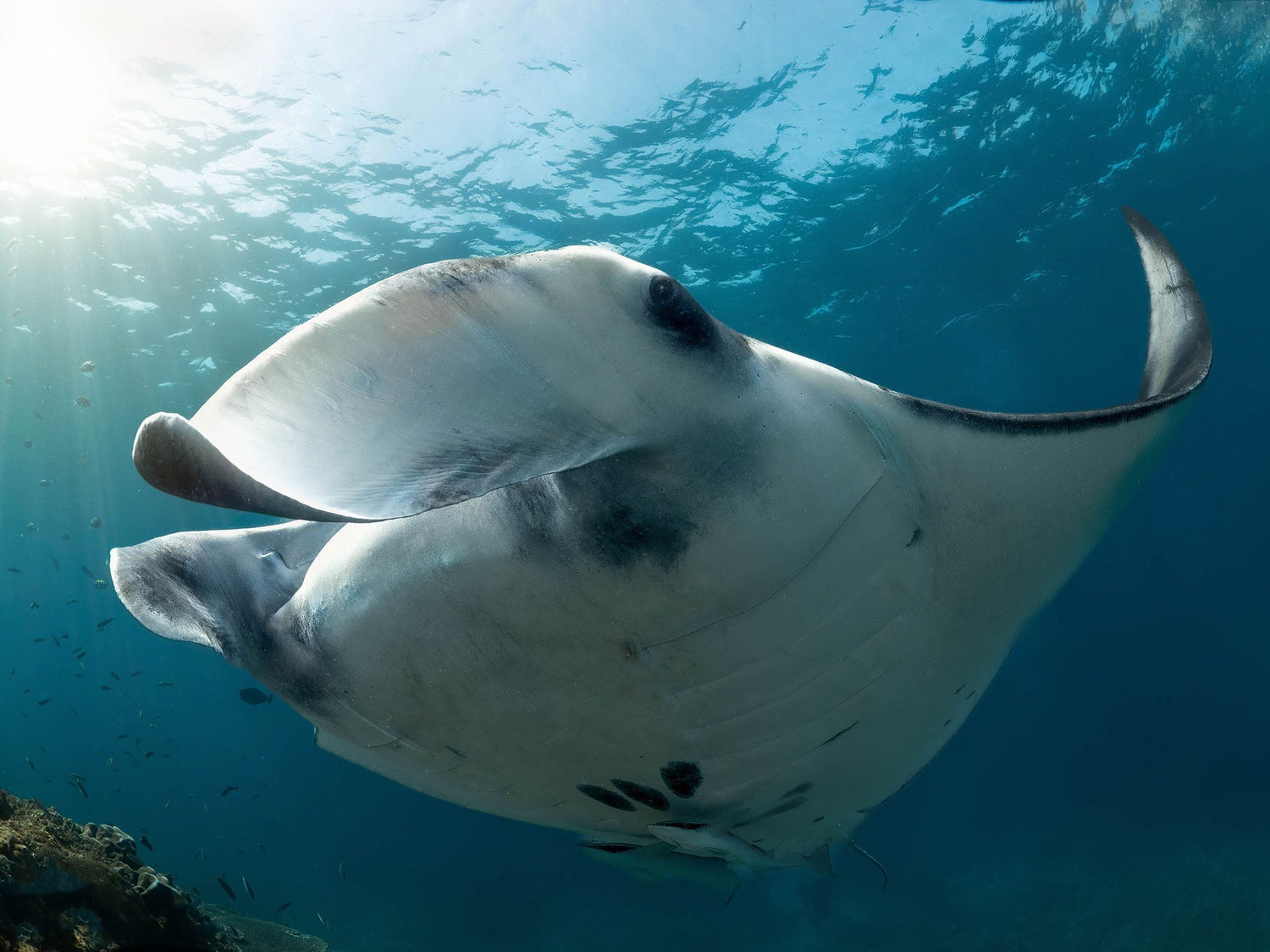
The next day is what I’m here for: manta rays. Manta Point is the best place to spot them, but it’s not always accessible due to the swells, which can make entry and exit tricky. This spot is understandably popular, and there are a huge number of boats jostling for position. I’m warned about the curse of the crowds here, and as we descend I see why—there are what seems like hundreds of them all snorkelling and trying to dive down to get that all-important selfie with a manta. Nyoman signals for me to follow him away from the crowds. After a few minutes swimming, a huge manta lazily swims toward me against the rays of the morning sun. He cruises over me and blocks out the light in a magical manta eclipse.
Becoming One With the Current
Back on the boat, I say how much better it might be if we could dive it in the afternoon—the light could be better, and the crowds fewer. The next week Manta Point is inaccessible, so I explore every reef in the area, and none of them disappoint. Dropping in one morning, I’m greeted by turtles everywhere, lazily going about their business. Never have I seen so many all in one area. Slowly, the current gently pushes us along and I gaze at the technicolor show on the reef as we drift by. The current begins to pick up now, and I get close to the reef as it increases speed—faster and faster. Nyoman makes the sign for a strong current. Yes, thank you. I can feel it. I’m in it. At that point, the current goes completely schizophrenic. I look at the fish in an attempt to work out what the current is doing—some are getting pushed down, some are going up, some simply look as confused as me. Nyoman flies past me pretending he’s on a hobby horse; I almost flood my mask laughing then he points forward, making the sign for a washing machine. It sucks me in, flips me over, and spits me back out into the incredibly strong current as I struggle to hold my camera to my chest. We look out into the blue as a group of new divers from another boat fly past us, all with a look of horror on their faces.

A manta ray glides on the sea bed during calmer currents. © Matt Jacobs
After around 20 minutes, the current slows, but my heart takes a few minutes to follow suit. Nyoman and I surface laughing, but I feel a deep respect for his knowledge of how the sea behaves around here. Back on the boat he shares some of this knowledge with me, and I’m in awe of the little tricks and tips he imparts. The dive sites are easy to learn here, but the currents can take many, many years and thousands of dives to truly understand.
We are back at Manta Point after a week, and I’ve got my afternoon dive. There are fewer boats, and as I drop in, the viz is wonderful with no crowds in sight. Krsna, my guide, demands a photo of himself under a large manta as a reward for fixing the afternoon dive. Not too much pressure then…

Krsna's photo request is granted, he is dwarfed by a large manta giving perspective on just how large these giants really are. © Matt Jacobs
Manta Ray Intelligence
The mantas assemble and swirl around me and I’m eyeball to eyeball with them as I let them approach me on their own terms—never the other way around. They seem to enjoy looking at themselves in my dome port. On this point, manta rays have demonstrated remarkable cognitive abilities that suggest a level of self-awareness uncommon in fish. Studies have shown that manta rays may pass a version of the mirror test, a classic experiment used to assess self-recognition. When exposed to mirrors, manta rays do not react aggressively as if facing another animal; instead, they perform unusual and repetitive movements, such as circling and flipping, seemingly to test and explore the reflection. This behavior suggests they may recognize the image as themselves rather than another ray. Supporting this, manta rays possess the largest brain-to-body ratio of any fish, with especially developed regions linked to higher-order processing and social interaction. Their enlarged brains and complex behaviors indicate advanced awareness, possibly placing them among the few non-mammalian, non-avian species with some degree of self-recognition.
The Gear that Gets the Job Done
I’m shooting on my LUMIX GH6 with an Olympus 8mm 1.8 fisheye using only ambient light so I need to get close. I stay at one level, manually white balance my camera, and decide I’m not going to move until my air is low, the mantas move, or the crowds descend upon us. One large manta cruises toward me and I see Krsna below me. I signal for him to get below it for a photo, he moves into position and I fire the shutter. Payment secured, I get back to shooting the squadron of mantas around me. One of them gently strokes me, as if feeling me out, as he wraps himself around me. The power in his fins is incredible—it’s the gentlest of touches yet full of brute, muscular strength.

There's a saying in underwater photography: "get close, then get closer." Thankfully the mantas in Indonesia were happy to oblige these up-close opportunities. © Matt Jacobs
After an hour and down to 50 bar, the crowd hits the water on cue and I signal I’m going up. I surface with that wonderful feeling that you only get when a huge animal chooses to hang around very close to you. We speed back to the dive center, passing beautiful cliffs shaped over millions of years by water, wind, and sunlight. Despite its popularity, it still feels unspoiled and undiscovered.
I meet Nicki for dinner, and she says she is soon off to the Cocos Islands but doesn’t have time to test her camera and Ikelite rig before she goes. She mentions she doesn’t have the awesome vacuum pump, and I suggest one will be vital for Cocos for peace of mind, so I lend her mine, as one wouldn’t arrive in time from the States to Indonesia before she leaves. I set it up to show her how to use the pump. I suggest I take her rig down on my next dive to make sure it’s all good before heading to Cocos.

What's better than one Ikelite underwater housing to shoot manta rays? Two, of course.
The next morning at Crystal Bay I find myself being handed down two Ikelite rigs and I descend. We are on the hunt for Mola again and I’m hoping we don’t encounter another crazy current, as holding two cameras could be interesting. There’s a slight current, and Nyoman tells me to wait at 30 meters (98 feet) as he drops deeper to find the mola. I hook into the reef with my reef hook as the current picks up and I put Nicki’s camera through its paces. All is good. The Mola are sadly elusive. I unhook and we move up the reef. A diver from another group swims up to me, points to his little camera, then points at mine, shrugging his shoulders and asking why I have two cameras. I think: “How would you like me to explain why I’m carrying two cameras—especially as I have both hands full?” I simply shrug my shoulders in return, leaving him none the wiser…

Clear viz, abundant life, and good company. What more could you want from a dive trip? © Matt Jacobs
Incredible Indonesia
It’s been a three-week blur of mesmerizing diving with crystal-clear viz, manta encounters, insane currents and wonderful people. The Mola were sadly not willing to show up for me, but that’s all the more excuse to come back.
A huge thanks goes to my guides Krsna and Nyoman, and to Nicki for logistics and her flawless organizing. For offers and deals diving Indonesia, contact Nicki Gibson and mention this article.
Additional Viewing
Manta Rays Underwater Camera Settings and Technique
The Atlantic Manta Ray Confirmed as a New Species: A Breakthrough in Manta Research
Close Encounters: Photographing Tiger Sharks in the Maldives
Bait Balls & Thresher Sharks: Underwater Photography in the Philippines
An Underwater Rockstar Among Royalty
What's in My Camera Case | Diving in Raja Ampat, Indonesia [VIDEO]
 Ambassador Matt Jacobs learned to dive in the Philippines while he was traveling around the world extensively as a photographer in the late 90's. It was only natural to combine his passion for photography with his love of the water. Egypt is now his spiritual home with a special fondness for the Red Sea. Matt is a Panasonic LUMIX Ambassador and his work has been published and sold as fine art internationally. Read more...
![New Underwater Docuseries on PBS Explores Rhode Island's "Wild Coast" [VIDEO]](http://www.ikelite.com/cdn/shop/articles/Ocean_State_Series_New_PBS_Logo_2_826ca3b8-3f1a-4c0e-86fb-03c44fff7bd8.jpg?v=1775156983&width=2571)