







By Douglas Klug
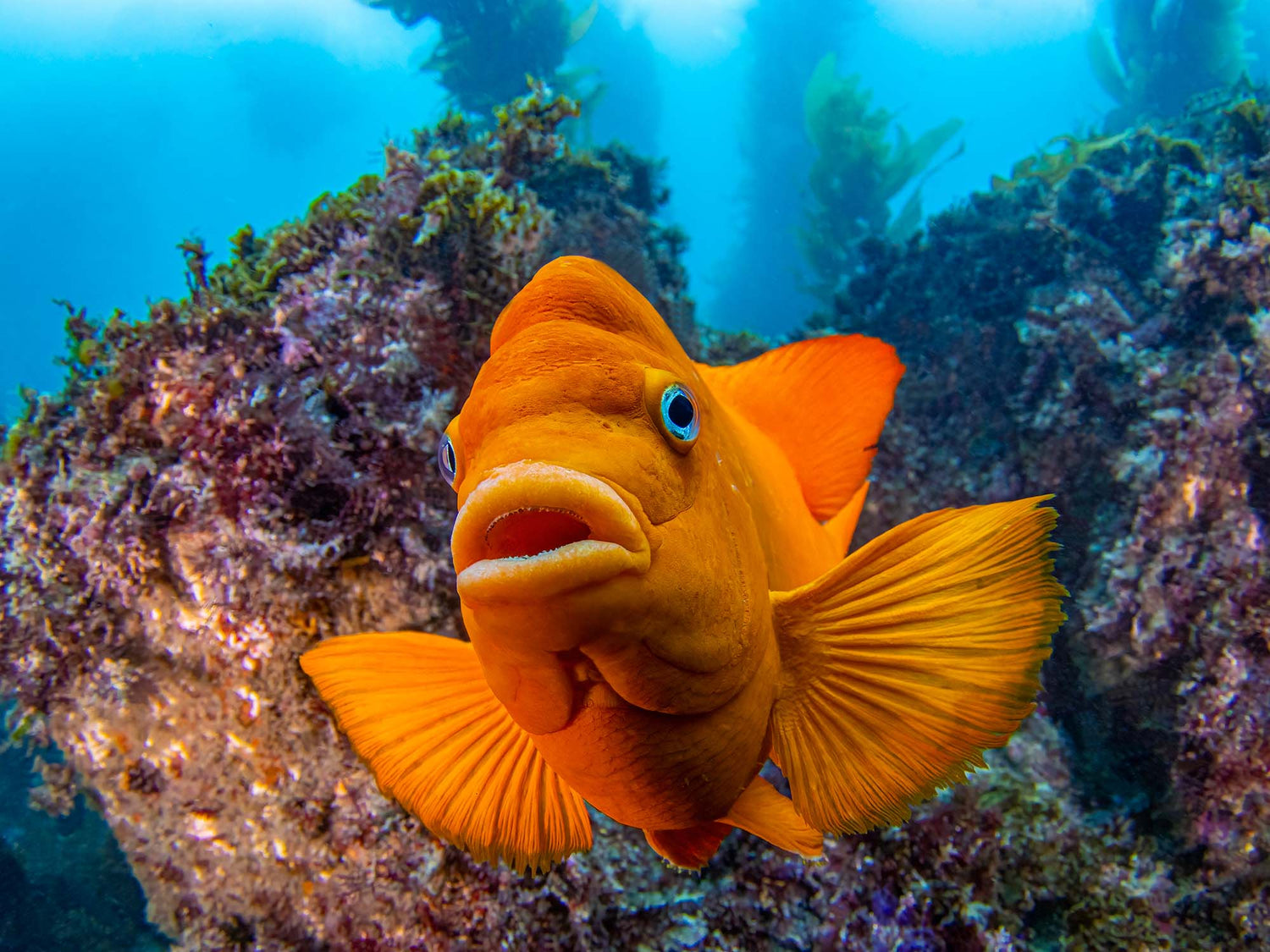
It’s the most precocious fish in Southern California’s waters. As bold as it is bright, with more than a few common names, it’s the star of the show on any kelp forest dive or snorkel. Whether it’s called the Catalina Goldfish, the Great Golden Damselfish, or the Garibaldi, its scientific name, Hyspops rubicundus, is Latin for “red fish with high cheeks” and describes it perfectly. Garibaldi are the California State Marine Fish, protected from fishing activities. Taking a Garibaldi, whether by hook and line or spear, is strictly prohibited in California Waters.

Canon R7 + Tokina 10-17mm lens at 10mm • 1/125 • f/9 • ISO 800 © Douglas Klug
Adult Garibaldi
Garibaldi are part of the damselfish family and, due to the harsh ocean conditions where they call home, they are the largest and strongest of the damselfish. They live their entire life-cycle in the kelp forest from eggs on algae, to larvae, to adults that call the rocky reefs with swaying fronds home, they’ve got no reason to leave.

Tokina 10-17mm lens at 12mm • 1/100 • f/8 • ISO 400 © Douglas Klug
How to Shoot the Scene
Schooling Garibaldi make stunning wide-angle underwater photographs due to their vibrant colors set against the natural shadows of the kelp forest. For successful images, strobes are a must and a TTL system allows for just the right amount of light on the colorful bodies. Without a TTL system, Garibaldi are notoriously easy to wash out due to their bright colors. The shots above were taken using dual DS232 strobes set to TTL and a DS Link TTL Converter. The dual strobes with TTL controlled output allowed me to shoot at slower shutter speed (1/100 – 1/125 second) and medium aperture (f/8 – f/9), keeping the natural light in the background and still freezing the action, despite the constant motion of the kelp forest.
LEARN MORE: When to Change Shutter Speed Underwater
Fertilizing Garibaldi
There’s much more to the Garibaldi story, though. These beautiful fish have a sense of purpose beyond their beauty. The males are fiercely territorial, seeking out what they perceive to be the perfect spot on the rocky reefs. They protect that section of reef against other males, taking ownership of their own little corner of the kelp forest. Any male that comes too close will be chased off in a flurry orange. While battling to hold on to their rock or section of reef, they set out to groom that area clear of everything except one species of red algae, forming single red patch on the reef.
The male garibaldi’s efforts aren’t farming for food, but to entice a female to lay eggs. The better the algae patch, the more likely he’s likely to succeed. After some courtship dancing over the algae patch while the female lays the eggs, the male then fertilizes them.

Tokina 10-17mm lens at 10mm • 1/160 • f/9 • ISO 800 © Douglas Klug
How to Shoot the Scene
Especially in California where they’ve learned that divers are not a threat, nesting and courting Garibaldi can be slowly approached by divers. These activities are best captured using close-focus wide-angle techniques and dual strobes to cast even lighting and freeze the motion of the fish. The shot above was taken with a 10mm wide-angle lens set at 1/160 second and f/9 using dual DS232 strobes for lighting. Here, the TTL exposure setting help prevent over-exposure of the fish and the reflective reef, since there were mere inches between the strobes and the fish over their nests.
LEARN MORE: The Myth of TTL Strobe Exposure Underwater

Canon R7 + Tokina 10-17mm lens at 10mm • 1/100 • f/11 • ISO 800 © Douglas Klug
Nesting Garibaldi
Fertilizing the eggs is only beginning of the male Garibaldi’s job. With eggs are in place and forming an orange mass, the male protects the eggs fiercely. Male Garibaldi will challenge marine life much larger than themselves that gets too close to the eggs. They have even been known to rush at and nip at marine mammals (including divers) that stray close to their nest. They oxygenate the eggs with their fins, flushing fresh water over the eggs while tending to the algae patch to keep things from settling on it. Garibaldi will pick up and carry away anything drifts on their nest, keeping it clear of the oceans debris.

Canon R7 + Tokina 10-17mm lens at 12mm • 1/125 • f/9 • ISO 800 © Douglas Klug
How to Shoot the Scene
The male Garibaldi is predictable when tending to its nest. Spot a nest and wait to see if the surge deposits anything there. When it inevitably does, get ready to shoot because the male will eventually notice, pick it up, and carry it away. This activity can be captured using a wide-angle lens with zoom capability, allowing the photographer to shoot from a bit farther back. Dual strobes using TTL exposure will create an even wash of light across the scene. This sequence, showing the garibaldi locating and carrying away an urchin test, was shot with a 10-17mm lens at 12mm, using a shutter speed of 1/125 and an aperture of f/9.
Embryonic Garibaldi
Garibaldi eggs grow as they develop, changing colors and clearing up so that the tiny young garibaldi eyes are eventually visible. The eggs hatch into the tiny larval fish that float around in the water column before becoming tiny transparent fry. Only a small fraction survive the onslaught of fry-eating fish in the kelp forest and develop into juvenile Garibaldi.

Canon 850D + Canon EF 100mm f/2.8 Macro lens • 1/160 • f/10 • ISO 800 © Douglas Klug
How to Shoot the Scene
Due to their small size, the eggs are best captured with a macro lens at minimum focus distance using a higher aperture and faster shutter speed. A single strobe over the top of the camera can be used, but dual strobes set on either side of the lens will generally provide better lighting coverage. The eggs above were captured using a 100mm macro lens shot at 1/160 and f/10 with dual DS232 strobes in TTL mode.
LEARN MORE: Super Macro Underwater Photography Techniques
Juvenile Garibaldi
The fry that survive eventually form into tiny versions of the adult garibaldi, with one difference. Though they’re colored with the Garibaldi’s signature orange body, the juveniles also sport a neon blue coloration. The smaller the baby, the more neon blue. The smallest are about the size of dime, and often hide near urchins, where they can duck behind the spines for safety from larger predatory fish or eels.
Experts believe that this blue coloration helps the juveniles move freely within the kelp forest by signaling to territorial adult males that they’re not mature enough to be a competitor.

Canon EF 100mm f/2.8 Macro lens • 1/200 • f/11 • ISO 400 © Douglas Klug
How to Shoot the Scene
Like their adult counterparts, the juveniles are somewhat predictable and will stay in one section of reef. If a diver finds one, they merely need to compose the background and then wait for the tiny fish to come into the frame in a good position. Due to their size and shyness, these fish are best shot with a macro lens. A single strobe over the top can be used, but the best way to avoid harsh shadows is the illuminate them with dual strobes from the sides. These juvenile garibaldi images were shot with an 18-150mm lens and a 100mm macro lens using dual DS232 strobes.

Canon R7 + Canon RF-S 18-150mm lens at 122mm • 1/160 • f/14 • ISO 1600 © Douglas Klug
Sub-Adult Garibaldi
Finally, as Garibaldi grow into sub-adults, the neon-blue coloration fades onto the just the fins, then eventually goes away altogether. At this stage, garibaldi will often school together. This brings us back to where we began our discussion about the California’s golden Garibaldi, growing into the next generation of adults so that the cycle starts again.

Canon R7 + Canon RF-S 10-18mm lens at 10mm • 1/80 • f/14 • ISO 1600 © Douglas Klug
Additional Viewing
Garibaldi Underwater Camera Settings and Technique
Underwater Cathedrals: Shooting Magnificent Kelp Forests
Catalina Island California Underwater Photography
Reflections: Manipulation with Mirrors and Light for Behavioral Images
More Power, Smaller Package: Moving to Mirrorless with the Canon R7

Douglas Klug has been diving California’s Channel Islands for over 30 years as a SCUBA diving instructor and underwater photographer in Santa Barbara, CA. Doug specializes in underwater photography within the kelp forest environment. His photo-essays have been published in print world-wide, including articles in California Diving News, DAN Alert Diver, and Dive Training. Doug’s images have been used in many publications and by the US National Park Service, US National Marine Sanctuary, the Monterey Bay Aquarium, Google, and Microsoft. Doug even does live talks on underwater photography for dive clubs and museums in Southern California. See more...
![Wide Angle TTL Underwater with Ecko Fiber Strobes and the OM TG-7 [VIDEO]](http://www.ikelite.com/cdn/shop/articles/steve-miller-ecko-little-cayman-cover_56be5767-26d0-4418-9718-e2d17f9bef89.jpg?v=1783693028&width=2000)
![Fluorescence Photography Underwater // Everything You Need [VIDEO]](http://www.ikelite.com/cdn/shop/articles/steve-miller-fluoro-blog-cover_754069ea-d3c8-45be-9b9d-7fccb95ca4fb.jpg?v=1784902380&width=1500)
